


Home Digital Piano article
The Ultimate Guide to Roland Rp501r Digital Home Piano
Home digital pianos deliver authentic piano playing experience without expensive acoustic piano costs, making them ideal for learners, students and musicians with space constraints.

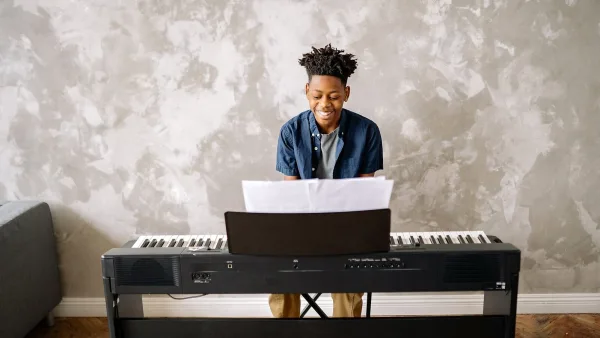
Home digital pianos have revolutionised how amateur musicians and serious learners engage with piano music, offering authentic playing experience without the expense, space requirements and maintenance demands of acoustic pianos. Modern home digital pianos combine sophisticated sound samples, weighted keys that replicate acoustic piano action and diverse musical capabilities that make them compelling options for contemporary home musicians.
What is a Home Digital Piano?
A home digital piano is an electronic keyboard instrument specifically designed to replicate the playing experience and sound of an acoustic piano. Rather than using physical strings and resonating wood, home digital pianos employ high-quality digital sound samples captured from expensive concert grand pianos, combined with weighted key mechanisms that simulate the resistance and responsiveness of acoustic piano action.
Home digital pianos typically range from compact models suitable for flats and small rooms to full-length 88-key instruments matching the dimensions of traditional acoustic pianos. This size range enables pianists to find instruments matching their available space whilst still enjoying authentic playing characteristics.
Why Home Digital Pianos Appeal to Musicians
Home digital pianos offer several compelling advantages over acoustic instruments:
- Affordability—significantly cheaper than quality acoustic pianos without sacrificing playing experience
- Space efficiency—vertical models occupy minimal floor space compared to grand pianos
- Portability—can be moved easily between rooms or locations, unlike heavy acoustic pianos
- Sound control—built-in volume control allows practice without disturbing neighbours
- Zero maintenance—no tuning required, no humidity-related damage, minimal service needs
- Diverse sounds—access to multiple piano types, electric pianos and supplementary instruments
These practical advantages have made home digital pianos particularly attractive to apartment dwellers, serious learners and musicians who travel regularly or lack space for traditional pianos.
Key Features of Quality Home Digital Pianos
When evaluating home digital pianos, several features distinguish quality instruments from budget alternatives:
- Weighted key action—mechanical systems replicating acoustic piano resistance and responsiveness
- High-quality sound samples—audio captured from expensive concert grand pianos
- Polyphony—the number of simultaneous notes the instrument can play without cutting off
- Headphone outputs—allowing silent practice without disturbing neighbours
- MIDI connectivity—enabling integration with computers for recording and composition
- Pedal inputs—supporting sustain pedals that replicate acoustic piano functionality
These features collectively determine the playing experience and musical capability a home digital piano provides, with quality varying significantly across price points.
Sound Quality and Sampling
High-quality home digital pianos employ sophisticated sampling technology to capture the complex, evolving tones of concert grand pianos. Rather than using single generic piano samples, quality instruments employ multi-sampling—recording pianos across the entire range, at various velocity levels, capturing the realistic variation in tone quality that results from playing with different force and articulation.
This technological sophistication means modern home digital pianos reproduce piano tone with remarkable authenticity. The subtle tonal shifts resulting from different playing dynamics, the natural sustain characteristics and the complex harmonics generated by acoustic pianos are all faithfully represented in quality digital instruments.
Keyboard Action and Playing Feel
The keyboard action—how the keys physically respond to your touch—fundamentally affects the playing experience. Quality home digital pianos employ weighted key mechanisms that simulate the resistance of acoustic piano keys. More sophisticated models include graded action, where keys become progressively heavier towards the lower notes, matching the physical characteristics of real pianos.
The most advanced home digital pianos incorporate escapement—a subtle mechanical effect where the hammer catches slightly during the key's travel, replicating an authentic piano feel. This attention to mechanical realism enables pianists trained on acoustic pianos to transition seamlessly to quality digital instruments.
Notable Home Digital Piano Models
Several manufacturers produce respected home digital pianos:
- Yamaha P-Series—Comprehensive range emphasising weighted action and authentic sampling
- Roland FP-Series—Professional-oriented digital pianos with sophisticated sound engines
- Casio Privia—Affordably priced compact pianos suitable for learning and casual playing
- Kawai ES-Series—Emphasising authentic feel and high-quality sound capture
Each manufacturer approaches home digital piano design from slightly different philosophical perspectives, resulting in distinct playing characteristics and feature sets.
Suitability for Learning and Practice
Home digital pianos are excellent tools for learning piano. The ability to practice silently through headphones enables learners to practise frequently without disturbing neighbours or household members. The lower cost compared to acoustic pianos removes financial barriers to beginning piano study. Built-in recording functionality allows learners to document their progress and evaluate their playing objectively.
For serious learners preparing for examinations or considering professional music study, quality home digital pianos with authentic playing feel provide adequate preparation for eventual acoustic piano work. The fundamental technique and musical concepts remain identical between instruments; the technological medium is secondary.
Integration with Music Production
Home digital pianos with MIDI connectivity enable integration into computer-based music production systems. Students can record their playing directly into digital audio workstations, accompanying themselves with backing tracks, drums and other instrumentation. This creative capability extends beyond traditional piano study into contemporary music-making and composition.
This technological integration appeals particularly to younger musicians and learners interested in music production alongside instrumental performance.
Maintenance and Longevity
Home digital pianos require minimal maintenance compared to acoustic pianos. No tuning is necessary, humidity fluctuations cause no damage, and regular playing produces no wear on strings or felt. The primary maintenance concern is occasional cleaning and ensuring good ventilation around the instrument.
Quality home digital pianos typically remain reliable for decades, holding value reasonably well in secondhand markets. The lower maintenance requirements make home digital pianos particularly practical for busy musicians with limited time for instrument care.
Conclusion
Home digital pianos represent a compelling option for anyone seeking authentic piano playing experience without the cost, space requirements and maintenance demands of acoustic instruments. Modern home digital pianos deliver sound quality and playing feel that closely approximates expensive grand pianos, enabling genuine musical learning and enjoyment. Whether you're a casual learner, serious student or musician with space constraints, quality home digital pianos offer the affordability, playability and musical capability that makes piano music accessible to contemporary home musicians.



Comments