


Arturia Minifreak article
Arturia Minifreak Explained: Features, Types and Tips
The Arturia MiniFreak combines digital sound engines with analogue filtering and a powerful modulation matrix — here is a clear explanation of how it all works.
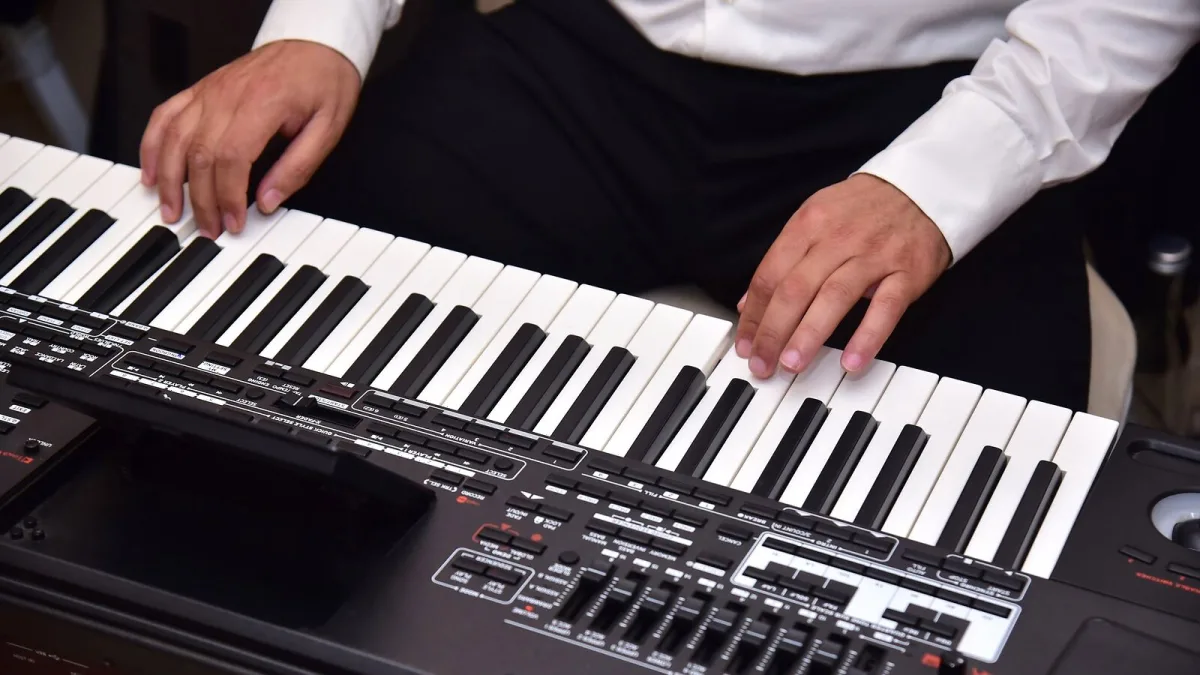
The Arturia MiniFreak is a synthesizer that takes a few minutes to understand but rewards that effort thoroughly. It sits at an interesting crossroads: digital sound engines that can produce a wide range of tones, combined with genuinely analogue filtering. If you are new to it, here is a clear explanation of what it is, what it does and why it sounds the way it does.
What Kind of Synthesizer Is It?
The MiniFreak is a six-voice polyphonic hybrid synthesizer. "Hybrid" means it combines two different technologies: digital oscillators (the sound generators) and analogue filters and amplifiers (which shape and colour that sound). The digital side is where you select the type of synthesis; the analogue side is where the tone gets warmth, movement and edge.
The keyboard is 37 Slim-key keys — compact and velocity-sensitive, with aftertouch. Aftertouch means the instrument responds to pressure applied after a key is pressed, which allows expressive control over modulation, vibrato, filter opening or other parameters in real time. It is a feature that raises the instrument above a basic controller considerably.
The Two-Engine Design
The most distinctive feature is its two independent sound engines. Each engine can be set to a different synthesis type, and the two can interact in several ways — layered on top of each other, or with Engine 2 processing the output of Engine 1 through frequency modulation, ring modulation or other relationships.
Synthesis types span a wide range, including:
- Virtual analogue: classic oscillator shapes — sawtooth, square, triangle — for familiar lead and bass tones.
- Wavetable: scanning through a library of waveform shapes to create animated, evolving digital timbres.
- Granular: added in Firmware 3.0, this breaks sounds into tiny grains to produce cloud-like textures, stretched tones and unstable, living digital sound.
- FM (frequency modulation): one oscillator modulates another's pitch at audio rate, producing metallic, bell-like and sideband-rich tones.
- Physical modelling: mathematical simulation of acoustic behaviour — plucked strings, resonant bodies, struck surfaces.
- Sample playback: substantially expanded by Firmware 5.0 (released September 2026), which adds user sample and wavetable import via the MiniFreak V software.
The number of available engine types changes with firmware. Arturia has expanded the list significantly through free updates since launch.
The Analogue Filter
Unlike a purely digital synthesizer, this hybrid instrument uses a polyphonic analogue filter — meaning each of the six voices gets its own analogue filter circuit rather than sharing a single digital filter across all voices. This produces the slight voice-to-voice variation and warmth that analogue hardware is associated with.
Filter modes include low-pass (cutting high frequencies), high-pass (cutting low frequencies) and band-pass (passing a mid-range band). In practical use, the filter is often the difference between a harsh digital sound and something with body and presence.
Modulation and Expression
The modulation system is one of the instrument's strongest qualities. Each voice has two LFOs (low-frequency oscillators — slow modulation sources) and two envelopes — one standard ADSR-style envelope and one cycling envelope that loops continuously. The modulation matrix connects sources to destinations across 13 modulation destinations.
Useful assignments include aftertouch modulating filter cutoff (pressing harder opens the filter), velocity controlling modulation depth (playing louder adds more vibrato), or a cycling envelope continuously sweeping a wavetable position for evolving texture.
Sequencer and Performance
There is also a 64-step sequencer with four automation lanes. Sequences can record notes and also automate parameter changes — filter movement, wavetable scanning, engine controls — across each step. The arpeggiator is equally capable, with rate, pattern, ratcheting and octave controls.
These are particularly useful for electronic music production, where a sequence can be a complete composition tool rather than just a note-recall device.
Firmware and MiniFreak V
One of the instrument's defining characteristics is how much it has grown through free firmware updates. Firmware 2.0 added wavetables and Super Unison. Firmware 3.0 added granular engines. Firmware 5.0 — the most significant update — introduced user sample and wavetable import. The MiniFreak you buy today is a more capable instrument than when it launched, and that trajectory is set to continue.
The MiniFreak V software is not just a preset editor. It is a plugin instrument, a sound browser and — as of Firmware 5.0 — the management environment for importing user content to hardware. Owning the hardware and not connecting it to MiniFreak V is leaving functionality unused.
The MiniFreak Vocoder Edition
A Vocoder Edition of the MiniFreak is also available, adding an integrated gooseneck microphone and dedicated vocoder functionality that uses the microphone as a modulator source. It otherwise shares the same architecture as the standard instrument.
Who Is the MiniFreak For?
This synthesizer suits electronic music producers, sound designers and keyboardists who want a genuinely flexible, creative polyphonic synthesizer rather than a simple preset player. Its six voices and full keyboard make it usable for chord work and pads; its engines and modulation make it interesting for exploration. If you are new to synthesizers or want to understand more about getting started, the beginner's guide has practical first steps, and the buyer's guide covers everything you need to consider before purchasing.
The Bottom Line
The MiniFreak is a hybrid polyphonic synthesizer with a two-engine architecture, analogue filtering, aftertouch and a modulation system that rewards exploration. Its firmware update path has made it progressively more powerful since launch, and the addition of user sample import makes it a genuinely open platform. Understanding the two-engine design and the interaction between digital synthesis and analogue filtering is the key to getting the most from it.





Comments