


Cello article
Cello Explained: Features, Types and Tips
The cello is the richest-voiced member of the violin family. This guide covers its construction, bow, strings, sizes, and the solo and orchestral repertoire that makes it one of music's most expressive instruments.
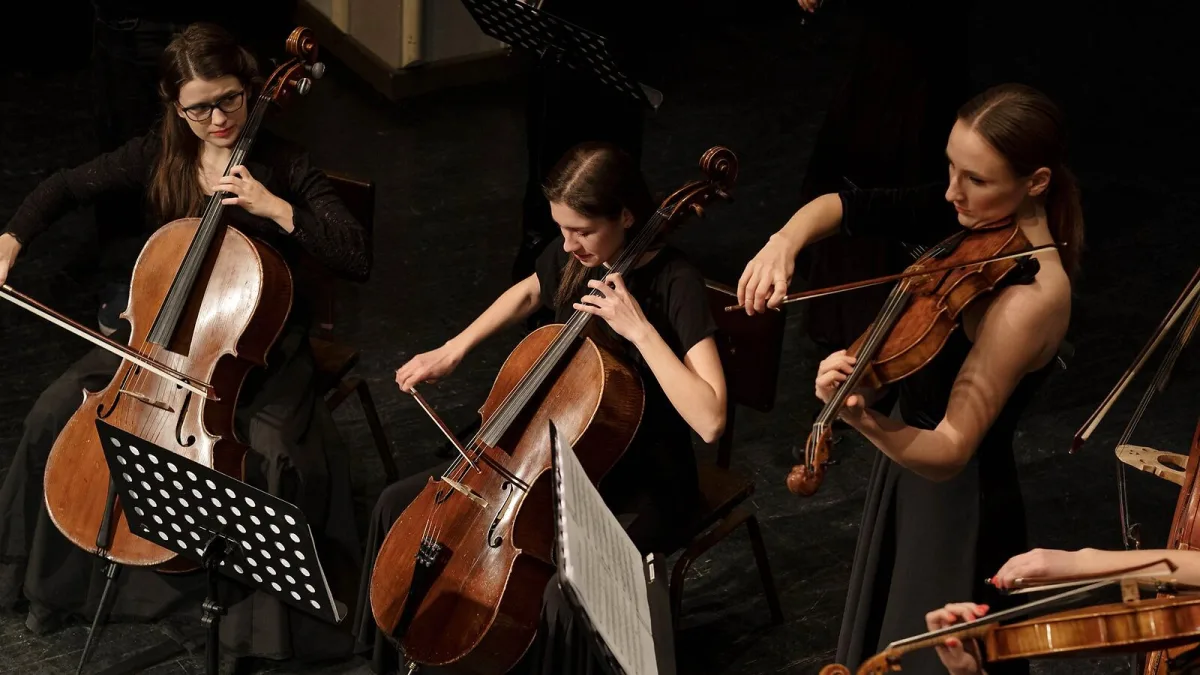
The cello occupies a singular place in the orchestral string family — deep, warm, and expressive in a way that makes it feel almost vocal. It is the instrument most often compared to the human voice, particularly in the upper register, and its range from the lowest C on a standard instrument to several octaves above makes it one of the most versatile in the concert repertoire. Here's what you need to understand about how it works and what makes it distinctive.
What the Cello Is
The cello is a bowed string instrument, the third-largest member of the violin family after the violin and viola. It is played seated, with the instrument held between the knees and supported by an adjustable metal spike (the endpin) resting on the floor. The bow is drawn across four strings tuned in perfect fifths: C2, G2, D3, A3 — an octave below the viola. The combination of size, string tension, and construction gives it its characteristic warmth and resonance.
Construction
The body is built from tonewoods chosen for their acoustic properties. The cello top (soundboard) is traditionally spruce — chosen for its stiffness-to-weight ratio and the way it amplifies vibration. The back, sides, and neck are maple, which reflects the sound back through the instrument and adds brightness. The fingerboard is ebony, chosen for its hardness and the way it ages under repeated contact with strings and fingers.
Inside the body, two critical components do much of the acoustic work: the bass bar (a thin strip of wood glued inside the top, below the bass strings) and the soundpost (a small wooden cylinder wedged between top and back). Together they distribute the vibration across the body and couple the two surfaces. The positioning of the soundpost has a significant effect on the instrument's tone — moving it even a fraction changes how the instrument sounds.
The Cello Bow
The bow is heavier and slightly shorter than a violin bow, with a broader, flatter taper. Entry-level bows use brazilwood or fibreglass. Better bows use pernambuco (a dense hardwood from Brazil), which is now rare and expensive. Carbon fibre bows have become a credible alternative at mid-range and above — they're consistent, resistant to humidity changes, and offer performance comparable to pernambuco at lower cost. The bow hair is horsehair, which grips the string when rosin is applied. Without rosin, the bow slides without producing tone.
Strings
Cello strings fall into three broad categories. Steel-core strings are bright, stable, and responsive immediately after fitting — preferred in orchestral playing. Gut-core strings (or modern gut-wound variants) are warmer and less stable in tuning, but closer to the historical sound of the instrument. Synthetic-core strings (Dominant and Larsen are the most used brands) combine warmth with better tuning stability than gut. Most modern players use synthetic strings, often combining brands for different characteristics on different strings.
Sizes
The cello comes in fractional sizes for young learners: 4/4 (full size, for players typically 11 and older), 3/4, 1/2, 1/4, and 1/8. Unlike the violin, where size recommendations are fairly standardised by age, sizing depends primarily on arm length and the player's physical build. A teacher should determine the correct size for a child. Playing on an instrument that is too large causes tension and bad technique habits that can take years to correct.
The Repertoire
The cello's solo repertoire is among the richest of any instrument. Bach's six unaccompanied suites remain the cornerstone of the instrument's literature, performed and studied by every serious player. The major concerti — Dvorák, Elgar, Schumann, Haydn — are cornerstones of the orchestral repertoire. There are major solo sonatas from Beethoven, Brahms, Debussy, and Prokofiev. In an orchestra, the section carries the bass line and inner harmonies while also stepping forward for significant melodic passages — a role that makes the instrument integral at every level of the ensemble.
Where to Go Next
For choosing your first or next cello, the complete buyer's guide covers every decision. For the best value instruments, the best cellos for the money covers the standout options at each price point. New to the instrument? The beginner's guide is the right place to start.






Comments