


Serum article
Serum Explained: Features, Types and Tips
Serum has quietly become one of the most-used sound-design tools in modern production. Here is what it actually does, in plain language.
If you have spent any time around bass-heavy electronic music, you have heard Serum even if nobody told you its name. It is the wavetable synthesizer built by Xfer Records, and it has quietly become one of the most-used sound-design tools in modern production — from squelchy dubstep growls to glassy pop leads. This guide explains what Serum actually is, how its engine works, and where it fits alongside the software synths around it.
What Is Serum?
Serum is a software synthesizer — a plugin, and a standalone instrument — developed by Xfer Records, the company founded by programmer Steve Duda. Its original claim to fame was making wavetable synthesis visible: instead of hiding the waveform behind knobs, the plugin drew it on screen and let producers watch it change in real time as they turned a dial.
That transparency is still the heart of the instrument. In March 2025, Xfer released Serum 2, a substantial update that kept the original wavetable engine intact while adding several new ways to generate sound. Existing owners received the update as a free upgrade, according to contemporary reporting from outlets including MusicTech and Attack Magazine.
How Wavetable Synthesis Actually Works
A wavetable is simply a collection of single-cycle waveforms stored in sequence. It scans through that table to generate sound, and as it moves from one waveform to the next, the harmonic content shifts. Automate that movement with an envelope or an LFO (a low-frequency oscillator that wobbles a parameter up and down) and you get a sound that evolves on its own, rather than sitting static like a simple synth waveform.
It layers extra shaping on top of that basic idea — warp modes, phase distortion and frequency modulation among them — so a single wavetable can be pulled into dozens of different textures. It is this depth, paired with instant visual feedback, that made it a favourite for producers building aggressive basses, animated leads and slowly evolving pads.
Serum 2's Five Oscillator Types
The biggest structural change in Serum 2 is that its oscillator slots are no longer locked to wavetable playback. There are now five distinct engines to choose from, and understanding what each one is for makes the instrument far less intimidating.
- Wavetable — the original engine, now with extra warp and phase-distortion options. Best for supersaws, digital basses and metallic leads.
- Multisample — loads SFZ-format sampled instruments mapped across the keyboard, useful for pianos, guitars, choirs and orchestral parts.
- Sample — plays back a single sample with looping, slicing and tempo-synced options, suited to vocal chops and one-shots.
- Granular — slices audio into tiny grains that can be stretched, reversed and repositioned, ideal for pads, drones and cinematic textures.
- Spectral — analyses a sound by its frequency content for real-time resynthesis, good for metallic or unstable timbres and transforming recorded material.
It provides three oscillator slots plus a dedicated sub-oscillator, and each slot can run any of the five engines independently — so a patch might combine a wavetable lead with a granular texture underneath, all inside one instrument.
Modulation, Filters and Effects
Its modulation system is deep even by synth standards: up to ten LFOs, four envelopes and eight macros, plus Chaos and 2D LFO generators for less predictable movement. The trick, as with any deep modulation matrix, is restraint — one source driving the main movement, a second adding subtle variation, rather than stacking several high-depth modulators onto the same knob.
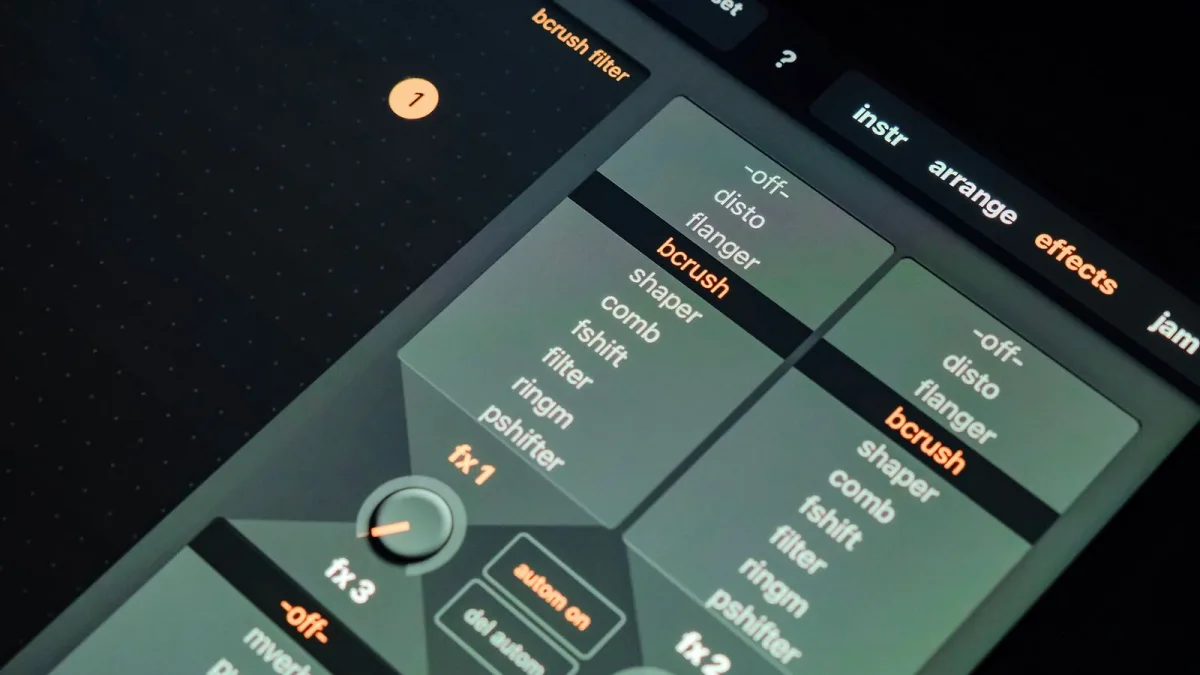
Underneath that sits a dual-filter section that can run in series or in parallel, with types including ladder-style, dirty and comb filters for everything from smooth low-pass warmth to squelchy acid tones. The effects rack, meanwhile, is arranged as two auxiliary buses plus a master chain, with room for multiple instances of a single effect — distortion, delay, convolution reverb and a frequency-shifter among the options.
The Arpeggiator and Clip Sequencer
It also added a built-in arpeggiator, which turns a held chord into a repeating rhythmic pattern, and a clip sequencer for building more structured patterns without leaving the plugin window. Both are handy for sketching ideas quickly; most producers still print the resulting MIDI into their DAW once a pattern earns its place in a track, since that makes later editing far simpler.
Why Producers Reach for Serum
Its reputation for digital, in-your-face sound design comes from how people have used it rather than any built-in limitation. It shows up constantly in dubstep, future bass, drum & bass, trap, progressive house and synthwave, but it is just as capable of gentle pads or cinematic textures — the five oscillator engines make sure of that.
If you are weighing Serum against its rivals, our round-up of the best wavetable synths for the money lines it up against Vital, Massive X and others by budget and use case.
Starting Out With Serum
New to the instrument entirely? Our beginner's guide to Serum walks through your very first patch step by step, and once you are past the basics, it is worth reading our list of common Serum mistakes to avoid before they become habits. If you have not bought it yet, our Serum buyer's guide covers what to check before you do.
The Bottom Line
Serum earned its place in modern production by making a genuinely deep synthesis engine feel approachable, and the update has widened that further without losing what made the original special. Whether you only ever touch the wavetable oscillator or end up combining all five engines in a single patch, it remains one of the clearest ways to see — and hear — exactly what a synthesizer is doing.






Comments