


Notion Notation Software article
Everything You Need to Know About Notion Notation Software
Notion sits between the major notation giants and the free tools — accessible, mobile-first and tightly integrated with Studio One. Here is what you need to know.
If you have looked at Sibelius or Finale and felt slightly overwhelmed (or slightly priced out), Notion is worth knowing about. Notion notation software from PreSonus sits in a different part of the market — accessible, affordable, tightly integrated with mobile devices, and genuinely capable for a wide range of compositional and scoring tasks. Here is everything you need to get your head around it.
What Is Notion?
Notion is a music notation application developed by Notion Music and acquired by PreSonus in 2014. It is available for Windows, Mac, iOS and Android, which makes it one of the few full-featured notation tools that runs natively on a tablet — a genuine differentiator. PreSonus is best known for Studio One, their flagship DAW, and Notion integrates tightly with it.
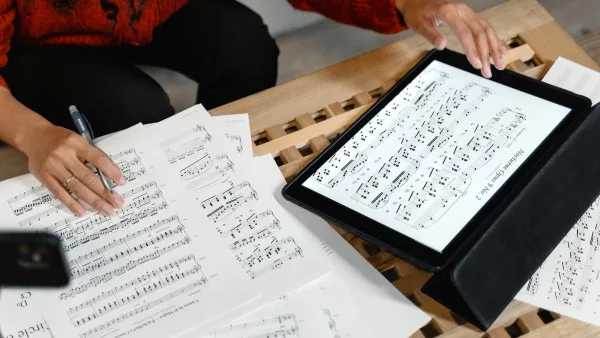
The software lets you write, edit and play back musical scores using standard notation. You enter notes via mouse, keyboard shortcuts, MIDI controller or, on tablet, directly on the touchscreen. Playback uses a built-in collection of high-quality sampled instruments, which makes the process of hearing your score back genuinely useful rather than merely functional.
Who Is It For?
Notion has a slightly different character from the two dominant notation programs. It tends to attract:
- Songwriters and composers who also produce — particularly those already in the PreSonus ecosystem via Studio One, where the two programs share sessions seamlessly.
- Film and TV composers who need to produce scores for live players and want a notation tool that is less heavy than Sibelius or Finale.
- Music educators who need notation on an iPad — Notion's mobile version is more complete than most competitors' tablet offerings.
- Orchestral writers who want expressive playback — Notion's soundset includes samples from major orchestral libraries, making the playback more musically convincing than many rival programs.
Core Features of Notion Notation Software
Notation Input
Note entry in Notion works via several methods: the mouse (click the note value and pitch), a computer keyboard (with numeric shortcuts for note lengths), an external MIDI keyboard (step-time or real-time recording), or the tablet touchscreen. The interface is clean and reasonably quick to learn, though it rewards spending time with the keyboard shortcuts.
Playback and Sounds
Notion ships with a built-in soundset that is genuinely impressive for a notation program — it draws on samples from London Symphony Orchestra sessions and other professional libraries. Playback interprets dynamics, articulations and tempo markings automatically, and there is a performance rules engine that handles idiomatic playing (such as string vibrato or brass fall-off) without manual programming.
You can also use VST plugins for playback, which opens the door to using your own sound libraries — a significant advantage for those who already own orchestral or virtual instrument collections.
Studio One Integration
One of Notion's strongest selling points is its tight integration with PreSonus Studio One. You can send a score directly to Studio One, where each instrument appears as a separate track ready for production. This workflow suits composers who want to write orchestrally and then produce the result in a DAW — a common approach in contemporary film and media scoring.
Mobile (iOS and Android)
The tablet version of Notion is unusually complete. Notation software on mobile is typically stripped-back; Notion on iPad functions closely to the desktop version, with touchscreen note entry, full playback and cloud sync. For musicians who want to compose away from a desk, this is a significant practical advantage.
How Notion Compares
| Feature | Notion | Sibelius | MuseScore (free) |
|---|---|---|---|
| Price | One-time purchase / subscription | Subscription | Free |
| Mobile support | Full iOS and Android | Limited | Basic |
| Built-in sounds quality | High | High | Standard |
| DAW integration | Studio One (native) | Limited | None |
| VST support | Yes | Yes | No |
For a closer look at how to choose between options, including pricing and what different types of users get from Notion, see the buyer's guide. If you are completely new to notation software, the beginner's guide takes you through the first steps.
The Bottom Line
Notion notation software fills a genuinely useful gap in the market: a serious notation tool that is comfortable on a tablet, integrates well with a major DAW, and ships with playback quality that most composers will find musically satisfying out of the box. It is not the most feature-rich program on the market, but for many workflows it is the most practical. If you are in the PreSonus ecosystem or need solid notation on an iPad, Notion belongs on your shortlist.




Comments