


Ambient Drone article
The History of Ambient Drone
Ambient drone draws on minimalism, electronic music, noise and post-rock — here is how it developed into a distinct and lasting form.
The history of ambient drone is not a single tidy lineage but a convergence of several independent traditions: 20th-century minimalist composition, electronic music, psychedelic rock, industrial noise, post-rock and the broader culture of experimental sound. What emerged from this convergence is a distinct musical identity that has become more, not less, relevant as digital production and streaming have made slow, immersive music more widely available.
The Minimalist Foundations
La Monte Young is the figure most often cited as the foundational voice in modern drone composition. Working in New York from the late 1950s onward, he developed sustained-tone performance and composition practices that foregrounded duration, tuning and overtone interaction above melody or conventional rhythm. His interest in just intonation — tuning based on pure mathematical frequency ratios rather than the equal temperament of the piano — drew attention to the beating and harmonic interference that occurs between sustained tones. This approach would influence virtually every later development in ambient drone.
Éliane Radigue was developing independently in Paris and New York during the same period, working with Buchla and ARP synthesizers to create long-form electronic works of extraordinary patience and detail. Her pieces could extend for an hour or more, built from slowly modulated analog synthesis with an almost meditative sense of development. She remains one of the central figures in the ambient drone tradition, and her works have been performed and recorded by contemporary ensembles worldwide.
Electronic Music and the Studio
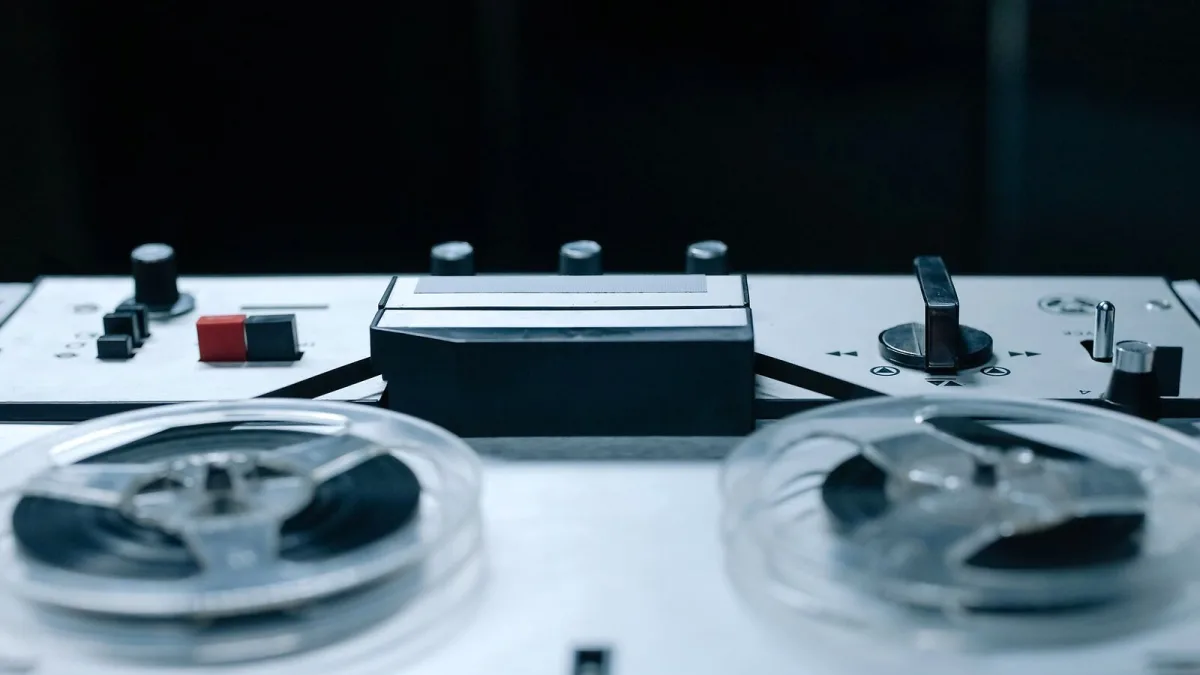
The availability of tape recording from the 1950s onward opened new possibilities for drone composition. Tape could hold and loop sound indefinitely, allowing sustained textures that were impossible to maintain by a live performer. Pierre Schaeffer’s musique concrète work established the idea of recorded environmental sound as a compositional material. Terry Riley’s tape-loop experiments in the 1960s moved drone and repetition into a more pop-accessible context.
Synthesizers made it still easier to generate and sustain tones of arbitrary length, precise tuning and gradually changing character. The ARP, Buchla, Minimoog and later Roland and Moog instruments gave composers continuous control over sound that no acoustic instrument could offer. Ambient drone as a studio practice — the kind of work that would come to define the genre for listeners on record rather than in concert — depended on these tools.
Brian Eno and the Ambient Framework
Brian Eno did not invent ambient drone, but he gave the broader ambient category its most important cultural framing. His 1978 album Ambient 1: Music for Airports, developed from tape loops of piano and voice, proposed music that could function both as focused listening and as an environmental background. The word “ambient” entered common use to describe music of this kind.
Eno’s subsequent Ambient series continued and deepened this approach, and his production work with artists including Harold Budd helped define what a quieter, more atmospheric form of this aesthetic could sound like on record. His influence on later practitioners is so pervasive as to be almost invisible.
Guitar Feedback and Noise
A separate thread of the ambient drone tradition runs through amplified guitar. Neil Young’s sustained feedback passages and the textural approach of late-1960s psychedelia established guitar noise as a legitimate compositional material. My Bloody Valentine, Sonic Youth and later artists developed this into something more structural: extended pieces built around feedback, alternate tunings and physical manipulation of the guitar. Earth’s early work in the 1990s is central to the genre’s heavy, slow guitar branch, which influenced what became known as drone metal.
Coil worked from an industrial and experimental electronics angle, incorporating drones and atmospheric long forms within more explicitly conceptual and challenging frameworks. Merzbow demonstrated the most abrasive possible approach: dense noise as a form of drone, sustained by physical force rather than melodic or tonal quality.
Post-Rock, Dark Ambient and the Internet Era
From the late 1990s onward, ambient drone fragmented into a number of recognisable subgenres. Dark ambient — atmospheric, often menacing electronic drone, associated with labels like Cryo Chamber — developed a large following in the 2000s. Post-rock acts incorporated sustained, slow-evolving passages into longer structures. The internet allowed small-run releases from independent artists to reach listeners globally, lowering the barrier for new practitioners to distribute work without institutional support.
Today the genre is as active as at any point in its history, with an enormous quantity of material released annually across Bandcamp, Spotify, dedicated labels and online communities.
The Continuing Tradition
The genre remains a genuinely living form. Contemporary artists continue to develop its vocabulary across electronic, acoustic and hybrid approaches. The tools have changed, but the fundamental compositional concerns — sustained sound, slow change, duration and resonance — remain constant.
For an introduction to what ambient drone music is and how it works, see our beginner’s guide. For the artists who define the genre, our best artists guide covers who to know. Our essential albums guide covers the key records. Our subgenres guide breaks down the different directions the genre has taken. And our newcomers guide suggests specific first listening steps.



Comments