


Ambient Drone article
A Beginner's Guide to Ambient Drone
Ambient drone rewards patience and attention — here is how to approach one of music's most immersive forms for the first time.
Ambient drone is one of those musical categories that can sound impenetrable from the outside and completely absorbing from inside it. It has no conventional structure, no lyrics, no hook in the conventional sense — and yet it has a devoted listening community, a rich artistic history and a practical creative culture stretching from avant-garde composition to home studios and film soundtracks. This guide is for anyone approaching it for the first time.
What It Actually Is
Ambient drone music is built around sustained sounds — tones, textures or noise that are held or slowly evolved over time rather than arranged into melodies and chord sequences. The drone is the point, not a backdrop. What changes is the subtle movement within the sound: the way overtones shift as a bowed string changes pressure, the slow filter sweep on a synthesizer pad, the gradual swell and fade of layered reverb.
The ambient side of the name signals the influence of Brian Eno’s ambient concept — music designed for deep listening or a quieter, more atmospheric engagement. The drone side comes from a different lineage: the sustained tones of La Monte Young, the long-form electronic works of Éliane Radigue, the amplified feedback of electric guitar, the resonant fundamental of an organ or harmonium. The two impulses combine: immersive texture with a fundamentally drone-based sonic structure.
Why It Sounds the Way It Does
Several physical and musical phenomena shape the listening experience in this genre:
- Overtones: Any sustained note produces harmonics — additional frequencies above the fundamental pitch. A drone sustains long enough that these become audible and prominent. This gives the music its characteristic richness even from a single sound source.
- Beating: When two frequencies are very close but not identical, they interact to produce a pulsing effect called beating. Many ambient drone works exploit this deliberately, creating organic, breathing movement without any explicit rhythm.
- Spatial depth: Heavy reverb and delay are standard tools. The sound becomes as much about the space it implies as the sound itself. The reverb tail of a chord or tone is as important as its attack.
- Duration: Time is a material here. A ten-second sound and the same sound held for three minutes are fundamentally different experiences. The extended duration is part of the composition.
Key Artists to Know
The ambient drone tradition spans several generations. La Monte Young brought sustained-tone and just-intonation practices into 20th-century composition. Éliane Radigue developed long-form electronic works on analog synthesizers that remain central to the genre. Earth developed a slow, heavy guitar-based drone in the 1990s that influenced drone metal and experimental rock. Contemporary artists like ProtoU and Dronny Darko work in darker, more atmospheric directions on labels like Cryo Chamber, while Forest Management exemplifies a quieter, meditative ambient drone approach. Brian Eno’s early ambient works — particularly the Music for Airports record — remain an important reference, though they occupy the softer edge of the spectrum.
How to Listen
Ambient drone music rewards a specific kind of attention. It does not work well as background music for tasks that require frequent mental engagement, but it works exceptionally well for:
- Deep or meditative listening, with full attention on the sound
- Late-night, low-light or contemplative contexts
- Working tasks that benefit from a continuous sonic environment without lyrics or hooks
- Sleep and rest contexts (many of these works are used this way)
For a first listening experience, choose a piece of 20 minutes or longer. Close your eyes and pay attention to the evolving texture rather than waiting for something to happen. Notice overtones, the movement within seemingly static sounds, and how the piece creates a sense of space.
How to Start Making It
Ambient drone production does not require expensive or complex equipment. Common starting points include:
- A synthesizer (hardware or software) with a sustained pad sound and slow filter movement
- An electric guitar with an e-bow or slide, run through reverb and delay
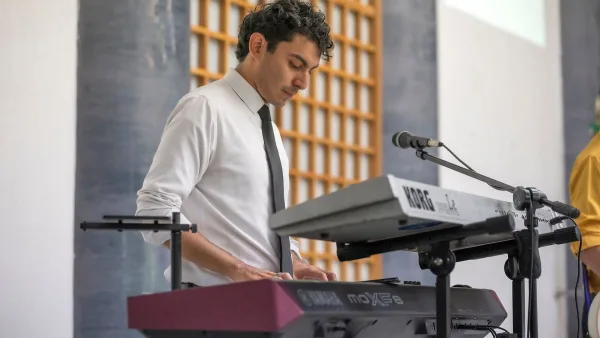
- A harmonium, organ or keyboard with long reverb
- A field recording stretched and processed with a tool like PaulStretch
- Any DAW with automation for slow filter and volume changes
The key constraint is patience. The genre requires letting sounds develop slowly and listening to what they actually do rather than immediately adding the next element. This is as much a compositional discipline as a technical one.
Where to Go from Here
For the context behind the genre, our ambient drone history covers the key movements and figures. Our best artists guide identifies who to listen to. Our essential albums page covers the key records. Our subgenres guide breaks down the different directions the music takes. Our newcomers guide suggests specific starting points. And our current tracks page keeps the listening current.


Comments