


Line Array article
The Ultimate Guide to Line Arrays
A line array is the default choice for live sound at scale. This guide explains the physics, the history, and the practical decisions around choosing and using one.
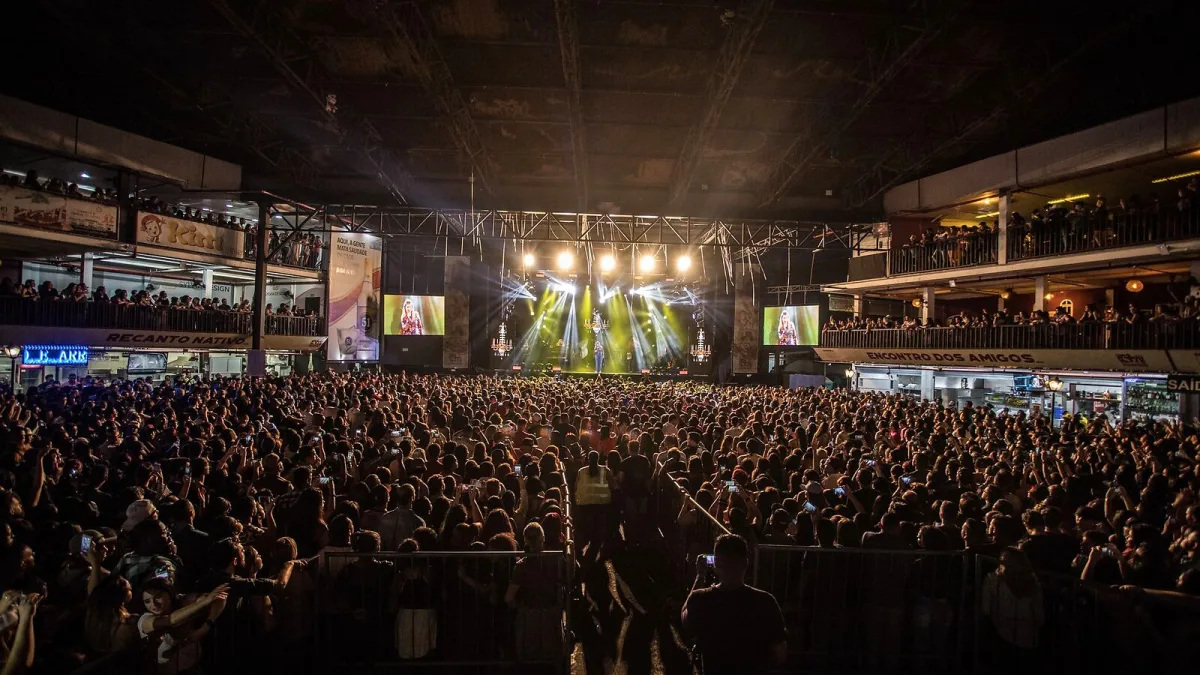
A line array is a speaker system built from multiple identical loudspeaker elements arranged in a vertical column and driven together. That basic description doesn't capture what makes them genuinely different from a conventional point-source cabinet, or why they have become the default choice for live sound at any significant scale. This guide covers all of it — how they work, where they came from, when to use one, and what the specs actually mean.
How a Line Array Works
A standard speaker behaves as a point source: it radiates sound in all directions, and level drops by 6 dB every time you double the distance. That's the inverse square law in action, and for most applications in small rooms it doesn't matter. Scale up to a large concert hall or an outdoor festival and it matters enormously — you either shout at the back row or deafen the front.
A line array changes this by coupling multiple speaker elements so they behave as a coherent source along their vertical axis. The result is cylindrical rather than spherical wave propagation — in theory, only 3 dB of level loss per doubling of distance. In practice you don't get the full benefit at long range, but the improvement over a point source is substantial and audible. High frequencies stay tighter and travel further. The vertical coverage is narrow and controlled; horizontal coverage depends on the waveguide geometry of each module, typically 70–120 degrees depending on the application.
A Brief History
The physics were understood long before the technology caught up. The breakthrough came in 1992 when Christian Heil at L-Acoustics developed V-DOSC, the first practical touring line array system. The key innovation was a waveguide that allowed the high-frequency drivers of adjacent modules to couple coherently — without that, the array's theoretical advantage breaks down above a few kilohertz. V-DOSC went commercial in 1994 and its use at major festivals, including Woodstock 1994 and Glastonbury through the mid-1990s, demonstrated what the format could do. Within a decade, every serious PA manufacturer had released an equivalent system and the conventional point-source column stack had become the exception rather than the rule at concert scale.
Types and Formats
Modern systems divide broadly by application. Touring rigs — the kind you see hung above large stages — are designed for regular rigging, high SPL, and the punishment of life in flight cases. The elements are heavy, typically 30–60 kg per module at the professional end, and require proper structural rigging from certified points. L-Acoustics K2, d&b audiotechnik J-Series, and Meyer Sound LEO sit at this level.
Mid-market touring and install systems strike a balance between performance and portability. QSC's KLA series, dB Technologies' DVA range, and RCF's HDL series all work for regional touring, houses of worship, corporate events, and fixed theatre installations where a full-scale touring rig would be impractical. These are self-powered in most cases, which simplifies deployment considerably.
Compact and portable arrays — LD Systems CURV, QSC KLA12 in modest arrays — serve small clubs, conference rooms, and event hire companies who need directional control and even coverage without the overhead of a professional system. They don't reach the SPL of touring rigs and their coupling behaviour at HF is less refined, but they offer a genuine step up from conventional cabinets in a manageable package.
Key Specifications Explained
Maximum SPL tells you how loud the system gets at one metre. This is always optimistic in the real world — you want to know the sensitivity (efficiency) and the power handling, which together determine sustainable output over a show. Frequency response tells you the system's usable range; most professional systems cover 55 Hz to 18 kHz or wider. Coverage angle matters enormously for install work: a 90-degree horizontal pattern suits a wide room; a tighter 60-degree or narrower pattern suits a long narrow space or a venue with balconies. Weight per element and the rigging capacity required determines whether a given system is viable in a particular venue.
When to Use One
The alternative to a flown system is ground-stacked point-source cabinets, a distributed speaker system, or a combination of the two. Ground stacks work for smaller rooms and outdoor stages without suitable rigging points; they lose the vertical control advantage and typically produce worse coverage uniformity over distance. Distributed systems — multiple smaller speakers positioned throughout a space — work well for speech in reverberant environments (large churches, conference centres) but can't produce the impact and coherence needed for music at volume. For most serious live music applications above club scale, a flown system is the correct answer, and below club scale, a compact self-powered array typically beats a conventional column.
For practical guidance on buying a system, the complete buyer's guide covers what to look for at each budget level. If you're new to live sound, line array for beginners covers the fundamentals without the jargon. The mistakes most commonly made when deploying these systems are detailed in common mistakes to avoid.
Worth Understanding Properly
Live sound engineers who understand how their speaker systems work make better decisions under pressure. The physics of these systems aren't complex — cylindrical wave propagation, HF coupling, vertical and horizontal coverage — but getting them wrong costs SPL, evenness, and intelligibility. Get them right and the difference from a conventional system is immediately obvious, even to a non-technical audience.





Comments