


Stereo Amplifier article
A Guide to Stereo Amplifiers
The stereo amplifier is the engine of any hi-fi system — the piece that turns a small electrical signal into something that can fill a room. Here is what you actually need to know about it.
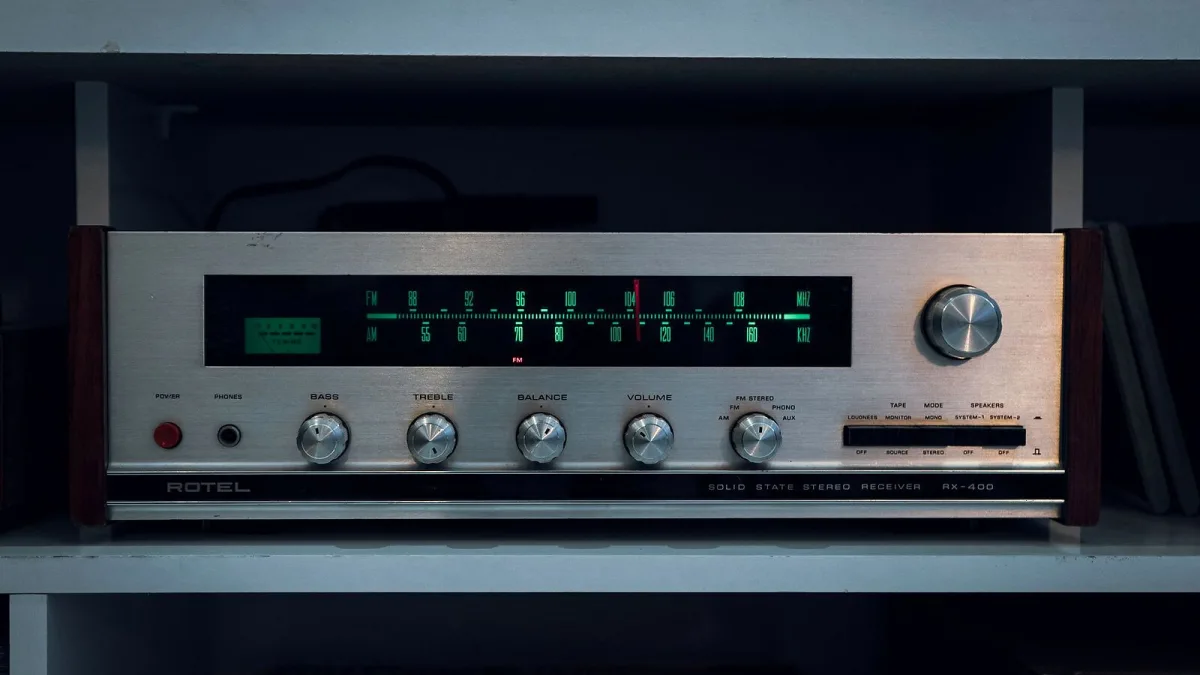
There is something satisfying about the idea of a stereo amplifier. Two channels, two speakers, a signal going in and music coming out — it is the essential piece of the hi-fi puzzle, the component that does the actual work of taking a small electrical signal and turning it into something loud enough to fill a room. This guide covers the key things worth understanding before you go near a shop or a spec sheet.
What a Stereo Amplifier Actually Does
Every audio system has a source — a turntable, a streaming box, a CD player, a phone — that produces a low-level electrical signal. That signal is too weak to drive a loudspeaker. The job of a stereo amplifier is to increase that signal to a level where it can move the speaker drivers and produce sound.
The signal path goes roughly like this: source → preamplifier → power amplifier → speakers. The preamplifier section handles input selection (which source are you listening to?), volume control and sometimes phono equalization for a turntable. The power amplifier section supplies the actual current and voltage the speakers need. In most domestic hi-fi, both stages live in one box — an integrated amplifier — which keeps the system simple and saves money compared with buying separate components.
Integrated Amplifiers Versus Separate Components
An integrated amplifier is the practical choice for most people. It does everything in one chassis, involves fewer cables and generally costs less than buying a separate preamplifier and power amplifier. The main argument for separates is flexibility — you can upgrade one component without replacing both — but unless you are building a serious system over a number of years, an integrated model is almost always the sensible starting point.
What this format is not is an AV receiver. An AV receiver is built around multichannel surround sound — it processes Dolby and DTS decoding, drives five or seven channels, and is primarily designed for home cinema. If you are building a two-channel music system, a dedicated two-channel amplifier will generally serve you better.
Amplifier Classes: What the Letters Mean
You will see references to Class A, Class A/B, Class D, and occasionally Class G. These describe how the output transistors (or valves) in the amplifier conduct during the audio cycle. Here is the practical summary:
- Class A — the output devices conduct continuously throughout the signal cycle. This produces a very linear circuit in principle, but the efficiency is low (a lot of energy becomes heat) and the amplifier runs hot. Class A designs are generally compact only at low power levels.
- Class A/B — the most common topology in traditional hi-fi. The circuit operates mostly in Class A at low levels and shifts toward a more efficient Class B behaviour at higher output. A reasonable compromise between efficiency and linearity.
- Class D — uses high-frequency switching and output filtering rather than traditional linear amplification. Can be very compact and efficient (efficiency above 80% is often cited), and runs much cooler. Modern Class D amplifiers can sound excellent — the "digital amp" nickname is somewhat misleading, as Class D is not inherently less musical than Class A/B.
- Class G — uses multiple power supply rails that switch according to signal demand, improving efficiency while retaining some characteristics of conventional linear design.
The class label is not a quality ranking. A well-designed Class D amplifier will beat a poorly designed Class A/B one in any meaningful test. What matters is the implementation, not the category.
Solid-State and Valve Amplifiers
Solid-state amplifiers use transistors. They offer low output impedance, good reliability, excellent load stability and reasonable running costs. They dominate the modern hi-fi market at every price point from entry-level to eye-wateringly expensive.
Valve amplifiers (sometimes called tube amps, particularly in American writing) use thermionic valves rather than transistors. They typically require output transformers, run hot and consume more power. Their sonic character, speaker-matching behaviour and maintenance requirements differ from solid-state designs. Some listeners strongly prefer the sound of valves on certain material; others prefer solid-state. Neither is objectively superior — the relevant questions are system matching, practicality and personal preference.
Power: How Much Do You Actually Need?
This is probably the most misunderstood number in hi-fi. Raw wattage does not translate directly into sound quality, and the relationship between watts and loudness is less dramatic than people expect. Every doubling of amplifier power produces approximately 3 dB more maximum level. Going from 50 watts to 100 watts gives you 3 dB — just about audible as a small increase in headroom, not a transformation.
What matters more than absolute wattage is matching the amplifier's output to the speakers' impedance and sensitivity. A speaker with high sensitivity (say, 92 dB/W/m) will play loudly from a modest amplifier. A speaker with low sensitivity (say, 84 dB/W/m) in a large room will need significantly more power to reach the same volume. Understand your speakers first, then choose amplifier power accordingly.
Key Brands in the Stereo Amplifier Market
The hi-fi amplifier market has a well-established roster of manufacturers, from entry-level to high-end:
- Naim, Cambridge Audio, Audiolab — British manufacturers with strong reputations for musical integrated amplifiers across a range of budgets.
- Yamaha, Denon, Marantz — Japanese manufacturers offering capable amplifiers, increasingly with network and digital functionality. Marantz's Model M1 won StereoNET's 2026 overall hi-fi product award.
- Rotel, NAD, Hegel — associated with high-current designs and practical amplification.
- Rega — produces compact, analogue-focused integrated amplifiers with built-in phono stages.
- McIntosh, Luxman, Accuphase, Mark Levinson — premium and high-end tier, for serious system builders.
Features Worth Considering
Modern integrated amplifiers often include far more than basic amplification. Depending on the model and price, you may find:
- A built-in phono stage for a turntable
- Optical and coaxial digital inputs for TVs and CD players
- USB audio for computer playback
- Bluetooth for wireless streaming
- Network streaming with Ethernet and Wi-Fi
- HDMI ARC for television integration
- A subwoofer output
- A headphone output
The presence of these features does not automatically make an amplifier sound better. For a simple vinyl and streaming system, a basic integrated with a phono stage and a line input may serve better than a feature-laden model whose multiple digital converters and streaming platforms you will never use.
Placement and Practicalities
Any amplifier — particularly a Class A or A/B design — generates heat and needs ventilation. Do not stack equipment directly on top of it, leave space above and around the chassis, and keep it away from heat-generating sources. Class D amplifiers run considerably cooler and are more tolerant of tight spaces.
The Bottom Line
A good amplifier is the engine of any hi-fi system. Understanding what class means, what power actually delivers, and how the amplifier needs to match the speakers will take you most of the way to a good decision. For buying-specific guidance, see our complete buyer's guide to stereo amplifiers, and if you're just starting out, our beginner's guide is the natural first stop. Our piece on common stereo amplifier mistakes to avoid is worth reading before spending any money.






Comments