


Fender Telecaster roundup
Fender Telecaster: A Complete Buyer's Guide
The wall of Telecasters at the shop all look similar; the differences that matter are in the neck, the pickups and the bridge. Here's what to check before you buy.
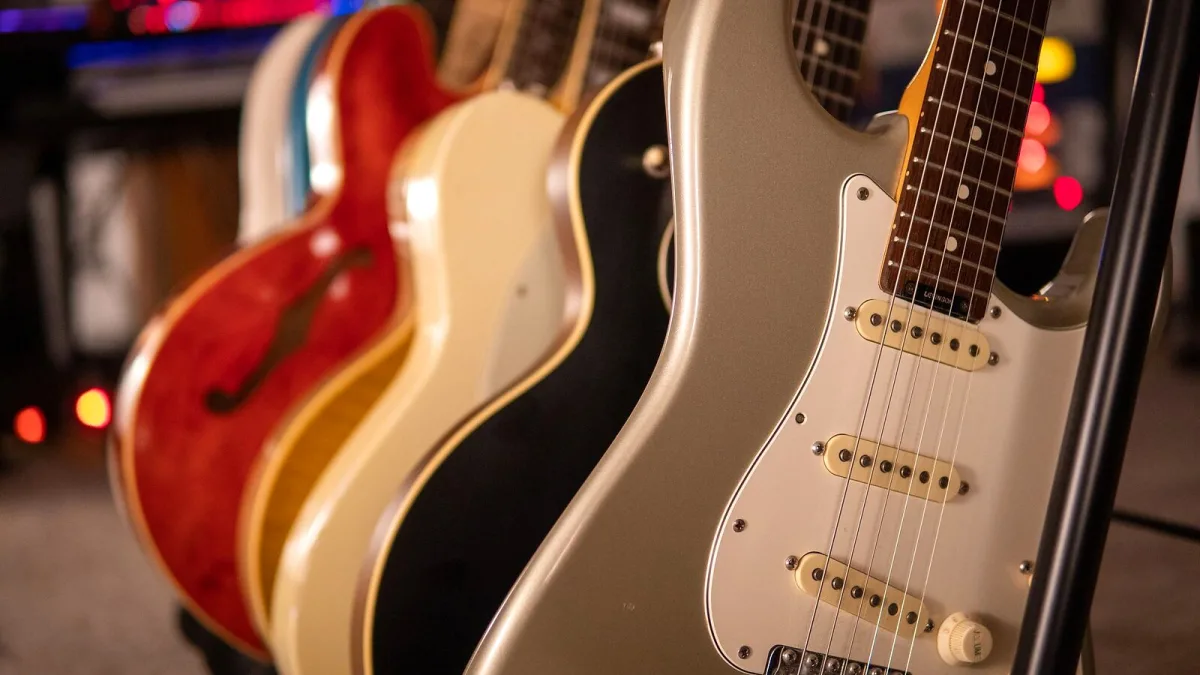
Buying a Telecaster sounds simple until you're stood in front of a wall of them, all looking roughly the same, at wildly different prices. The differences are real, though — they're just in places you can't always see from across the shop. This guide breaks the decision down into the parts that actually change how a Telecaster plays and sounds, so you can work out what you're paying for before you hand over any money.
Start With the Body Wood, Not the Finish
Most Telecasters are built from alder or ash, and the choice matters more for weight and grain than for some fixed tonal law. Ash tends to be heavier with a pronounced grain pattern, often left under a translucent finish so you can see it. Alder is lighter and more consistent, which is why it's the default on most modern production models. Be wary of any claim that one wood always sounds brighter than the other — individual pieces of timber, the finish, the electronics and the setup all interact, and a confident-sounding rule of thumb is usually an oversimplification.
Neck Profile and Fingerboard Radius
This is the part that actually decides whether a Telecaster feels right in your hands, and it's the one most beginners skip past. A few things worth checking before you buy:
- Neck profile — modern "C" shapes suit most players; slimmer or chunkier profiles are a matter of hand size and preference
- Fingerboard radius — a flatter radius (around 9.5 inches on current Player and American Professional II models) makes low action and bending easier than a vintage-style rounder board
- Fret count and size — 21 frets is traditional, 22 is now common on modern models, and taller frets generally make bending and vibrato feel smoother
- Nut width and scale length — the Telecaster's 25.5-inch scale gives noticeably firmer string tension than a shorter-scale guitar, which some players need to adjust to
Play the same riff on two different necks before deciding. Specs on paper won't tell you as much as five minutes with each Telecaster in your hands.
Pickups: What You're Actually Listening For
Every standard Telecaster carries two single-coil pickups, but output and character vary a lot between price tiers. Cheaper pickups can sound thin or harsh at the bridge; better-wound sets, like Fender's V-Mod II units on the American Professional II, tend to sound fuller without losing the twang. When you're trying a Telecaster in a shop, run through all three switch positions — bridge, middle and neck — through a clean amp setting first, so you're judging the pickups rather than the amp's own colouration.
Some modern Telecasters also add a push-push tone control that switches the middle pickup into series mode, giving a louder, thicker tone on tap. It's a genuinely useful feature if you play styles that need both a clean twang and a heavier crunch from the same Telecaster.
Bridge Types: Three-Saddle vs Six-Saddle
| Bridge type | Pros | Considerations |
|---|---|---|
| Traditional three-saddle | Classic look and feel; compensated saddles intonate well when set up properly | Two strings share each saddle, so adjustment is slightly less precise |
| Modern six-saddle | Independent intonation for every string; easier to set up accurately | Less vintage-correct appearance; some players feel it changes the attack slightly |
Neither option is objectively better — it's a genuine trade-off between vintage character and setup precision. Also worth checking: whether the strings load through the body or top-load at the bridge. String-through construction tends to feel firmer under the hand; top-loading is common on cheaper models and simplifies restringing.
Matching a Range to Your Budget
| Range | Best suited to |
|---|---|
| Squier Telecaster | First-time buyers, tight budgets, or a backup/travel guitar |
| Player / Player II | Gigging players who want reliable modern spec without premium pricing |
| American Professional II | Working musicians wanting refined pickups, playability and build quality |
| American Vintage II | Players chasing an accurate period-correct feel and tone (1951, 1963, 1972 spec) |
If it helps to see the reasoning behind specific picks at each price point, our round-up of the best Telecasters for the money goes through concrete recommendations tier by tier.
A Quick Pre-Purchase Checklist
- Check the neck relief and action — low, buzz-free action with reasonable relief suggests a well set-up instrument
- Inspect the fret ends for sharpness and the frets themselves for wear or flat spots
- Test the tuners for smooth, backlash-free turning
- Weigh the Telecaster in your hands, not just on a spec sheet — ash-bodied models in particular can vary noticeably
- Play it unplugged first; a good acoustic response through the body is usually a decent sign
If you're brand new to the instrument rather than upgrading, it's worth reading our beginner's guide to the Telecaster alongside this one, since some of the decisions here matter less on your first guitar than others.
The Bottom Line
A Telecaster's price tag mostly buys you refinement, not a different instrument. The bolt-on neck, twin single-coils and fixed bridge stay constant from a Squier to an American Vintage II; what changes is the consistency of the pickups, the accuracy of the fretwork and the quality of the setup out of the box. Decide on neck feel and bridge type first, then let your budget point you to the right range. And once you've bought one, it's worth skimming our piece on common Telecaster mistakes to avoid, since a fair few relate to decisions made at the point of purchase.





Comments