


Erhu article
Erhu Explained: Features, Types and Tips
The erhu is China's best-known bowed instrument — a two-stringed, fingerboard-free fiddle with a voice closer to singing than playing. Here's how it's built and why it sounds the way it does.
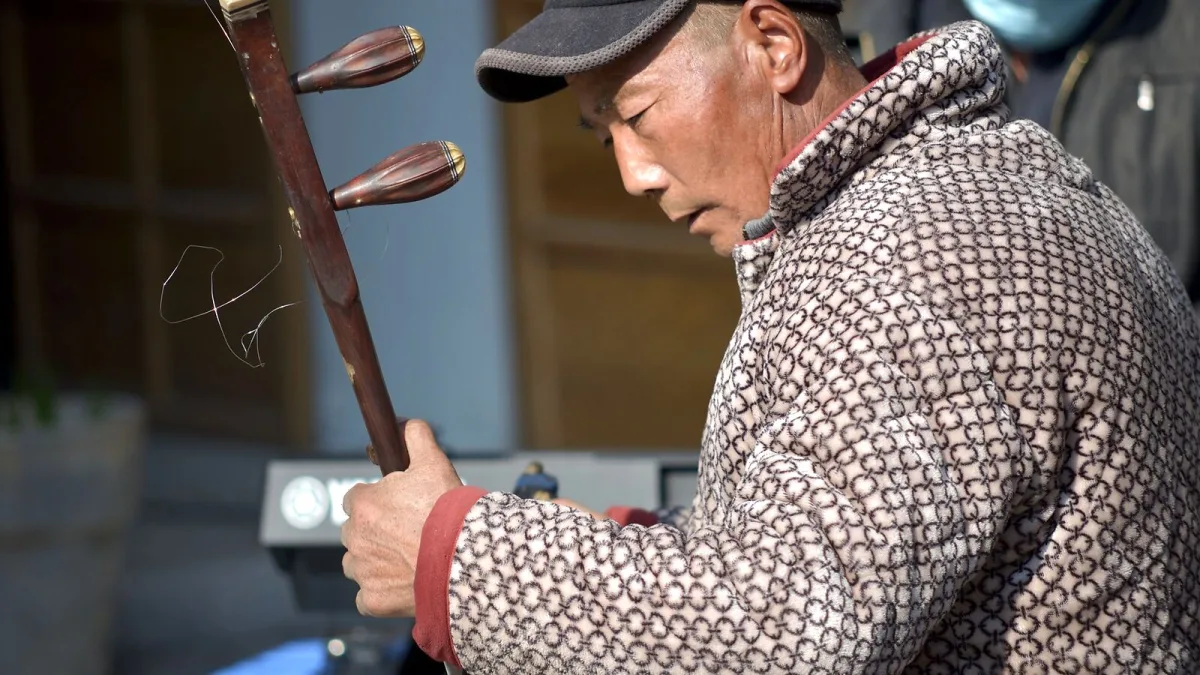
Ask most people to name a Chinese instrument and, sooner or later, they'll land on the erhu — that two-stringed fiddle with a voice so close to the human one that it can sound like someone singing rather than playing. It turns up in film scores, conservatory recitals and folk sessions alike, and yet the way it actually works surprises almost everyone who looks closely. There's no fingerboard, the bow never leaves the strings, and the whole thing balances on your thigh rather than tucking under your chin. Here's what the instrument is, how it's built, and why it sounds the way it does.
What Is the Erhu?
The erhu is a two-stringed bowed instrument from China, sometimes described in English as a Chinese two-string fiddle. It belongs to the huqin family — a broad group of Chinese bowed spike fiddles that share the same basic idea: a small resonating body, a long neck, and a bow that does the singing. Of that whole family, the erhu is by far the best known outside China, thanks to its central role in Chinese orchestras, opera ensembles and, increasingly, film and television scores.
Traditionally it was a folk and theatre instrument, carried into teahouses and street performances long before it found its way onto the concert platform. Modern conservatory training and standardised construction have since given it a more formal life alongside its older, looser folk traditions — both of which are still very much alive today.
How It's Built: Resonator, Skin and Bow
Strip an erhu down to its parts and you'll find a small hexagonal resonator (round and octagonal versions exist too), usually cut from a hardwood such as rosewood, padauk or ebony. The front face is traditionally covered with stretched python skin, which acts as the vibrating membrane and gives the instrument its distinctive, slightly nasal warmth. A long neck rises from the resonator, carrying two tuning pegs and two strings — metal on modern instruments, though silk was the historical norm.
The bow deserves a paragraph of its own, because it's the detail that catches out every newcomer. Rather than sitting outside the strings as on a violin, the horsehair is threaded permanently between them. Pulling the bow one way engages the inner string, pushing it the other way engages the outer — so changing strings is a matter of bow direction and pressure, not repositioning the bow arm.
Why There's No Fingerboard
Here's the detail that most surprises string players coming from the violin or guitar: the erhu has no fingerboard at all. The left hand stops the strings by pressing fingertips directly against them in mid-air, without ever pushing the string down onto anything solid. It's a demanding system — there's nothing to press against for reference — but it's also what gives the erhu its famously vocal quality, allowing continuous slides, subtle vibrato and the kind of pitch-bending speech-like phrasing a fretted or fingerboard instrument simply can't produce.
Tuning and the Instrument's Voice
The two strings are usually tuned a perfect fifth apart, most commonly D4 on the inner string and A4 on the outer, though exact pitching can shift slightly depending on the ensemble or repertoire. That narrow two-string range sounds limiting on paper, but skilled players shift hand position along the neck constantly, opening up a surprisingly wide register. Tone comes from the interplay of the python-skin membrane, the wood of the resonator, the small bridge that sits on the skin, and how the bow is drawn — too much pressure or too little rosin, and the sound turns harsh rather than singing.
Meet the Family: Gaohu and Zhonghu
The erhu has close relatives that share its build but sit at different pitches. The gaohu is smaller-bodied and higher-pitched, often heard leading the melodic line in Cantonese music. The zhonghu, by contrast, is larger and lower, closer to a viola's role in a Western string section. Together with the erhu, they form the backbone of the bowed strings in a modern Chinese orchestra, each covering a different part of the texture the way violins, violas and cellos do in a Western one.
Erhu or Violin? A Common Mix-Up
Because both are bowed, two-eared newcomers sometimes assume the erhu is simply "a Chinese violin", but the comparison only goes so far. The playing position is different (resting on the thigh rather than under the chin), the bow sits between the strings rather than outside them, there's no fingerboard, and the whole vocabulary of ornamentation — the slides, the vibrato, the way a note bends into the next — grows out of that fingerboard-free left hand. It's a genuinely distinct instrument with its own technique, not a regional variant of the violin.
Where Next
If the construction and history have caught your interest and you're thinking about picking one up, our complete buyer's guide walks through what to check before you spend anything, and our round-up by price tier is a useful next stop once you know roughly what you're after. Absolute beginners will get more mileage from our beginner's guide, which covers first posture, tuning and bow strokes step by step, while anyone already a few weeks in should have a read of the common mistakes players make early on before habits set in.
The erhu rewards patience more than most instruments — there's no fret to fall back on, so your ear does most of the early work. But that same demand is exactly what gives it a voice unlike anything else in a Western string section: closer, somehow, to a person telling you something than an instrument playing at you.




Comments