


Snare Drum Snares article
Snare Drum Snares Explained: Features, Types and Tips
Take the wires off a snare drum and you've got an ordinary tom. Here's what those wires actually do, and how to get them working for you.

Take the wires off the bottom of a snare drum and you're left with a perfectly ordinary tom. Put them back and you've got that crisp, dry crack that cuts through a mix without any help from an amp. This guide is a straightforward look at what snare drum snares actually are, the main types you'll come across, and how tension and construction shape the sound — the sort of background I'd want a band mate to have before they start fiddling with the strainer mid-soundcheck.
What the snares are actually doing
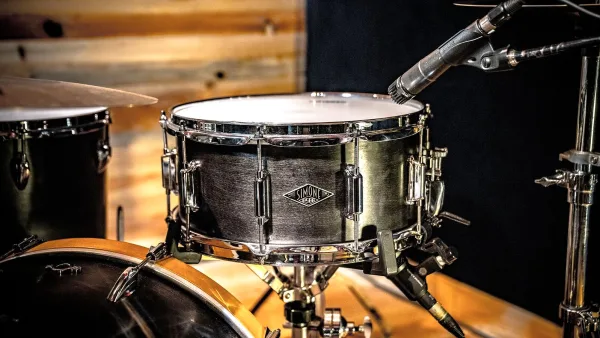
A snare drum has two heads: the batter head you strike, and the resonant head underneath, against which a set of tensioned wires sits. When you hit the batter head, the shell and the resonant head vibrate sympathetically, and that vibration sets the wires buzzing against the head. That buzz — layered on top of the drum's own tone — is what separates a snare drum from every other drum in the kit. Remove or disengage the wires and you simply get the shell's plain tone back.
The full assembly usually includes the wires themselves, end plates that gather the strands together, and a strainer mechanism that lets you engage, release and fine-tune the tension without removing anything.
The main types you'll encounter
| Type | Typical material | Common use | General character |
|---|---|---|---|
| Coiled wire | Steel or steel alloy | Standard drum kit | Bright, sensitive, lively |
| Cable | Metal cable | Orchestral, concert band | Focused, more controlled |
| Gut-style | Natural or imitation gut | Orchestral, historical setups | Warmer, less metallic |
| Synthetic gut | Nylon or similar | Marching, pipe bands | Dry, articulate |
Coiled wire — sometimes called "snappy" snares — is what most drum-kit players will ever fit, and it's the type this guide focuses on. The others exist because orchestral and marching contexts want a genuinely different kind of response, not because coiled wire is somehow inferior.
Strand count and what it actually changes
Replacement sets come with varying numbers of individual strands, typically somewhere between about a dozen and several dozen. More strands mean more contact with the resonant head, which generally gives a fuller, denser buzz. Fewer strands open the sound up and let more of the shell's natural tone through. Neither is objectively better; it's a genuine trade-off between fullness and openness, and it interacts with drum size, head choice and tuning rather than working in isolation.
Why tension makes or breaks the sound
Snare drum snares are unusually sensitive to how tightly they're set. Too loose, and they rattle unevenly and respond inconsistently at soft dynamics. Too tight, and the drum starts to sound choked and thin, losing the very sustain that gives a snare its character. The goal is a clean, controlled buzz at both quiet and loud playing — not silence, and not chaos, but something musical in between. Small, incremental adjustments at the strainer get you there far more reliably than large swings.
The strainer: your everyday control
The strainer is the lever fitted to the side of the shell that lets you engage or release the wires instantly, without touching the tension adjustment itself. Flick it off and you get a plain, open tone useful for certain rim effects or quiet passages; flick it back on and the buzz returns immediately. Most strainers also carry a separate fine-tuning knob or screw for tension, which is the control you'll actually use day to day once the wires are fitted and roughly set.
A well-adjusted strainer holds its position reliably through normal playing. If the wires disengage on their own during a heavy backbeat, or the lever feels loose and imprecise, that's usually a mechanical fault worth investigating rather than something to fight around with extra tension.
Diagnosing a few common problems
A little buzz on a resting drum nearby, or a slightly inconsistent response at very quiet volumes, is often just how the instrument behaves and not necessarily a fault. Genuine problems tend to show a clearer pattern: uneven buzz usually points to a bent strand or poor contact across the width of the head, a consistently weak or thin sound often means the wires are simply too loose, and a choked, lifeless tone points the other way, towards excessive tension.
Matching snares to the style of music
- Rock and pop: medium-to-high strand counts for a strong, cutting backbeat.
- Jazz: lower strand counts for openness and dynamic sensitivity.
- Hip-hop and R&B: controlled, well-damped wires for a short, punchy hit.
- Metal and punk: bright, cutting wires that stay articulate at volume.
If you're thinking about replacing yours, our buyer's guide to snare drum snares covers exactly what to check before you buy, and our beginner's guide is worth a read if this is your first time dealing with them directly.
The bottom line
Snare drum snares are a small, inexpensive part doing an outsized job: they're the whole reason a snare drum sounds like a snare drum rather than just another tom. Get the type roughly right for your style of playing, keep the tension balanced rather than extreme, and you'll get a genuinely musical response out of almost any decent drum.




Comments