


Crash Cymbal article
Common Crash Cymbal Mistakes to Avoid
Most crash cymbal problems — cracking, poor sound, mounting failures — come from a short list of repeatable mistakes. Here is what to watch for and how to fix it.

Mistakes That Come Up Again and Again
Most problems with crash cymbals — cracking, poor sound, mounting failures, technique issues — come from a short list of repeatable mistakes. The majority are easily fixed once you know what to look for. Here is what to watch for and how to correct each one.
Mistake 1: Playing It Too Often
The crash is an accent instrument. Its job is to mark phrase beginnings, reinforce downbeats, signal section changes and create moments of dynamic emphasis. Played continuously, it loses impact, becomes fatiguing to listen to and obscures the groove. The most common mistake beginners make — and many intermediate players retain — is treating the crash like a hi-hat alternative rather than a punctuation mark.
The fix: listen to experienced drummers in recordings and count how rarely they use the crash, relative to how frequently beginners tend to. The difference is usually striking. Use the crash cymbal with intention, not as a default.
Mistake 2: Using a Missing or Wrong Sleeve
The cymbal sleeve — the plastic or nylon tube that sits between the mounting bolt and the instrument's hole — is not optional. Without it, the metal bolt makes direct contact with the metal of the mounting hole. This cuts into the material with every strike and, over weeks or months, converts the round mounting hole into an elongated keyhole shape. A keyhomed cymbal cannot be remounted safely and typically has to be retired or repurposed for effects use.
Check every crash cymbal on every stand and replace missing sleeves immediately. Replacement sleeves cost almost nothing. Replacing a cymbal costs considerably more.
Mistake 3: Overtightening the Wingnut
The wingnut on the cymbal stand should hold the crash secure but allow it to tilt and flex freely when struck. A cymbal clamped rigidly to the stand cannot move when hit — instead, the impact stress goes directly into the metal rather than being absorbed through natural movement. This dramatically increases the risk of cracking, particularly at the edge and around the bell.
Tighten the wingnut until the cymbal cannot fall off the stand. Then check that it still moves and tilts freely. If it does not, loosen slightly. Using a felt washer both above and below the cymbal, between the metal hardware and the instrument itself, helps protect the underside of the cymbal from stand contact damage.
Mistake 4: Striking the Extreme Edge Repeatedly with Excessive Force
The edge of a crash cymbal is its most vulnerable area. Repeated hard impacts in exactly the same spot — particularly the very outermost edge — concentrate stress in a small area and accelerate cracking. This is especially common in drummers who play with a steep stick angle rather than a glancing blow.
Strike the bow rather than burying the stick into the edge. Use the shoulder of the stick rather than the tip, which distributes impact more broadly and produces a fuller accent. Varying the strike position around the circumference of the cymbal rather than hitting the same spot every time also distributes wear more evenly.
Mistake 5: Positioning the Crash Cymbal Too High or Too Far Away
A crash mounted too high requires you to raise your arm above a comfortable playing angle, which increases wrist strain and makes it harder to produce a clean, glancing accent. A crash positioned too far away forces a stretch that compromises speed and technique.
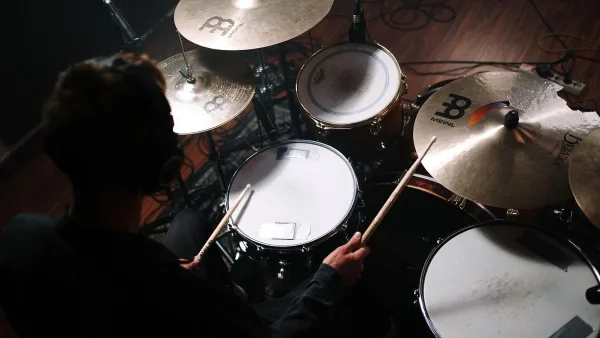
Position the cymbal within comfortable natural reach from your snare drum position, slightly above the height of the hi-hat and angled at approximately 15–30 degrees toward you. You should be able to strike it cleanly from the wrist without raising your elbow above shoulder height. If reaching the crash consistently feels awkward, move the stand rather than adapting your technique to an inconvenient position.
Mistake 6: Ignoring Cracks
A cracked crash cymbal will not heal. Small cracks spread quickly under playing conditions — often within a few sessions — and a crack that starts at the edge can propagate to the bell, at which point the cymbal may fragment during playing. Continuing to play a cracked instrument is both a sound quality issue and a safety one.
Inspect every cymbal regularly, particularly around the edge and mounting hole. If you find a crack, stop playing on that cymbal and either retire it or repurpose it as an effects instrument at lower volume. Drilling a small hole at the end of a crack can temporarily slow its propagation, but this is a stopgap, not a repair.
Mistake 7: Buying Based on Specifications Alone
Alloy designation (B8, B20), size and weight are useful shorthand but they do not determine the sound of an individual cymbal. Individual instrument variation — particularly among hand-hammered professional models — can be substantial. Two cymbals of the same model, size and weight can sound noticeably different from each other.
Always test before purchasing where possible. If buying online, use a retailer with a clear return policy. Reviews are useful for identifying which models to try, but the instrument in front of you is the one you will be playing, and your ears are the final authority on whether it is the right choice for your setup.



Comments