

Novation Circuit Tracks article
Novation Circuit Tracks Explained: Features, Types and Tips
The Novation Circuit Tracks combines two polyphonic Nova synth tracks with four drum tracks and a 32-step sequencer in a battery-powered portable groovebox.
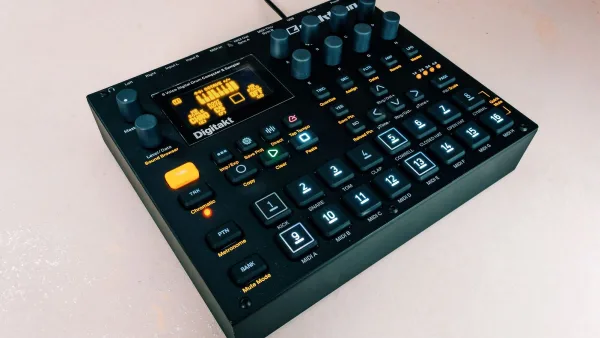
The Novation Circuit Tracks is a standalone groovebox synthesiser and sequencer designed for portable music production and live performance. Released in 2021 as an update to the original Circuit, it combines two polyphonic synthesiser tracks — each running the Nova synth engine — with four sample-based drum tracks, a 32-step sequencer, and 32 RGB velocity-sensitive pads, all in a compact battery-powered unit.
The Nova Synthesiser Engine
The two synthesiser tracks each provide 6-voice polyphony using the same Nova synthesiser architecture found in Novation's Summit and Peak hardware synthesisers. The Nova engine offers three oscillators per voice, four filter types (low-pass, high-pass, band-pass, and notch), a modulation matrix, amplitude and frequency envelopes, an LFO, and an effects section with reverb, chorus, delay, and distortion. The engine produces a wide tonal range from clean analogue-modelled tones to aggressive, modulated textures.
The Drum Tracks
Four dedicated drum tracks play sample-based percussion. Drum patches are loaded from Novation's presets or from custom samples uploaded via the Components app. Each drum track is velocity-sensitive, and drum parts can be programmed in real time by holding pads or in step mode for precise rhythmic control. The separate drum and synthesiser track architecture allows beat and melody parts to be sequenced independently with different pattern lengths for polyrhythmic arrangements.
The Sequencer
The 32-step sequencer operates in a grid of 32 pads. Patterns are recorded in real time (pressing pads while the sequencer runs) or in step mode (entering notes one step at a time). Pattern length is adjustable per track from one to thirty-two steps. A Scales mode limits pad input to notes within a selected key and scale, making it easier to play in tune in performance without music theory knowledge. Up to 32 sessions — each with eight patterns per track — can be stored on the device.
Performance and Live Use
The eight macro knobs control pre-assigned synthesiser parameters, allowing expressive real-time sound shaping without menu navigation. In Session mode, the 32 pads switch to launching patterns across all tracks simultaneously, which is the primary mode for live performance. The device's battery operation (6 AA batteries, approximately 4 hours, or USB-C bus power) makes it genuinely portable. No laptop or power socket is required for a complete performance setup.
The Components App
Deep parameter editing, patch management, firmware updates, and sample loading for drum tracks are handled through the Components web application (browser-based). On the device itself, the interface is intentionally minimal — eight macro knobs and a pad grid with no display. The design philosophy accepts limited on-device editing in exchange for immediate, hands-on playability. This trade-off suits live performance but can frustrate producers who prefer deep in-device editing.
Connectivity
USB-C provides power, MIDI, and audio (the Circuit Tracks operates as a class-compliant stereo USB audio interface). 3.5mm MIDI in and out sockets allow connection to external hardware synthesisers and modular systems. Stereo line output connects to speakers or a mixer. There is no CV connectivity, but the MIDI out enables the Circuit Tracks to sequence external hardware.
For purchasing guidance, see the Novation Circuit Tracks buyer's guide. New players can start with the beginner's overview.





Comments