

Mpc Live 3 roundup
Mpc Live 3: A Complete Buyer's Guide
The MPC Live 3 is the right tool for producers who need a complete, portable production system. Whether that's you depends on your context.

Buying an MPC Live 3 is a meaningful commitment. It is an expensive piece of hardware with a specific workflow, and it is best approached with a clear idea of what you actually need it to do. This guide covers who it is designed for, how it compares with the alternatives, and what to think about before spending the money.
Who This Is For
This device is designed for producers who want to work away from a computer without giving anything up. Battery power, built-in speakers, two preamp inputs with phantom power, a 7-inch touchscreen, 16 expressive MPCe pads and eight CV/Gate outputs — the point is that you can take this to a studio session, a rehearsal room or a performance venue and have a complete production and performance system.
If you are producing primarily in a fixed studio with a computer at the centre, the Live 3's portability premium is money you are paying for something you will rarely use. In that situation, the MPC X SE or MPC One may be a more cost-effective route to the same software and workflow in a format that makes more sense for your setup.
MPC Live 3 versus MPC Live II: Is the Upgrade Worth It?
If you already own a Live II, the upgrade is substantive. The Live 3's processor delivers around four times the performance, RAM increases from 2 to 8 GB, storage grows from 16 to 128 GB, and the MPCe pads add three-dimensional position sensing. These are not incremental changes — they materially expand what is possible in standalone mode, particularly around running complex plug-in stacks and large sample libraries without a computer. If the Live II's processing limits were frustrating you, the Live 3 resolves them.
If you are a new buyer comparing the Live 3 and a used Live II, the cost difference is significant and the answer depends on what you are planning to do with it. For simple beat-making and sampling workflows, a Live II at a lower price is still capable hardware.
Comparing Alternatives
The main comparison points are the MPC One range, the Elektron Digitakt II and Octatrack, the Native Instruments Maschine+ and an iPad-based production setup.
The MPC One offers the same software environment in a more compact, desk-oriented form without battery power or built-in speakers. It is significantly less expensive. If portability and battery operation are not priorities, it is a more focused tool.
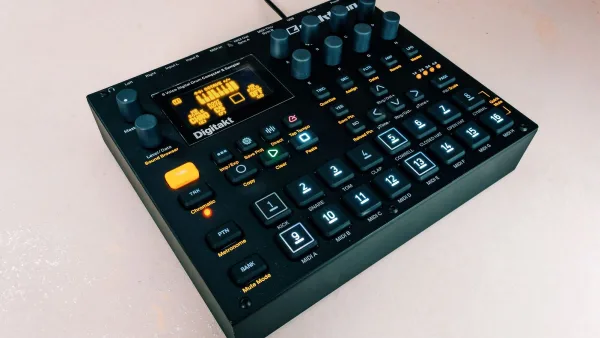
The Elektron Digitakt II and Octatrack are deeper hardware sequencers with more immediate hands-on control and a different creative logic. They do not have the plug-in depth of the MPC platform but their step-sequencer architecture is more nuanced out of the box. The choice between MPC and Elektron is one of workflow temperament as much as specification.
The Maschine+ runs the same NI software environment as the desktop Maschine, has a powerful processor and deep Komplete library integration. It is worth evaluating if your production context is heavily NI-dependent.
What to Check Before Buying
Confirm the firmware version and any known bugs affecting your intended workflow before purchasing. New hardware platforms can have software issues at launch that are resolved in subsequent updates. Check the MPC forum and user community for the current status on stability in MPC3 at the version you will be running.
Budget for the accessories you will actually need: a good carry bag or case if you intend to use it portably, additional storage (the SATA expansion slot accepts an additional SSD), and a decent quality instrument cable or balanced cable for your inputs. The built-in speakers are functional for monitoring but not reference-quality — plan accordingly if you are mixing for release.
The Right Context
It is excellent hardware for the workflow it was designed for. It is not the most hands-on step sequencer, not the cheapest route into standalone production, and not the obvious choice for a producer who wants to stay inside a computer DAW. For those who need a capable, self-contained production system they can take anywhere, it is the most fully specified device in its class. For more on how to use it from the start, the beginner's guide covers the workflow step by step. For the full feature overview, see the MPC Live 3 guide.



Comments