


Acoustic Panels article
Common Acoustic Panels Mistakes to Avoid
Setting up room treatment is easy to get subtly wrong. These are the most common mistakes people make with acoustic panels and how to avoid each one.
Setting up room treatment is easy to get mostly right and just as easy to get subtly wrong. The mistakes people make with acoustic panels tend to fall into predictable patterns — wrong material, wrong position, wrong assumptions about what treatment actually does. Here are the ones that cost the most.
Buying Foam Instead of Mineral Wool
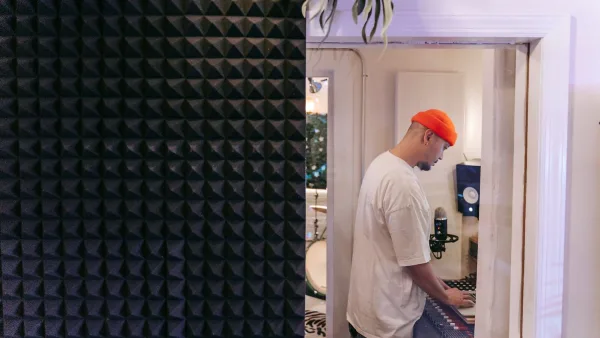
The single most common mistake is buying cheap acoustic foam tiles — the pyramid or wedge-profiled products widely sold online for home studios. They absorb at high frequencies reasonably well and do almost nothing below 500 Hz. Most of the acoustic problems in a home studio — bass build-up, room modes, poor low-mid clarity — exist below 500 Hz. A room treated with thin foam tiles sounds slightly less harsh at the top end but remains acoustically problematic where it matters most. The solution — mineral wool panels wrapped in fabric — costs the same or less and performs dramatically better. Spend the foam budget on one or two mineral wool panels and notice the difference.
Treating the Wrong Surfaces
Acoustic panels placed arbitrarily on walls make less difference than panels placed at first reflection points. The most effective positions are: both side walls at the point where the speakers' first reflections bounce toward the listening position; the ceiling above the mix position; and the back wall behind the listener. Covering random sections of wall with panels — particularly covering the back wall completely before treating the sides and ceiling — misses the positions that have the most influence on what you hear at the mix position. Identify the first reflection points before buying and placing anything.
Confusing Treatment with Soundproofing
Room treatment and soundproofing are entirely different disciplines. Acoustic treatment improves how a room sounds from the inside — it reduces reflections, flutter echo, and frequency colouration. Soundproofing prevents sound passing between rooms and is a structural challenge involving mass, decoupling, and sealed air gaps. Covering walls with panels will not prevent drums from being heard next door. This is one of the most common expectations that sets up for disappointment; addressing it early avoids the frustration of expecting something treatment panels cannot deliver.
Ignoring the Bass
Standard acoustic panels are largely ineffective at low frequencies. A room with well-treated mid and high frequencies but untreated bass modes will still produce misleading mixes — the bass will feel different at the mix position than on other systems. Corner bass traps are the correct tool for this: large-volume absorbers placed in room corners, where low-frequency energy accumulates disproportionately. Most home studio treatment setups underinvest in bass treatment and overinvest in mid-high absorption. The bass is the harder problem and the one that produces the most significant improvements when addressed.
Over-Damping the Room
Too much absorption makes a room sound dead and uncomfortable to work in — the sense of being in a completely enclosed, lifeless space. A mixing room should be controlled, not anechoic. The correct balance is treating early reflections and corner modes while preserving some natural room life. Diffusers on the back wall scatter sound rather than absorbing it, which reduces echo without making the room feel dead. Once first reflections are controlled and bass modes are reduced, adding diffusion is generally more useful than adding further acoustic panels.
Not Repositioning After Listening
Initial panel placement is a starting point, not a final answer. After treating the first reflection points, sit down and listen critically to reference material. You may find the stereo image has improved but the bass is still uneven, or that the high end has become too dry. Repositioning panels, adjusting angles, adding or removing treatment — all of this is part of the process. Room acoustics respond to changes in ways that are hard to predict from theory alone; listening and adjusting after each change is the way to dial in a room properly.
For a complete explanation of how treatment works, the overview covers the essentials. For buying guidance, the buyer's guide covers what to look for. For specific recommendations, the best panels guide has the breakdown. If you are new to treating a room, the beginner's guide covers where to start.
Treatment Is an Iterative Process
Most of these mistakes are recoverable. Foam acoustic panels can be replaced with mineral wool; positions can be changed; bass traps can be added. The key insight is that room treatment is a process rather than a one-time installation — listen, adjust, and keep going until the room sounds like a room you can make accurate decisions in.




Comments