


Groovebox article
Groovebox Explained: Features, Types and Tips
Sound generation, a sequencer and hands-on control, all in one box. Here's what a groovebox actually is and how it differs from the gear around it.
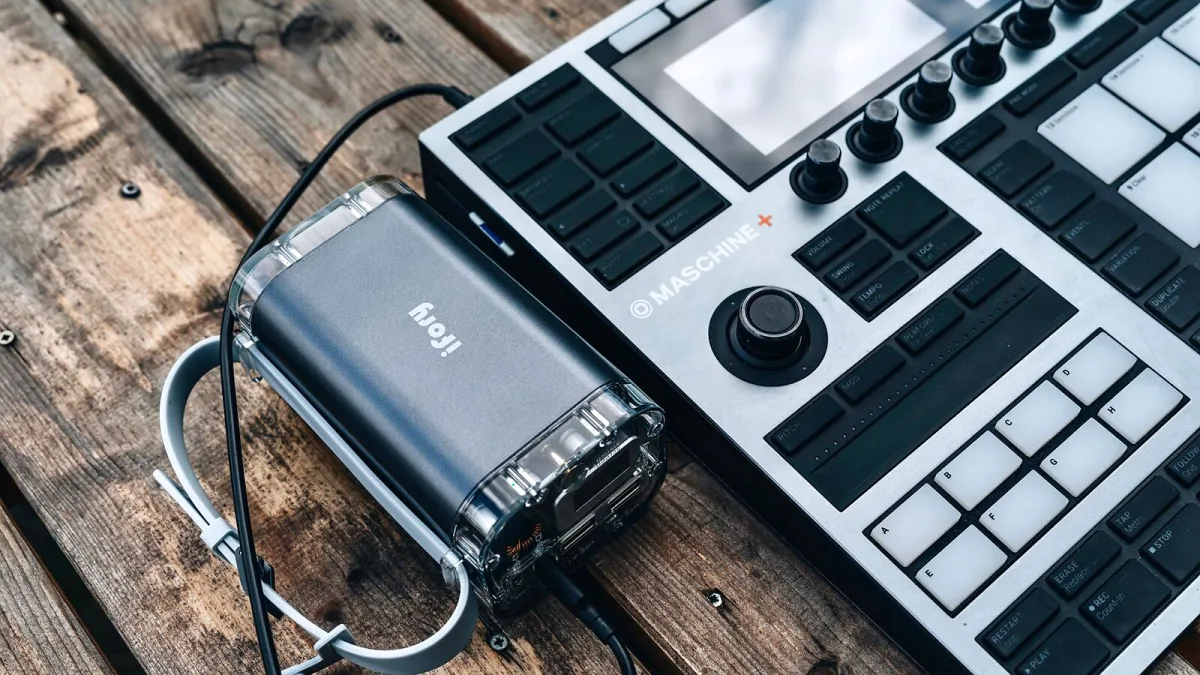
If you've heard musicians talk about writing a whole track "in the box" without meaning a computer, they're probably talking about a groovebox. It's one of those lovely bits of gear that does several jobs at once — here's exactly what it is, what it's made of, and where it sits next to the equipment it's often confused with.
So, what actually is a groovebox?
A groovebox is a self-contained instrument that combines sound generation — drums, synths, samples, or all three — with a built-in sequencer, effects and hands-on performance controls. The idea is integration: you can create a sound, sequence it and perform it, all from one box, without ever opening a laptop.
It's a broad, slightly informal term rather than a strict technical category, and manufacturers don't apply it consistently. What matters more than the label is what a particular instrument actually does — which is exactly what we'll unpack below.
How it differs from the gear it gets confused with
| Instrument | How it's different |
|---|---|
| Drum machine | Focused mainly on percussion; a groovebox usually adds melodic tracks too |
| Sampler | Focused on recording and playing back audio; becomes groovebox-like once it adds proper multitrack sequencing and effects |
| Synthesizer | Focused on generating and shaping sound; a groovebox usually wraps that in drums and sequencing as well |
| Music workstation | Leans towards broader linear arrangement and recording; a groovebox favours patterns and immediacy |
| DAW (software) | Offers deeper editing and mixing on a computer; a groovebox trades some of that depth for portability and tactile, computer-free control |
What's actually inside one
Sound engines
A groovebox may include analog synthesis, virtual-analog modelling, FM synthesis, wavetable synthesis, sample-based (PCM) sounds, dedicated drum synthesis, or sample recording and playback — often several of these together. Having several engines doesn't automatically mean every track can use every one; track counts and polyphony can still impose limits worth checking before you assume flexibility.
The sequencer — genuinely the heart of the thing
This is usually what defines a groovebox more than anything else. Common approaches include step sequencing, real-time recording, pattern-based sequencing with a song or arrangement mode for chaining patterns together, and more advanced touches like parameter automation, probability, conditional trigs and microtiming. The sequencing method a device uses often determines whether it actually suits how you think musically — which is worth trying before you commit to buying.
Sampling
Sampling ranges from basic one-shot playback to full recording and editing: maximum sample time, internal or expandable memory, chopping, slicing, time-stretching and pitch-shifting all vary hugely between models. A product marketed as a "sampler" doesn't automatically support long recordings or deep editing — that's worth checking in the manual rather than assuming from the name.
Effects and connectivity
Reverb, delay, distortion, filters and compression are common onboard, though how many can run simultaneously — and whether they're per-track or shared — often matters more than the list of names. On the connectivity side, look for MIDI, USB (and whether it carries audio as well as MIDI), audio input for sampling, storage, and CV/Gate if you want to link into modular gear.
The main types you'll encounter
- Drum-focused — built around percussion synthesis and sampling, suited to techno, house, hip-hop and rhythm-led work.
- Synth-focused — several melodic tracks and synthesis engines, often with drums included, for basses, leads and chords in one box.
- Sampling-focused — centred on recording, chopping and manipulating audio, popular in hip-hop and beat music.
- Workstation-style — broader song construction, recording and mixing, closer to a standalone production system.
- Portable — lightweight, often battery-powered, prioritising immediacy over depth.
- Hybrid / modular-compatible — adds CV/Gate for use as the centre of a wider hardware setup.
Who makes them
Elektron is closely associated with detailed, performance-oriented sequencing across families like Digitakt, Syntakt and Digitone. Roland's MC-series and AIRA Compact instruments, and its SP-404MKII sampler, draw on decades in drum machines and pattern sequencers. Akai's MPC line has shaped much of modern groovebox design through pad-based sampling and sequencing. Novation's Circuit family and Teenage Engineering's OP-Z favour compact, approachable workflows, while Korg's Electribe series and Native Instruments' Maschine ecosystem each bring their own take on combining pads, sequencing and sound.
A few tips before you dive in
Learn the sequencer before you go chasing more sounds — it shapes your whole workflow far more than the sound engine does. Keep an eye on polyphony and track limits rather than trusting a spec sheet's headline numbers. And don't confuse portability with simplicity: some of the smallest boxes hide surprisingly deep, menu-heavy systems underneath. If you're weighing up which type actually fits your workflow, our buyer's guide walks through exactly that decision.
The bottom line
A groovebox earns its name by combining sound-making, sequencing and performance into one self-contained instrument — the boundary with drum machines, samplers and synths is genuinely blurry, and that's fine. What matters is understanding the sequencer, sound engine and sampling capability of the specific one you're looking at, rather than the marketing label attached to it. New to the whole idea? Our beginner's guide is a gentler place to start, and it's worth reading through the common mistakes people make once you've settled on one.





Comments