


Moog Muse roundup
Moog Muse: A Complete Buyer's Guide
A substantial instrument at a substantial price. Here's who the Moog Muse genuinely suits, and the questions worth asking before you buy one.
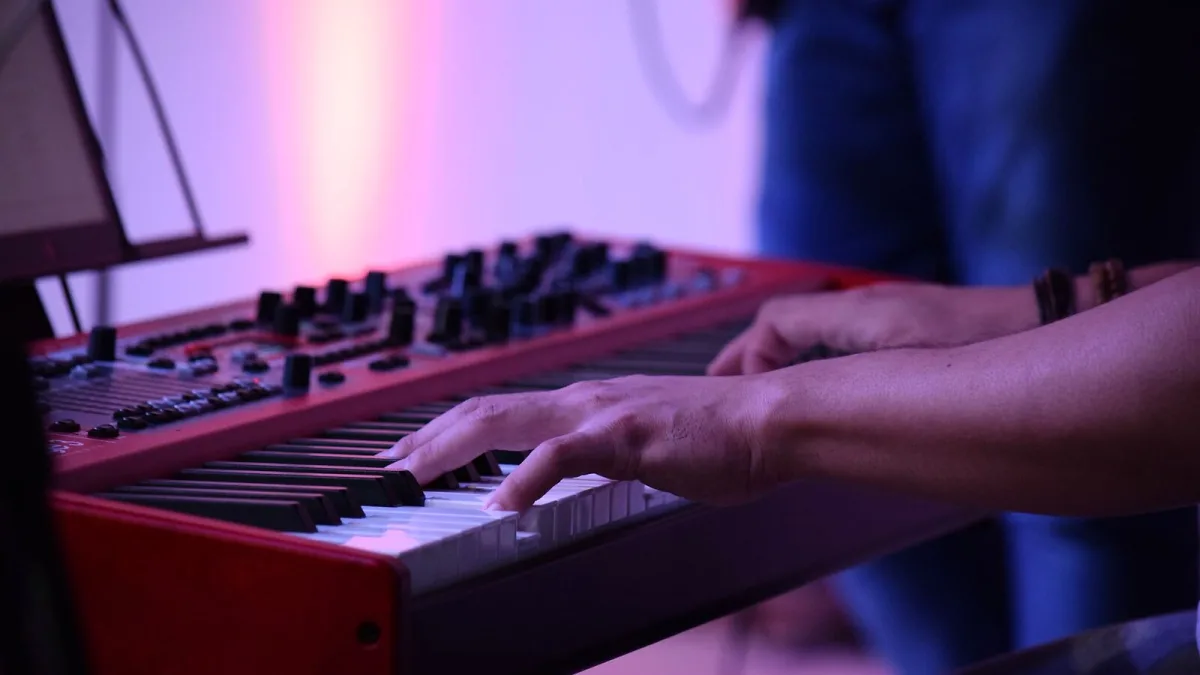
A few things before you commit to a Moog Muse: it's a substantial purchase, it's a substantial instrument physically, and it genuinely isn't the right fit for every keyboard player. Let's go through who it suits, what it costs, and exactly what you're getting for that money.
Who the Moog Muse is actually for
Released in July 2024, the Moog Muse is Moog's eight-voice, bi-timbral analog polyphonic synthesizer — a proper step up from the brand's compact monophonic and paraphonic instruments like the Grandmother and Matriarch. It's aimed at players and producers who want real chords, layered sounds and sequenced patterns, all in genuine analog circuitry, rather than a single-note lead instrument.
It suits you if you:
- Already play or write with chords and want that in a Moog's analog voice
- Want to layer two sounds — bass and pad, for example — from a single instrument
- Value hands-on, front-panel control over menu-diving
- Want a sequencer capable of more than a basic step pattern
It's a poor fit if you mainly need per-note expressive control (polyphonic aftertouch or MPE), since it doesn't offer either — only channel aftertouch, which applies pressure across the whole part. If that distinction matters to your playing, it's worth reading in full before you buy.
What the Moog Muse costs, and against what
At launch, this instrument carried a US list price of $3,499 — a genuine premium-tier price, placing it alongside instruments like the Sequential Prophet-6, OB-6 and Novation Summit rather than entry-level polysynths. Expect UK and EU pricing to sit at a comparable premium level once local tax and distribution are factored in; check current pricing with an authorised Moog dealer before buying, since list prices and promotions do shift over time.
At that price tier, you're paying for genuine dual analog oscillators and dual ladder filters per voice across all eight voices, not a single shared filter section — a meaningfully more expensive design to build than a typical analog polysynth.
What it actually gets you for the money
| Feature | What it means for you |
|---|---|
| 8 voices, bi-timbral | Play two patches at once, sharing eight voices between them |
| 2 analog oscillators + modulation oscillator per voice | Rich, classic Moog tone plus FM-style textures when the mod oscillator runs at audio rate |
| 2 Moog ladder filters per voice | Series, parallel or stereo filtering — more sonic range than a single-filter design |
| 61-key Fatar keyboard, velocity + channel aftertouch | A proper playing feel, though no per-note (polyphonic) aftertouch or MPE |
| 64-step polyphonic sequencer with probability | Genuinely generative patterns, not just a fixed loop |
| 16-slot modulation matrix | Flexible routing beyond the fixed front-panel connections |
| CV/clock In and Out, MIDI, USB | Fits into a modular rig, not just a MIDI/USB studio setup |
The physical reality
Before you buy, think about where this actually lives. It measures roughly 99 × 42 × 11 cm and weighs around 14.55 kg — a genuinely substantial instrument, not something you casually move between rooms for a quick session. If your studio or stage setup is space-constrained, factor that in before ordering.
Questions worth asking before you pay
- Do I need per-note (polyphonic) aftertouch or MPE? If yes, this isn't the instrument for you.
- Will I actually use the bi-timbral layering, or would a simpler single-timbre polysynth do the job?
- Do I have the desk space and the budget for a premium-tier instrument, or would a more compact Moog suit better?
- Is my dealer able to confirm current firmware and warranty terms?
If you're still genuinely unsure whether the architecture itself makes sense for you, our explainer covers exactly how the voices, filters and sequencer work together, section by section.
If you're newer to instruments like this
If everything above sounds like a lot to take in, you're not alone — this is a deep instrument, and there's no shame in easing into it gradually rather than trying to use every feature on day one. Our beginner's guide is built for exactly that gentler starting point.
The bottom line
This is a premium, purpose-built instrument for players who want real analog polyphony, layered sounds and a proper sequencer, not a general-purpose keyboard. If that description matches how you actually play and produce, it's a genuinely well-built option at its price tier. If it doesn't, there's no shame in looking at a simpler, more affordable Moog instead — and it's worth reading our piece on common mistakes owners make so a big purchase doesn't come with an easily avoidable regret.






Comments