


61 Key Keyboard article
61 Key Keyboard for Beginners: A Complete Guide
Starting on a keyboard rewards a little preparation — here is a practical beginner's guide to choosing the right instrument, setting it up and making progress from the first session.
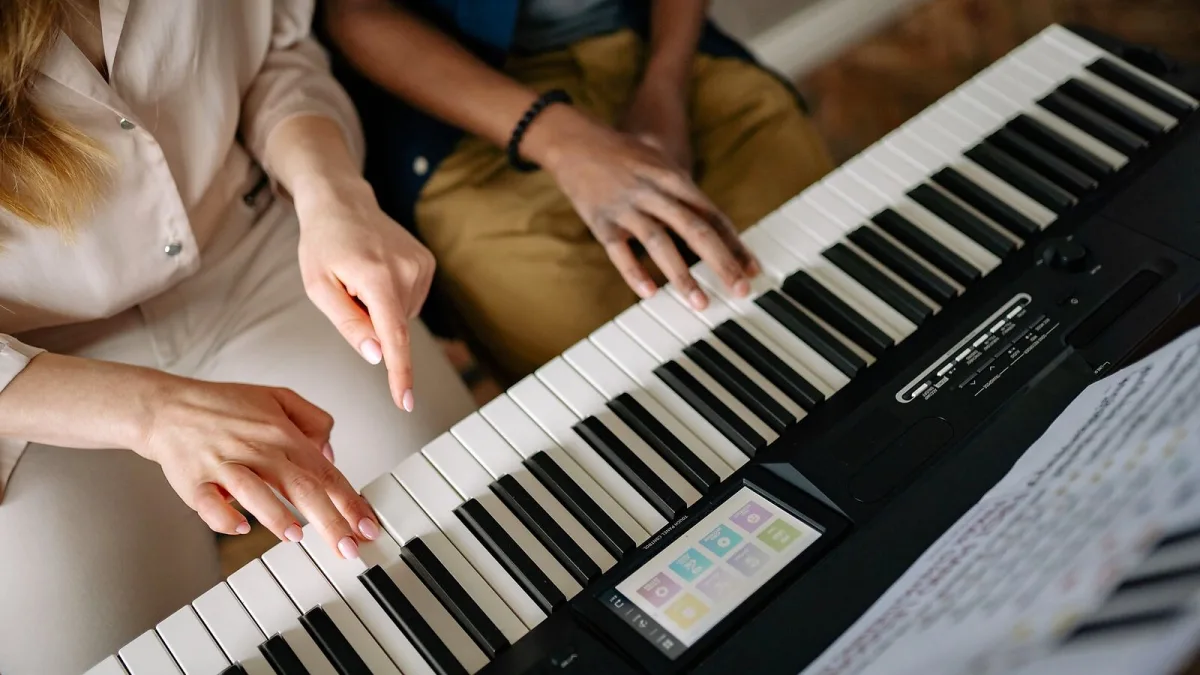
Starting on a 61 key keyboard as a complete beginner involves a few decisions before the first note is played — choosing the right instrument, setting it up correctly, and establishing a practice approach that actually produces progress. Here is a practical beginner's guide covering all three.
Choosing Your First Keyboard
For most beginners, the Yamaha PSR-E373 or Casio CT-S300 at around £90–120 is the right starting point. Both have touch sensitivity — meaning harder keystrikes produce louder notes, which is fundamental to expressive playing — and a headphone output for quiet practice. Neither requires external amplification for home use.
Do not buy a keyboard without touch sensitivity. Instruments without it produce the same volume regardless of how hard you press, which prevents you from developing dynamic control. This is a common mistake among parents buying first keyboards for children, and it limits musical development from the first lesson.
A 61 key keyboard is sufficient for most beginner repertoire. The five octaves cover the range needed for the first year or two of piano study. If your teacher works from a piano method that requires all 88 keys, you will need to consider a larger instrument eventually — but not for the first year.
Setting Up Correctly
Position the keyboard on a stable stand at a height where your elbows are level with the keys when seated with relaxed shoulders. Your wrists should not angle upward or downward — they should be roughly level with your forearms. Adjust the seat height to achieve this rather than adjusting your posture around a fixed seat.
Connect headphones and set the volume to a comfortable level before playing. If your keyboard has a lesson function, explore it in the first session — most modern Yamaha and Casio models have built-in exercises that introduce correct hand position and basic technique.
The First Sessions
Start with hand position. The curved-finger resting position — fingers curved over the keys as if holding a ball — is the foundation of piano technique. Every correct practice minute reinforces it; every incorrect minute reinforces the wrong habits.
Begin with five-finger exercises in C major: right hand, then left hand, then both together at a slow tempo. A metronome should be on from the first session. Most built-in modules have a metronome or rhythm accompaniment — use it. Timing stability developed early prevents months of later correction.
Using the Built-In Features
Most beginner keyboards have more built-in functionality than first-time buyers explore:
- The lesson function usually works with split keyboard and one-hand-at-a-time modes.
- The rhythm section can be used as a simple metronome or backing track.
- The auxiliary input allows you to play along with music from a phone or tablet.
- The recording function (on some models) allows you to play back your practice and identify timing issues.
How to Progress Faster
Short, daily sessions are more effective than long, infrequent ones. Fifteen minutes every day produces faster progress than ninety minutes on the weekend. Focus on specific passages rather than playing through whole pieces — deliberate repetition of difficult bars builds skill more efficiently than repeated whole-piece run-throughs that always stumble at the same point.
A teacher makes a significant difference, even in the early stages — habit errors are caught before they become ingrained. Online resources are adequate for supplementary learning but are not a replacement for periodic in-person correction.
For background on the format and its specifications, see the overview. For specific models to buy, see the best 61 key keyboards for the money.
When to Consider Upgrading
A beginner's first 61 key keyboard will serve well for one to two years of regular practice. The signals that suggest an upgrade is warranted: the key action feels too light compared to pianos you encounter at lessons or in practice rooms; the sound quality of the built-in piano voice no longer satisfies during practice; or your teacher suggests you need weighted keys to develop accurate touch response.
At that point, the upgrade path from a budget 61 key keyboard typically goes in one of two directions: a 76-key or 88-key instrument with graded hammer action for serious piano study, or a better quality 61-key instrument with improved sounds and connectivity for keyboardists who want to stay portable. Both are valid directions depending on your musical goals.
Common Beginner Questions
Beginners frequently ask whether they should start on an acoustic piano rather than a keyboard. If an acoustic piano is available and practical, it provides a better touch experience from the start. If it is not — for reasons of space, budget or noise — a quality portable keyboard is a perfectly functional starting instrument. Many professional keyboard players learned initially on unweighted instruments. What matters is consistent practice with correct technique, not the instrument category.




Comments