


Ebm article
The History of Ebm
Rachel traces Electronic Body Music back to its three real birthplaces — Düsseldorf, Aarschot and Essex — and follows the thread through to the genre splits of the 1990s.
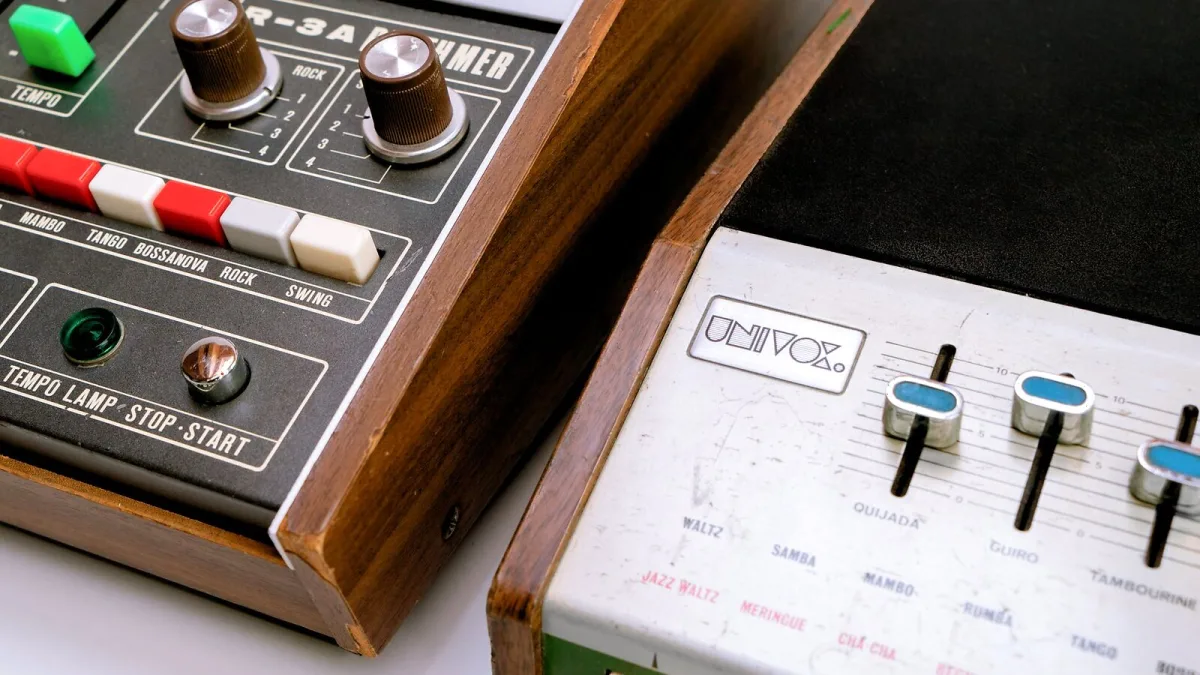
Every genre has an origin story, but few are as satisfyingly stark as this one. EBM — Electronic Body Music — wasn't dreamed up in a boardroom or focus-grouped into existence. It came out of cold rehearsal rooms in Düsseldorf and Aarschot, built by people who'd rather strip a song down to its bones than dress it up. Here's how that happened, city by city, record by record.
Düsseldorf Starts Stripping Things Back
Start in Germany, late 1970s. DAF — Deutsch Amerikanische Freundschaft — formed in Düsseldorf in 1978, and their whole approach was subtraction rather than addition. Where punk bands were adding noise and speed, DAF took the opposite route: fewer instruments, fewer notes, just rhythm, voice and electronic pulse hammered into place. Their run of early-1980s albums — Alles ist gut and Gold und Liebe, both from 1981, and Für immer in 1982 — turned that minimalism into something genuinely physical. Songs like "Der Mussolini" and "Alles ist gut" were provocative, sexually direct and built almost entirely from rhythm. Purists sometimes call DAF "proto-EBM" rather than EBM proper, since their music also sits comfortably in German post-punk and Neue Deutsche Welle. That's a fair distinction, but it doesn't change how much of the later template started right here.
They weren't working in isolation. Liaisons Dangereuses, led by Chrislo Haas and Beate Bartel, released a stark, sequencer-driven self-titled album in 1981 that shares the same minimal, club-oriented DNA — another record that sits right at EBM's foundation, whichever label you attach to it.
Belgium Turns Rawness Into a System
Meanwhile, roughly 250 miles away, Belgium was building its own version. Front 242 formed in Aarschot in 1981, and where DAF's approach felt like a punk band that had swapped guitars for machines, Front 242 approached the same raw material with far more technical control. Sequencers, samplers, drum machines and processed vocals were assembled with real deliberateness. Their 1981 track "Body to Body" is often pointed to as an early landmark, and by the time of Geography (1982) and No Comment (1984), the band had a genuinely codified sound: relentless, danceable, and unmistakably electronic.
Front 242 are also widely credited with popularising the actual phrase "Electronic Body Music" to describe what they were doing, although accounts of exactly when and how the term first surfaced vary between sources. Whatever the precise origin, the name stuck — and by the mid-1980s EBM had become a genuine, recognisable genre.
Essex Pushes It to the Edge
The third crucial piece of the story comes from, of all places, Essex. Nitzer Ebb formed there in 1982, with Douglas McCarthy, Bon Harris and David Gooday taking the Belgian and German EBM blueprints and stripping them even further. Their vocals became commands rather than lyrics; their arrangements left huge, deliberate gaps around a pounding central rhythm. That Total Age (1987) remains the most-cited entry point into their catalogue, with tracks like "Join in the Chant" and "Warsaw Ghetto" showing just how minimal and forceful this music could get while still filling a dancefloor.
The 1990s: EBM Becomes Several Genres
By the early 1990s, EBM's original template had spread far enough that it started splitting into recognisable branches. Some acts — Front Line Assembly, Skinny Puppy — pushed toward denser, more atmospheric electro-industrial production. Others chased a harsher, more distorted sound that would eventually get labelled dark electro or aggrotech. And a softer strand, led by acts like VNV Nation and Covenant, folded in brighter synth-pop melody and trance-influenced production to create what's now called futurepop. Belgium, true to form, produced its own further mutation too: new beat, a slower, heavier club sound built from the same electronic dance lineage but pulled in a different direction by acid house and Hi-NRG influences.
None of these branches fully replaced original-flavour EBM. They ran alongside it, and in some cases still do.
Where the Story Sits Now
Genres this underground don't usually get a tidy ending, and EBM hasn't had one. The original records from DAF, Front 242 and Nitzer Ebb are still in circulation, still influencing new producers, and the dedicated club scene around this style has never really gone away — it just moved rooms a few times. If you want to meet the people who actually built this history rather than just read about them, our guide to the best EBM artists to know is the natural next stop, and our breakdown of the subgenres untangles exactly how each 1990s branch differs from the next.
The Bottom Line
EBM is a genre with three genuinely distinct birthplaces — Düsseldorf's stripped-down provocation, Aarschot's technical control, and Essex's stark minimalism — that somehow fused into one recognisable sound. If you're new to all this and want the plain-English version before the history lesson, our beginner's guide is exactly that. But if you're the sort who likes knowing why a sound exists before you fall for it, you've just read the short version of forty-odd years of very loud, very deliberate machine music.




Comments