


Breakcore article
A Beginner's Guide to Breakcore
Breakcore isn't defined by speed — it's defined by what happens to the breakbeat. Here's a proper introduction to the genre, its roots and its sound.

Some genres are defined by a sound. Breakcore is defined by an act: taking a drum break and pulling it apart until the edit itself becomes the music. It's fast, frequently abrasive, sometimes surprisingly melodic, and built almost entirely from other people's rhythms turned into raw material. Here's a proper introduction to what breakcore actually is, where it sits next to the genres it borrows from, and why "just play it faster" gets the whole thing wrong.
What Actually Defines the Genre
It's tempting to define breakcore purely by speed — plenty of tracks sit above 160 BPM, some considerably higher. But tempo alone doesn't get you there; plenty of fast tracks aren't breakcore, and plenty of it isn't especially fast throughout. The real defining trait is what happens to the breakbeat itself. In jungle or drum and bass, a sampled break usually keeps its shape as a groove you can dance to. Here, the break gets isolated, sliced into pieces smaller than a single drum hit, reordered, stretched, distorted and sometimes rendered almost unrecognisable — the editing becomes the compositional event, not just the backing.
Where the Sound Comes From
The genre didn't arrive from one scene or one artist. It grew out of several overlapping traditions colliding in the 1990s:
- Jungle and drum and bass supplied the core vocabulary — sampled funk breaks, syncopation and bass-heavy production.
- Hardcore techno and gabber brought speed and distorted, confrontational kick drums.
- Digital hardcore, closely associated with Alec Empire and Atari Teenage Riot, added punk aggression and politically charged noise.
- Industrial and noise music shaped its taste for saturation and harsh, unpolished textures.
- IDM and experimental computer music contributed detailed, unusual sequencing and a listening-focused approach rather than a purely dancefloor one.
None of these traditions "invented" it on their own — it's genuinely a product of all of them meeting at once, mostly in DIY parties, warehouses and independent labels rather than any commercial scene. For the full story of how that unfolded, our history of breakcore goes into the scenes, labels and key releases in far more depth.
Breakcore and Its Neighbours
Because it borrows so heavily from other genres, its edges are genuinely blurry — even specialists disagree about exactly where it starts and stops.
| Genre | How it compares |
|---|---|
| Jungle | Shares breakbeat and bass foundations, but keeps a more continuous, danceable groove |
| Drum and bass | Shares tempo and lineage; this genre pushes much further into rhythmic disruption |
| IDM | Shares detailed programming and experimentation, but isn't necessarily breakbeat-centred or aggressive |
| Digital hardcore | Shares punk intensity, but leans more on programmed beats, guitars and vocals |
| Gabber / hardcore techno | Shares speed and distorted kicks, with less emphasis on chopped breaks |
| Speedcore | Shares extreme tempo, but is usually more kick-driven than breakbeat-driven |
The Ingredients That Give It That Sound
A handful of recurring techniques show up across almost all of it, whatever the particular flavour:
- The Amen break — a short drum passage sampled from The Winstons' 1969 recording "Amen, Brother" — is one of the genre's most-used raw materials, alongside the Think break and other sampled or synthesised percussion.
- Rapid stutter edits and micro-editing, rearranging pieces far smaller than a normal beat division.
- Abrupt shifts in tempo, meter and density, often with no warning.
- Heavy distortion, clipping and aggressive compression.
- Sudden contrasts — a wall of noise dropping without warning into something sparse or oddly beautiful.
Where People Actually Made This
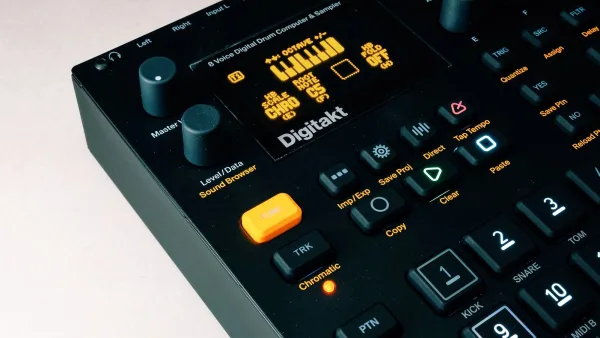
Almost none of it came out of proper studios. Early scenes clustered around DIY parties, warehouses, squats and small independent labels rather than any unified industry — production was cheap, distribution was word of mouth, and the whole culture leaned punk in attitude as much as in sound. That's part of why so much of the genre still feels handmade rather than polished: a sampler, a tracker and a lot of stubbornness were enough to get started, and largely still are.
Is It All Just Noise?
Not remotely, though it's a fair first impression. It covers a genuine spectrum: some of it is abrasive, industrial-leaning and confrontational, while other corners are intricate, melodic and almost classical in structure — the same chopped-break technique can serve either mood. Our guide to breakcore's subgenres maps out that range properly, and our roundup of key breakcore artists is a good way to hear the difference for yourself.
The Bottom Line
Breakcore is less a fixed sound than an approach — treat a breakbeat as raw material rather than a finished groove, and push the editing until it becomes the whole point. That's why it can sound like a warehouse rave falling apart at the seams one minute and something strangely delicate the next. If this all sounds intriguing rather than intimidating, our guide on where to start with breakcore is the gentler way in.



Comments