


Gibson Sj 200 Guitar article
A Guide to Gibson Sj 200 Guitar
Gibson's biggest flat-top has been on more famous stages than almost any other acoustic. Here's what it is, where it came from, and how it earned the name.
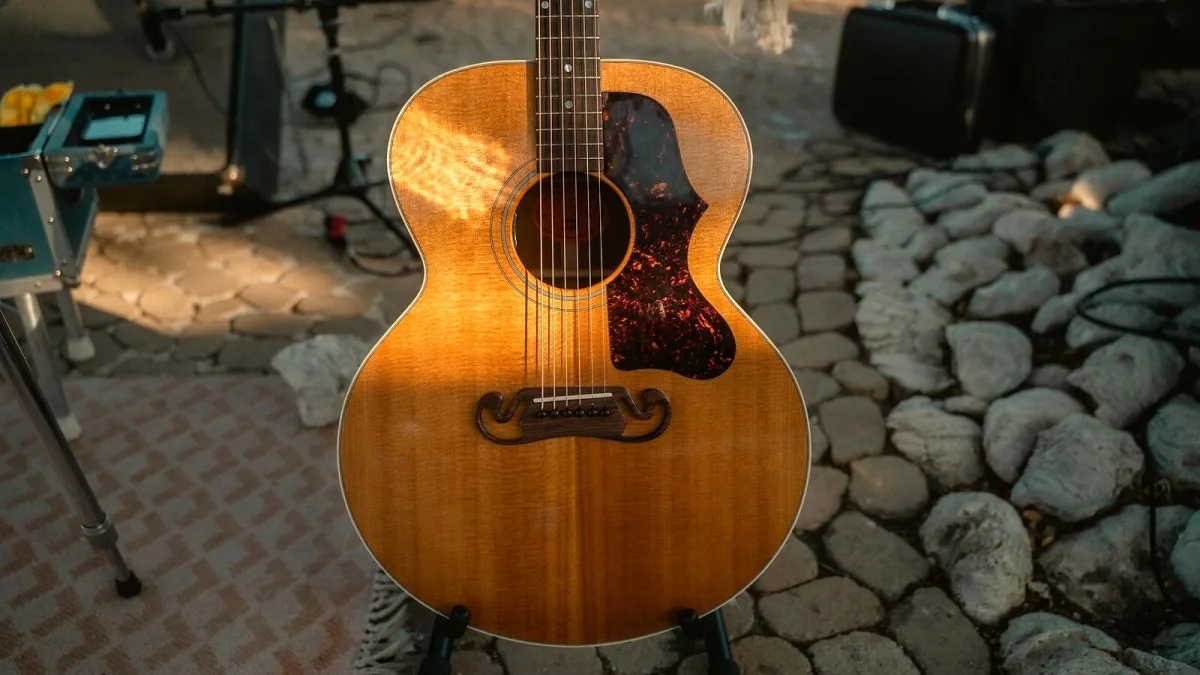
The Gibson SJ-200 is the guitar brand's biggest, boldest flat-top acoustic, and it has been photographed on more famous stages than almost any other model in the catalogue. If you've ever wondered why a guitar this large exists, or why players from George Harrison to Bob Dylan have reached for one, this guide covers what the SJ-200 is, where it came from, and what actually changed inside it over the decades.
What Is the Gibson SJ-200?
It is a super-jumbo acoustic guitar — Gibson's term for a body noticeably larger than a standard dreadnought, built to project without amplification. The lower bout, the widest part of the body, measures roughly 16⅞ inches across on a classic example, giving the top far more surface area to move air than a smaller guitar.
That size is matched by a 25½-inch scale length (the distance from nut to bridge), a spruce top, and a distinctive rosewood "moustache" bridge — so called because its shape curls upward at each end like a moustache. The result is a guitar built for strong bass, wide dynamics and a big chordal voice, which is why it has always suited strumming, flatpicking, country and singer-songwriter work more than quiet fingerstyle playing.
How It Sounds and Plays
Pick one up and the size makes sense almost immediately. Players reach for this guitar for:
- Strong acoustic projection without an amp
- Broad, confident bass response
- Clear, forceful strumming
- A large, full chordal sound
- Genuine stage presence
- Flatpicking and country-style rhythm work
The trade-off is comfort. A body this large can feel like a bit of a handful for players with shorter arms or a smaller frame, especially compared with a dreadnought, slope-shoulder or concert-size guitar — worth bearing in mind before you fall for the sound alone.
From Super Jumbo to J-200: A Short History
Gibson built the first Super Jumbo in 1937, reportedly as a custom order for the performer Ray Whitley, who needed an acoustic guitar loud enough to hold its own alongside a band. The model was formally renamed the Super Jumbo 200 in 1939, and by around 1955 Gibson had shortened that to J-200 — though both "SJ-200" and "J-200" have stuck around in Gibson's own naming ever since, sometimes for guitars from the very same production run.
Early examples used rosewood back and sides through 1937–1940, with an ebony fingerboard. In 1941, Gibson switched to a rosewood fingerboard and changed its tuner design. After the Second World War, maple became the standard back-and-sides wood, and by 1947 the guitar was being advertised simply as the J-200. That rosewood-to-maple switch matters for tone: maple tends to sound clearer and more immediate, while the earlier rosewood versions are generally associated with a deeper low end and richer overtones — though bracing, top thickness and setup all play a part too, so treat those as tendencies rather than guarantees.
Bracing: Why Two SJ-200s Can Sound Different
Bracing is the internal lattice of wood glued under the top that controls how it flexes, and Gibson has changed the SJ-200's bracing more than once. Early guitars used a double-X pattern with extra transverse ladder braces. In 1941 Gibson moved to a single X-brace with angled tone bars, before returning to a double-X layout around 1952. Modern SJ-200 Original models use traditional hand-scalloped X-bracing, where wood is carved away from the braces to let the top vibrate more freely.
The practical upshot is that two guitars wearing the same name may be built quite differently inside. Anyone comparing instruments — especially older ones — should look past the badge to the specific era and specification.
The Players Who Made It Famous
Few acoustic guitars carry as much stage history. This model has been closely associated with George Harrison and other members of the Beatles, Jimmy Page, Pete Townshend, Neil Young, Gram Parsons, Cat Stevens, Elvis Presley, Mike Nesmith and the blues musician Mance Lipscomb. Bob Dylan has his own signature edition, reviewed favourably by Acoustic Guitar magazine. It's this visibility, as much as the sound, that earned it its long-standing nickname from Guitar World: the "King of the Flat-tops."
Worth noting: appearing with a guitar on stage or in photos isn't proof that a particular recording used that instrument. Where a claim matters for research or resale, it's worth verifying against a more specific source.
The Modern SJ-200 Range
Gibson currently builds several distinct families under this name, and the differences are more than cosmetic:
| Model | Typical build | Aimed at |
|---|---|---|
| SJ-200 Original | Hand-scalloped X-bracing, vintage-style appointments | Players who want the traditional voice |
| SJ-200 Standard | Maple neck, rosewood board, 25½" scale, 12" fingerboard radius | Everyday USA-built instrument |
| Custom Shop / historic recreations | Period-accurate specification and finish | Collectors and vintage-tone purists |
| Artist signature models | Varies by artist (e.g. the Bob Dylan SJ-200) | Fans of a specific player's guitar |
Some modern versions add onboard electronics, including L.R. Baggs pickup systems, for players who need to plug into a PA. Finishes span natural and sunburst options through to custom colours, and appointments such as the pickguard artwork and hardware plating vary by model, so two guitars in this range can look quite different sitting side by side even with a similar specification underneath.
Bottom Line
The Gibson SJ-200 earned its reputation the old-fashioned way: it's genuinely loud, genuinely big, and it has been in the hands of enough famous players to become a design classic in its own right. If you're weighing one up for yourself, our Gibson SJ-200 buyer's guide covers the specs worth checking before you spend, and our beginner's guide is worth a read if this would be your first acoustic. Looking at specific models, see our round-up of the best Gibson SJ-200 guitars, and if you already own one, our guide to common SJ-200 mistakes is worth a look before you change strings or go vintage-hunting.






Comments