


Gibson Hummingbird article
The Ultimate Guide to Gibson Hummingbird
You can spot one from the back row before you've heard a note. Here's what the Gibson Hummingbird actually is, and why it's earned that reputation.
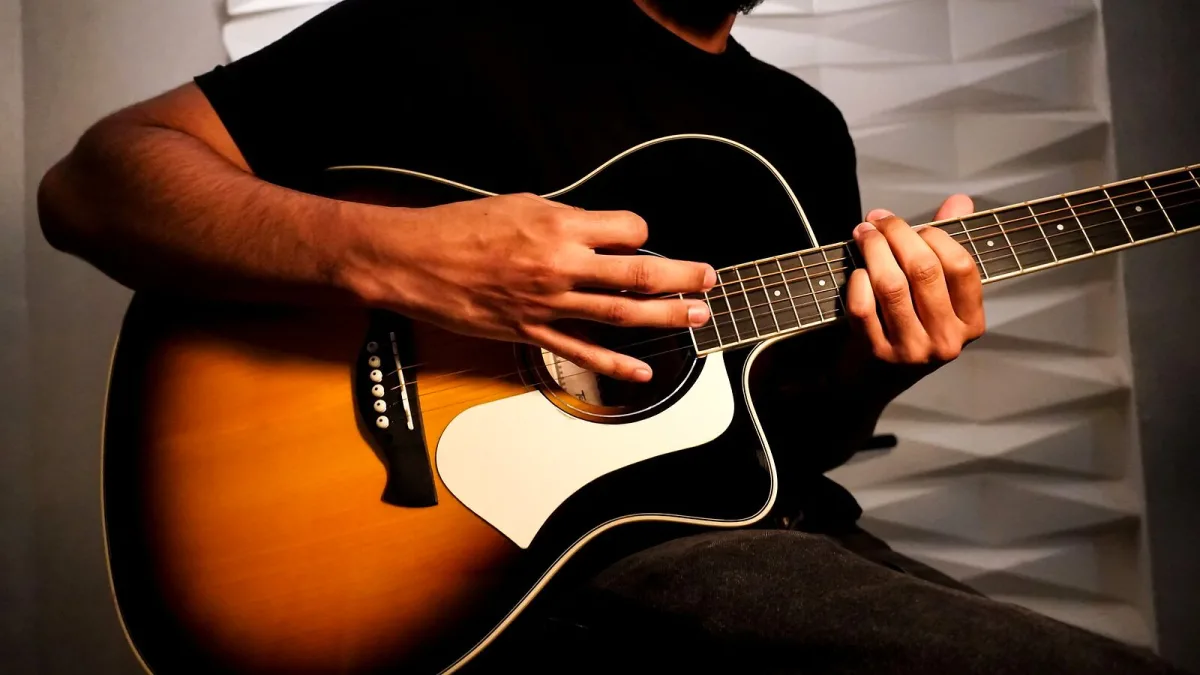
There's a reason you can spot a Gibson Hummingbird from the back row of a gig before you've even heard a note out of it. That ornate pickguard has been doing the job since 1960, and the guitar underneath it has earned its reputation the hard way — through six decades of records, tours and genuine tonal character. Here's what it actually is, how it got here, and why it still matters.
What the Gibson Hummingbird Actually Is
Strip away the decoration and the Hummingbird is a square-shoulder dreadnought — Gibson's first, introduced in 1960 as a direct response to the growing popularity of that body shape. Square shoulders means a fuller, rounder upper body than Gibson's older round-shoulder designs, which pushes more air and gives the guitar real strumming power. A spruce top over mahogany back and sides is the traditional recipe, paired with a shorter-than-usual 24.75-inch scale length.
The Details That Make It Instantly Recognisable
- The pickguard. An engraved hummingbird surrounded by floral detailing — genuinely ornate for a production instrument, and the reason the model got its name.
- Double-parallelogram inlays. Rectangular fingerboard markers that are as much a Gibson acoustic signature as anything else in the catalogue.
- Cherry sunburst finish. Not the only finish available, but the one most associated with the model historically.
- Reverse-belly bridge. A rosewood bridge shape that's changed subtly across the decades but remains a Hummingbird hallmark.
How It's Changed Since 1960
"1960s Hummingbird" isn't one specification — it's several. Early-'60s examples had a wider nut, roughly 1 11/16 inches, which narrowed to around 1 5/8 inches by the mid-1960s. Adjustable saddles, common on earlier guitars, were phased out around 1970, alongside a shift to three-piece laminated mahogany necks. If you're chasing a genuinely vintage instrument, the exact year matters far more than the decade. Our complete buyer's guide goes through what to actually check before you commit to one.
What It Sounds Like
A spruce-and-mahogany Hummingbird tends toward a warm, midrange-forward voice rather than a scooped, bass-heavy one. Expect strong projection for strumming, a rounded low end rather than the extended bass of a rosewood dreadnought, and enough clarity up top for vocal accompaniment and moderate flatpicking. The shorter 24.75-inch scale also means somewhat lower string tension than a longer-scale dreadnought at the same tuning, which tends to make chording and bends feel a little easier under the fingers.
Who's Played One
The Hummingbird's cultural footprint runs through country-rock and singer-songwriter music particularly. Gram Parsons is one of the earliest and best-documented users, connecting the model to the Byrds and the Flying Burrito Brothers. Keith Richards is widely associated with it through Rolling Stones recordings, and Sheryl Crow has kept it visible in more contemporary roots-rock settings. Plenty of other well-known names get mentioned alongside the model too — worth noting that ownership, photographs and sustained professional use aren't all the same thing, so treat the longer lists you'll find online with a little caution.
Today's Model Range
Current Gibson production spans Standard, Original, Studio, Artist and Custom Shop variants, each pitched at a different budget and level of historical faithfulness, and Epiphone offers considerably more affordable versions built to a different specification entirely. Our roundup of the best Hummingbirds for the money breaks down which tier suits which player, and if you're weighing this up as your first serious acoustic, our beginner's guide is worth reading first.
The Bottom Line
The Gibson Hummingbird earned its status honestly: a distinctive square-shoulder dreadnought design, a warm and forgiving mahogany-spruce voice, a genuinely comfortable short scale, and six decades of use by players who needed all three. Whether you're after a vintage original Gibson Hummingbird or a current-production model, understanding what's changed — and what hasn't — is the key to choosing the right one.





Comments