


Gibson Acoustic Guitar article
Gibson Acoustic Guitar Explained: Features, Types and Tips
The whole Gibson acoustic family explained: body shapes, the J-45, Hummingbird, Dove and SJ-200, tonewoods, and the latest additions to the range.
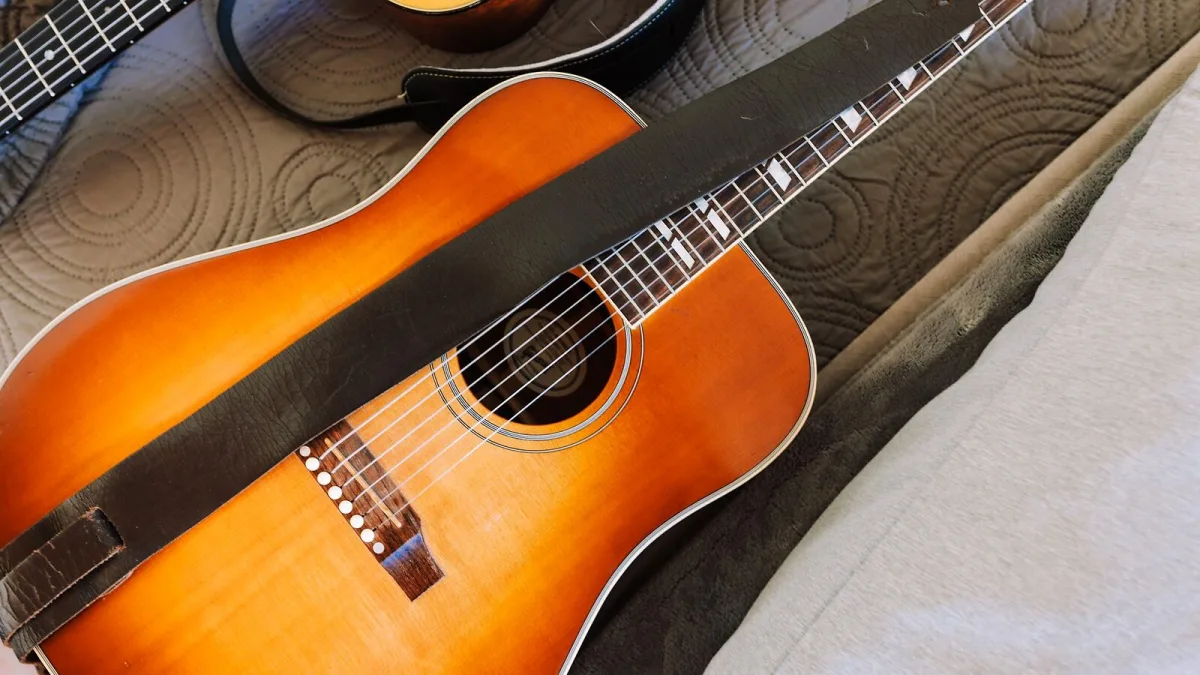
I'll be honest, I came to Gibson acoustics through the electric side of the family — Les Pauls, SGs, all that riffy heritage — and it took me a while to realise the acoustic range has just as much personality behind it. A Gibson acoustic guitar isn't one thing; it's a whole family of genuinely different-sounding instruments built around a handful of classic body shapes. Here's the full picture, features, types and the bits that actually matter when you're getting to know one.
The Four Body Shapes That Define the Range
Gibson organises its acoustic catalogue around four broad body categories, and understanding these is the fastest way to understand the whole range:
| Body category | Character | Key models |
|---|---|---|
| Small Body | Compact, comfortable, focused tone | L-00, LG-2 |
| Round Shoulder | Softer-shouldered dreadnought, balanced and versatile | J-45, J-35 |
| Square Shoulder | Pronounced dreadnought silhouette, strong for rhythm | Hummingbird, Dove |
| Jumbo / Super Jumbo | Large body, maximum volume and projection | J-185, SJ-200 |
None of these are strict rules — wood, bracing, strings and setup all shift how any individual guitar actually sounds — but as a starting map for a Gibson acoustic guitar, it's a genuinely useful one.
Meet the Icons of the Gibson Acoustic Guitar Range
The J-45 is Gibson's round-shoulder dreadnought and arguably its defining acoustic model: warm, balanced and equally happy strumming or fingerpicking, which is why it's become such a songwriter's favourite. The Hummingbird, introduced in 1960, was Gibson's first square-shoulder dreadnought, and its pickguard and broad, rhythm-friendly voice made it instantly recognisable. The Dove shares that square-shoulder body but leans brighter and more articulate, with its own distinctive decorative flourishes.
At the big end, the SJ-200 dates back to 1937 and earned the nickname "King of the Flat-Tops" for its sheer volume and projection — a genuinely different physical experience to play compared with the smaller models. The J-185 sits between the dreadnoughts and the SJ-200 in both size and projection. And if you'd rather something compact, the L-00 and LG-2 are Gibson's small-body tradition: comfortable, focused, and often easier for fingerstyle playing or recording.
Tonewoods, Briefly Explained
You'll see the same handful of wood combinations across the range, and each nudges the tone in a particular direction:
- Spruce top — clear attack, dynamic range and projection; the standard soundboard choice.
- Mahogany back and sides — warmer, drier, more mid-focused.
- Maple back and sides — found on jumbos like the SJ-200; adds clarity and separation.
- Rosewood back and sides — extended bass and treble, longer sustain.
These are tendencies rather than guarantees — bracing pattern, body size and finish all play a part too, so two guitars with the same wood spec can still feel noticeably different in your hands.
What's New in the Range
Gibson keeps the acoustic side moving: 2026 brought a refreshed Songwriter Recording Artist range built with L.R. Baggs HiFi electronics for stage use, a returning J-160E — the acoustic-electric historically linked to the Beatles — in Antique Natural and Vintage Sunburst, plus new koa versions of the Hummingbird and SJ-200, and previewed 12-fret instruments drawing on early-20th-century design. It's a good reminder that "Gibson acoustic" isn't a fixed, static catalogue; it's still actively evolving.
Gibson Versus Epiphone
Worth a quick mention: Epiphone is Gibson's affiliated, more accessible sister brand, and it produces its own versions of several Gibson-associated designs, including the SJ-200, Hummingbird and Dove. They're related but distinct — specifications, materials and build should be checked model by model rather than assumed from the shared name and shape. Our complete buyer's guide goes into exactly what to check before you commit to either.
Finding Your Fit
If you're weighing up which shape and model actually suits how you play, our round-up of the best Gibson acoustic guitars for the money breaks the range down by what each is genuinely best at, and if this is your first serious acoustic, our beginner's guide is written specifically with a first-timer in mind.
The Bottom Line
A Gibson acoustic guitar is really four families in one badge: compact small-bodies, balanced round-shoulder dreadnoughts, rhythm-forward square-shoulders, and big, projecting jumbos. Once you know which shape suits how you actually play, the specific model choice — J-45, Hummingbird, Dove, SJ-200 or one of the smaller L-series guitars — gets a lot easier to make with confidence.






Comments