


Tabla Drumming article
A Guide to Tabla Drumming
The first time you hear it played properly, tabla drumming stops sounding like percussion and starts sounding like speech. Here's why.
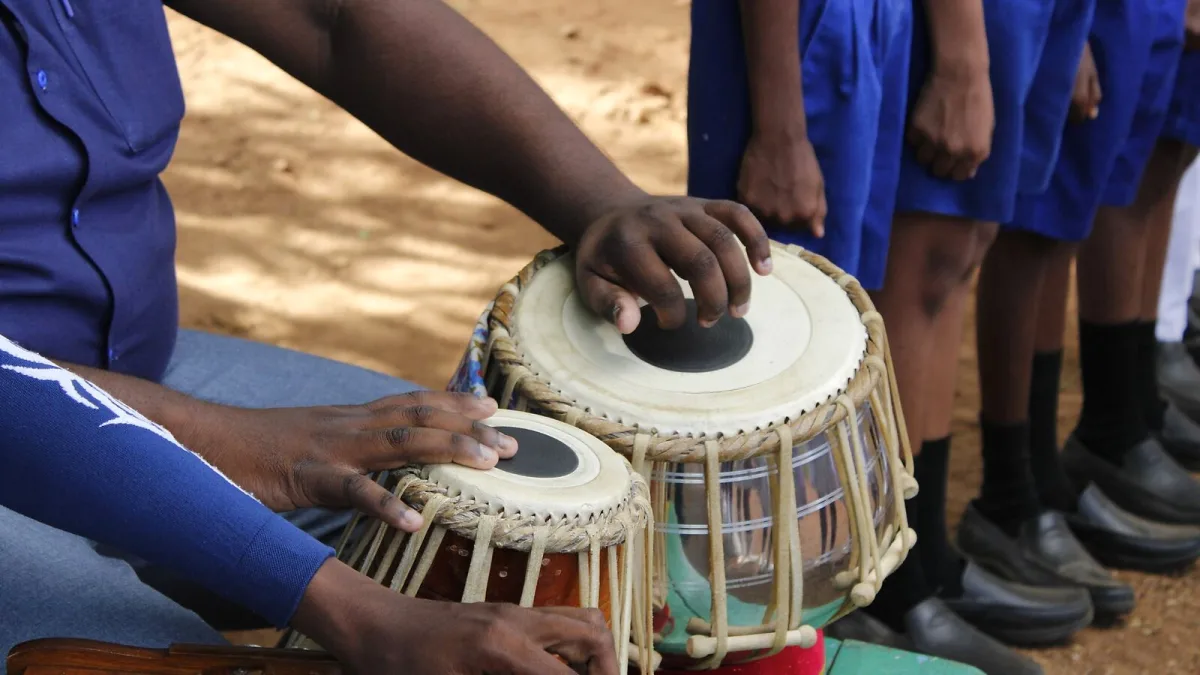
There's a moment, the first time you hear tabla drumming properly played, when you stop thinking of it as percussion and start hearing it as speech. That's not an accident. The whole tradition is built on spoken syllables turned into sound, and once you know that, the instrument stops being a mystery and starts being genuinely fascinating. Let's take it slowly.
Two drums, two very different jobs
A tabla is actually a pair of drums, not one. The smaller, right-hand drum is the dayan, tuned to a specific pitch and responsible for the bright, treble sounds. The larger left-hand drum, the bayan, supplies the bass — and unlike most drums, its pitch can be bent mid-stroke by pressing or sliding the heel of the hand across the head. Between them, the two drums cover a genuinely wide tonal range for something played entirely by hand.
The black patch that makes it all work
Look closely at either drumhead and you'll see a dark circular patch near the centre. That's the syahi — a layered tuning compound that adds mass to the membrane and gives the drum its stable, distinctly pitched tone. It's one of the more unusual pieces of acoustic engineering in any hand percussion instrument, and it's a large part of why the instrument can sound almost melodic rather than purely rhythmic.
Speaking before you play
Every stroke has a spoken syllable attached to it, called a bol — na, tin, tun, ta, ge, dha, dhin, and others. Students learn to recite these syllables aloud before they ever touch the drum, because the sound of the word and the sound of the stroke are meant to match closely. It's a genuinely elegant teaching method: you can practise the rhythm on a bus with your mouth long before you ever sit down at the instrument.
Rhythm cycles, not bars
Western music thinks in bars; Hindustani music thinks in cycles, called tala. A tala repeats a fixed number of beats with specific points of emphasis, and the tabla's job is to articulate a recognisable pattern within it, called the theka.
| Tala | Beats | Where you'll hear it |
|---|---|---|
| Teental | 16 | The most widely used classical cycle |
| Ektal | 12 | Vocal and instrumental classical repertoire |
| Jhaptal | 10 | Classical accompaniment and improvisation |
| Rupak | 7 | Vocal and instrumental performance |
| Keherwa | 8 | Light-classical, folk and popular music |
A living, argued-over history
The popular story says the tabla was invented when a 13th-century poet split a larger drum in two. It's a lovely story, and it's almost certainly a legend rather than documented fact. What's better established is that related tuned, paired drums existed across South Asia and Persia for centuries, with the tabla tradition most people would recognise today emerging in North India by around the 18th century. Several distinct schools, or gharanas — Delhi, Ajrada, Lucknow, Farrukhabad, Benares and Punjab — developed afterwards, each with its own phrasing and stroke preferences.
Where you'll actually hear it
Tabla drumming accompanies Hindustani vocal and instrumental performance, supports Kathak dance, and stands entirely on its own in solo recitals built from forms like peshkar, qaida and tihai. It's also travelled well beyond the classical stage — into film scores, fusion projects, jazz collaborations and electronic production, largely thanks to internationally prominent players who took the instrument into rooms it had never been heard in before.
Where to go from here
That's the shape of the whole tradition in outline. If you're thinking about actually learning, our beginner's guide to tabla drumming walks through the first real steps, and if you're ready to buy your first pair of drums, our complete buyer's guide covers what actually matters beyond the decorative finish.
The bottom line
Tabla drumming rewards patience more than almost any instrument I can think of — a spoken language, a tuned drumhead, and a rhythmic system built in cycles rather than bars. Once those three ideas click, everything else is simply depth.




Comments