


Sitar article
The Ultimate Guide to Sitar
There's far more to the sitar than its famous drone. A grounded guide to how India's great long-necked lute makes its sound, where it comes from, and how to start.
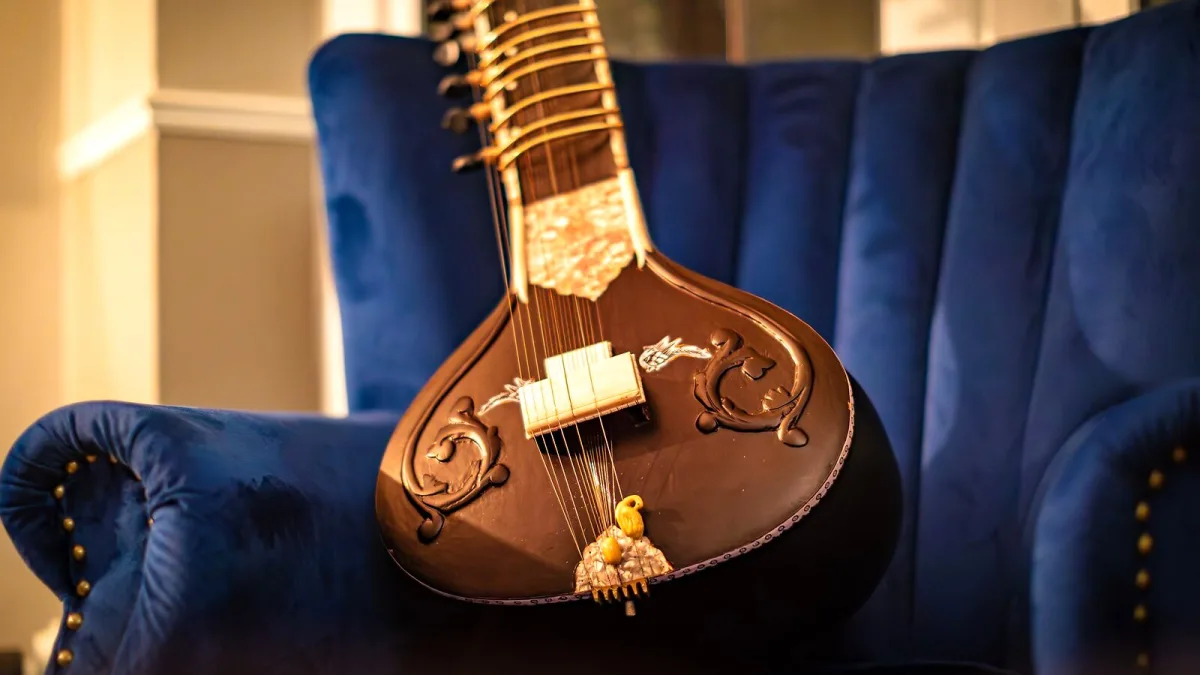
Few instruments announce themselves like the sitar. One shimmering, buzzing phrase and you are somewhere else entirely — which is exactly why it has fascinated listeners far beyond the North Indian classical tradition that raised it. But there is a great deal more to it than that famous drone, and it rewards anyone willing to understand where its voice comes from. Here is a grounded guide to the instrument, its sound and its roots.
What the sitar is
The sitar is a long-necked, fretted, plucked lute at the heart of Hindustani (North Indian) classical music. Its unmistakable sound comes from several parts working together: a main melody string, drone strings, a bank of sympathetic strings that ring on their own, curved movable frets, and a specially shaped bridge called the jawari. Most sitars carry around 18 to 20 strings in total, of which only six or seven are actually played; the rest are the sympathetic strings, or taraf, that hum in reply underneath.
A history worth respecting
You will often read that the 13th-century poet Amir Khusrau invented the sitar. It is a lovely story, but the documentary evidence does not bear it out — and the instrument deserves better than a tidy myth. The instrument we know took shape gradually, drawing on both Indian string traditions and Persianate long-necked lutes (the name is usually linked to the Persian setar, “three strings”), and reached something like its present form across the 18th and 19th centuries. By 1873 there was even a detailed Urdu manual, the Qanun-i-Sitar, covering how the instrument was built and played. In other words, this is a mature classical instrument with centuries of thought behind it, not an exotic novelty.
How it makes that sound
Three things give the instrument its character. First, the jawari — a broad, gently curved bridge surface that produces the instrument's signature shimmering buzz and long sustain. Second, those sympathetic strings, tuned to the notes of the piece, which vibrate in sympathy and wrap every phrase in resonance. Third, the way the left hand works: rather than simply pressing a string down as on a guitar, the player pulls it sideways across the curved fret to bend the pitch. That technique, meend, is the soul of sitar playing — a single fret can yield a glide of several semitones, closer to a singing voice than to a keyboard.
The right hand does the plucking with a mizrab, a wire plectrum worn on the index finger. It takes a while to wear one comfortably and strike a clean, even stroke — there is no shortcut, only patience.
The shape of a performance
A classical sitar recital is built on a raga — a melodic framework with its own notes, moods and rules — and it usually unfolds in stages:
- Alap — a slow, free exploration of the raga, with no fixed pulse.
- Jor — a pulse emerges, still without a strict rhythmic cycle.
- Gat — a composed piece set to a tala (rhythmic cycle), usually joined by tabla.
- Jhala — a fast, exhilarating finish that leans on the drone strings.
Not every performance follows this exactly — the raga, the school and the player all shape it — but knowing the arc makes listening far richer.
Two great schools
Two modern approaches tower over the rest. The Maihar tradition of Ravi Shankar is broad and instrumental, with strong bass and rhythmic development — and it was Shankar, through his concerts, his recordings and his friendship with George Harrison, who carried it to Western audiences at Monterey and Woodstock. The gayaki-ang of Ustad Vilayat Khan takes a different path, imitating the human singing voice with long, aching bends and lyrical phrasing, often on a slightly different six-string design. Listen to both, along with players such as Nikhil Banerjee and, more recently, Anoushka Shankar, and you will hear how much room the instrument holds.
Buying your first sitar
If the sound has got under your skin, resist the pretty tourist instruments hanging in gift shops — a decorative instrument is usually miserable to learn on. A plainer instrument from a reputable maker, properly set up, is the better buy every time. Look for:
- A straight, stable neck and secure, aligned frets.
- No cracks in the gourd (the tumba) or the soundboard.
- Tuning pegs that turn smoothly and hold.
- Sympathetic strings that respond clearly.
- A sound bridge and a well-shaped jawari.
- Somewhere local that can supply strings and do repairs.
Decide, too, whether you want a Ravi Shankar-style or Vilayat Khan-style instrument, as they differ in stringing and setup.
Tuning and care
There is no single “correct” tuning. It depends on your chosen tonic (Sa), the raga, the style and the instrument, so always use the exact chart supplied for your instrument rather than assuming they are all the same. Bring new strings up to pitch gently — the thin sympathetic strings snap easily — and expect a settling-in period of frequent retuning.
One firm warning: the jawari is delicate, specialist work. Its shaping controls the buzz, sustain and clarity, and filing it yourself can ruin the instrument. Leave it to an experienced sitar technician. Otherwise, keep it out of extremes of heat and damp, and transport it in a rigid, padded case that protects both the gourd and the long neck.
The bottom line
The sitar is not a sound effect — it is a deep, living classical instrument with a rich history and a technique all its own. Learn what the jawari, the sympathetic strings and meend are really doing, sit with a proper recording of Shankar or Vilayat Khan, and it stops being merely exotic and starts being what it truly is: one of the most expressive instruments ever made.




Comments