


Piano Accordion article
The Ultimate Guide to Piano Accordions
The piano accordion is one of the most complete self-contained instruments available. Here is a full account of how it works, what distinguishes different types and why it matters.
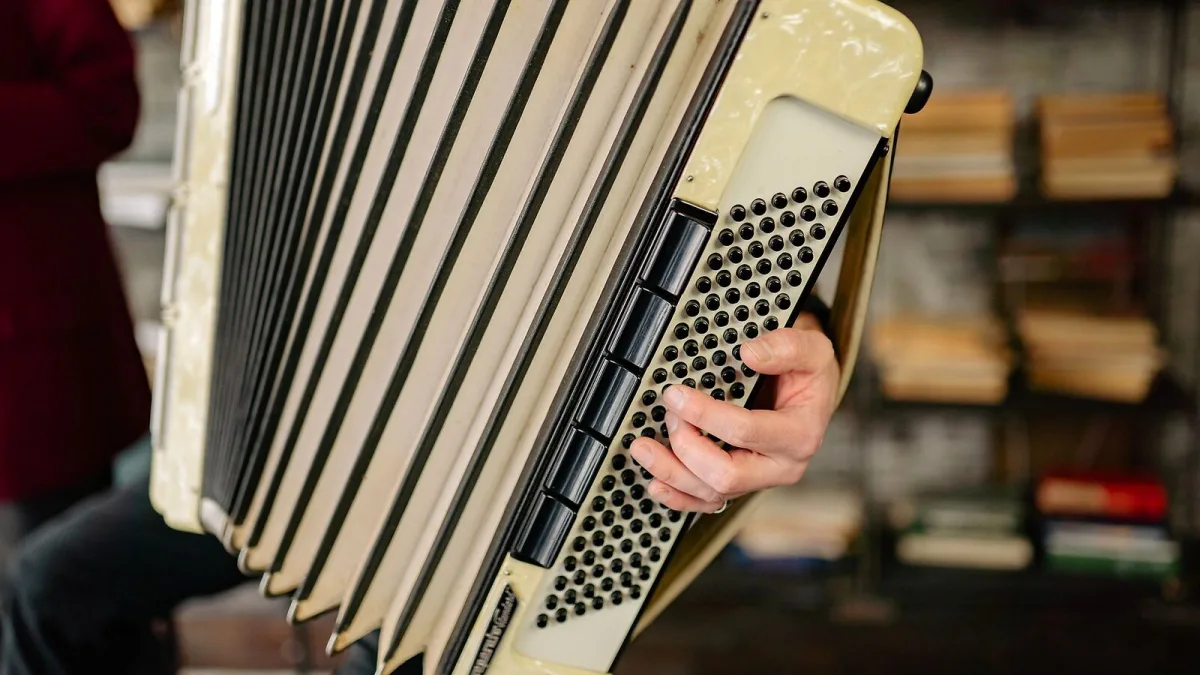
The piano accordion is one of the most complete self-contained instruments available to a musician. It carries its harmony, melody and bass in a single portable package, driven by a bellows the player controls with both arms. That combination of expressiveness, range and independence has made it central to dozens of musical traditions across Europe, the Americas and beyond.
How It Works
A piano accordion uses free reeds — shaped metal tongues, each tuned to a specific pitch — to produce sound. When the player moves the bellows, air flows through the reed blocks. The reeds vibrate at their fixed pitches, and the resulting sound passes through the instrument's chambers to the outside.
The treble keyboard on the right side operates valves that admit air to specific reeds. The left-hand bass buttons do the same for the bass and chord reeds on the left side. The bellows, held between the two, are the player's primary expressive tool: how fast they move, how consistently they sustain pressure and when they change direction shapes every aspect of the music's dynamics and phrasing.
Unlike a piano, where each key is a fixed hammer-and-string action, its keys operate air valves. The feel, key travel and spring tension vary considerably between instruments and manufacturers — these are worth evaluating directly, not assumed from appearance.
The Right Hand: Treble Keyboard and Registers
The right-hand keyboard is laid out identically to a piano keyboard, which is why musicians with piano experience often find the piano accordion's treble side immediately readable. Full-size instruments use 41 keys, covering a range adequate for most classical, folk and popular repertoire. Intermediate instruments typically have 37 keys; compact and student instruments fewer.
Register switches — usually a row of switches or buttons above the treble keyboard — select different reed combinations. Reeds are organised in ranks: the 8-foot rank is the fundamental pitch; the 4-foot rank sounds an octave higher; the 16-foot rank an octave lower. A tremolo register uses two reeds at the same fundamental pitch tuned slightly apart, creating a characteristic beating or pulsating quality sometimes called "musette" tuning. The available combinations depend on how many reed ranks the instrument contains.
The Left Hand: Bass Systems
The left-hand side of a piano accordion typically uses the Stradella bass system. This provides preset chord buttons arranged in a logical pattern: a row of fundamental bass notes, counter-bass notes, and further rows for major, minor, dominant-seventh and diminished-seventh chords. A player who understands the Stradella layout can produce complete harmonic accompaniment efficiently, which is why it has become standard for folk, dance, popular and much classical repertoire.
Free-bass systems replace or supplement the preset chords with individual chromatic notes, giving the left hand independent melodic and contrapuntal capability. This is particularly relevant for advanced classical playing. Some instruments incorporate both systems through a converter mechanism, allowing the player to switch between Stradella and free bass as the music demands.
Size and Weight
Piano accordions vary substantially in size and weight. A full 41-key, 120-bass accordion can weigh eight to twelve kilograms or more. This matters physically: the instrument is worn on both shoulders, held against the body and played standing or seated. A player who cannot comfortably sustain a rehearsal with a heavier instrument will play better on a lighter 72-bass model. The 72-bass layout accommodates a very wide repertoire, and the weight saving over a 120-bass instrument is significant.
For students and players returning to the instrument after a long break, starting with a manageable size is a practical rather than a musical compromise.
Acoustic versus Digital
Acoustic piano accordions produce sound through physical reed vibration and cannot be silenced for late-night practice. Digital instruments — Roland's V-Accordion is the best-known range — use modelled or sampled sounds and allow headphone use, MIDI connection and programmable voicings. They are practical solutions for players with noise restrictions, recording needs or preferences for electronic versatility.
Digital instruments do not replicate every physical characteristic of an acoustic reed instrument, and many players with strong roots in folk, tango or classical repertoire prefer the acoustic response. The choice depends on practical circumstances as much as tonal preference.
History and Cultural Range
The accordion emerged in early 19th-century Europe — Cyrill Demian's 1829 Viennese patent is one commonly cited milestone — through several instrument makers working on free-reed designs. The instrument specifically, in its standardised black-and-white treble keyboard form, became widely adopted in American popular music from the 1920s through the mid-20th century, driven by vaudeville, television and accordion-based bands.
Today the instrument is active in French musette, Argentine and Finnish tango, Italian folk traditions, Scandinavian folk music, zydeco, Cajun, polka, Irish and Scottish ceildh music, classical concert performance and contemporary popular recording. Few instruments of its size span that range.
For practical guidance on buying, see the complete buyer's guide. Specific model recommendations appear in the best piano accordions for the money. Players just starting out will find the beginner's guide a more appropriate first read.





Comments