

Nose Flute article
Nose Flute: A Complete Guide
The nose flute is older, more musical, and more widespread than most people realise — this complete guide covers its history, mechanics, and the forms you can play today.
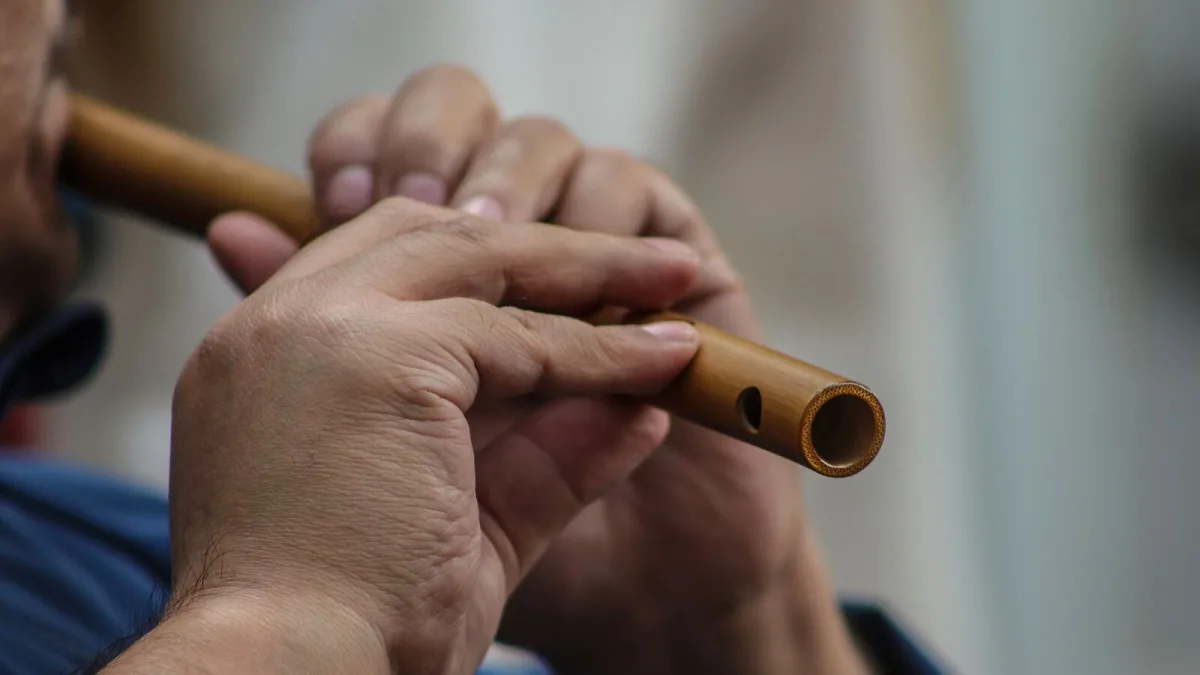
The nose flute is one of those instruments that makes people do a double take — and then, almost invariably, ask for a go. It is small, inexpensive, and surprisingly expressive, yet most people in the UK have never heard one played well. This complete guide covers what it actually is, how it works, its global history, the types available today, and why it might deserve a place in your life.
What Is a Nose Flute?
A nose flute is a wind instrument played by directing a stream of air from one nostril through a shaped cup that fits over the nose and mouth. The player's mouth acts as the resonating chamber: by changing the shape of the oral cavity — much as a vocalist moves through vowel sounds — the player controls pitch and tone. No reeds, no keys, no valves. The instrument itself is essentially a precisely shaped conduit; the music comes from you.
Because pitch is produced by the player's body rather than by the instrument's physical length or holes, it is theoretically capable of an enormous range. In practice, skilled players can cover well over two octaves with clean intonation, producing a tone that is breathy, intimate, and strikingly human in character.
A Brief History
It is one of the oldest wind instruments known to archaeologists, and it appears independently across a remarkable number of cultures. In Polynesia — particularly in the islands of Hawaii, Tahiti, and the Philippines — these flutes were ceremonial and social instruments long before European contact. The Tahitian vivo and the Filipino bangsi are among the most documented traditional forms, typically carved from bamboo, with a single notch to direct the breath.
Across parts of sub-Saharan Africa, South America, and South-East Asia, analogous instruments evolved separately, all based on the same acoustic principle. The association with the nose in many Pacific cultures carries a deeper meaning: the nose breath was considered purer and more sacred than mouth breath, giving the instrument a spiritual dimension that mouth flutes did not share.
In the West, this unusual wind instrument arrived largely as a novelty in the nineteenth and early twentieth centuries. Toy manufacturers produced tin versions, and vaudeville performers used them for comic effect. That novelty reputation has lingered, but it does the instrument a disservice — in the hands of a practised player, it is genuinely musical.
How a Nose Flute Works
The mechanics are elegantly simple. The cup seals lightly over the nose and the upper lip, leaving the mouth open below. The player exhales gently through the nose; the cup channels that air stream downward into the open mouth cavity. There is no mouthpiece in the traditional sense — the lips, teeth, tongue and cheeks form the resonating space.
Pitch rises when the player narrows the oral cavity (as if saying "ee") and drops when it opens (as if saying "oh" or "aw"). Dynamics are controlled by breath pressure — but unlike a recorder or whistle, it is relatively easy to overblow and produce a thin, reedy squeak, which is why breath control is the central skill to master early on.
Available Types
Modern designs fall into a few distinct camps:
- Plastic moulded — the most common type sold today, typically made from food-grade plastic. Lightweight, washable, and cheap. Brands such as the Bocarina (designed by Australian inventor Steve Mann) have developed ergonomic shapes that improve seal and comfort.
- Tin or stamped metal — the classic Western novelty form, still available from specialist suppliers. Durable but less comfortable for long sessions.
- Traditional bamboo or wood — generally from South-East Asia or the Pacific. These are often decorative as well as playable, and vary considerably in cup geometry.
- Clay or ceramic — handcrafted versions that can be beautifully made; less common and more fragile.
The Bocarina in particular has attracted a community of dedicated players precisely because its design is optimised for actual playing rather than novelty. If you are serious about learning, it is one of the most recommended starting points.
In Contemporary Music
It occupies a curious position in contemporary music. A fixture of world music ensembles that draw on Pacific or Filipino traditions, it has also attracted interest in experimental and avant-garde circles — its unusual tone colour, somewhere between a human voice and a gentle flute, draws composers looking for intimacy and peculiarity in equal measure. A handful of YouTube performers have amassed substantial audiences by playing recognisable melodies on it with genuine skill and expressiveness.
In folk and acoustic settings, it slots in naturally alongside other small wind instruments — the tin whistle, the ocarina, the penny flute. Volume is modest, but in a quiet circle or a recording context it holds its own remarkably well.
Is It Difficult to Learn?
Getting a first sound takes most people about five minutes. Getting a good sound — consistent tone, clean pitch changes, some dynamic variation — takes rather longer, but the learning curve is genuinely friendly compared to most wind instruments. There is no embouchure to build up in the traditional sense, no fingering to memorise, and no reeds to crack or replace.
The main challenges are breath control (avoiding overblowing), learning to shape the oral cavity precisely, and building the muscle memory to slide smoothly between pitches. Players with a background in singing often find the transition easier, because they already understand how the mouth shapes affect resonance.
If you want to get started, our beginner's guide walks through the very first steps, and our setup and technique guide covers the finer points of positioning and breath control. When you are ready to choose an instrument, the buyer's guide is worth reading before you spend any money.
Bottom Line
The nose flute is a genuinely ancient, cross-cultural instrument that has been unfairly boxed in as a joke by its Western novelty history. It is accessible, expressive, deeply portable, and — at its best — capable of producing music that surprises anyone who assumed it was only good for a laugh. Whether you come to it from world music, folk, experimental performance, or sheer curiosity, it rewards the time you put in.






Comments