


Hang Music Instrument article
The Ultimate Guide to Hang Music Instrument
The Hang was one Swiss company's own instrument; the handpan is the whole family it inspired. Here's the real history and how it actually works.

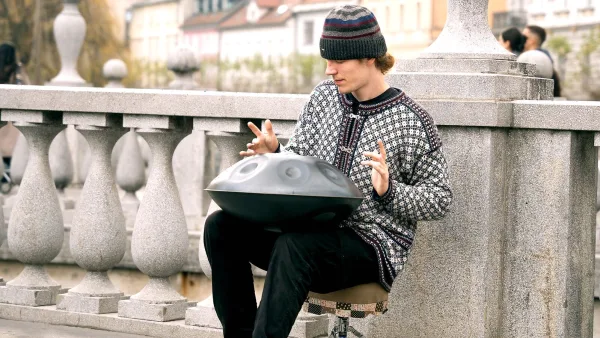
There's a particular sound that stops people in a park or a busy street — a warm, bell-like ring rising from something that looks like two flying saucers pressed together on someone's lap. That's the handpan, and its story starts with one specific instrument, the Hang, made in Switzerland at the turn of the millennium. This guide untangles the history, the terminology and how the thing actually works.
Where It All Began
The Hang was created around the year 2000 in Bern, Switzerland, by Felix Rohner and Sabina Schärer of PANArt, and shown publicly for the first time at the Frankfurt Musikmesse in March 2001. Their earlier work had been with the Trinidadian steelpan, which reached Bern in the 1970s, and that background shaped the Hang's tuned metal surface. The Indian ghatam — a clay pot played with the hands — is often cited as a second influence, particularly the idea of a resonant vessel you play directly with your fingers rather than a stick or mallet. Percussionist Reto Weber is widely credited with encouraging Rohner and Schärer toward an instrument playable this way, though the precise details of that early collaboration aren't fully documented.
Hang, Handpan or Hang Drum — Does It Matter?
It matters more than most casual listeners realise. "Hang" is PANArt's own instrument and its own name — the company has been explicit that it does not consider later, similarly shaped instruments from other makers to be Hangs. "Handpan" became the general term the wider community settled on for that whole family of related instruments. "Hang drum" is the phrase most people reach for instinctively, and it's technically inaccurate, since the instrument isn't a membranophone in the way a conventional drum is — there's no skin, just shaped and tuned steel. PANArt itself stopped making the original Hang around 2013, so any Hang in circulation today is a legacy instrument, while modern handpans are built by a decentralised community of independent makers.
How the Shape Makes the Sound
A Hang or handpan is built from two metal shells joined around a central rim. The top holds a central note — commonly called the Ding — surrounded by a ring of tuned tone fields, while the bottom shell has an opening, the Gu, that shapes the instrument's bass resonance. Striking a tone field produces a fundamental pitch along with an octave-related partial and further overtones, which is where that distinctive bell-like shimmer comes from. Nothing about the sound depends on a struck skin or a struck string — it's entirely the shaped, tensioned steel doing the work.
Scales, Not a Full Keyboard
Almost every handpan, Hang included, is tuned to a single scale rather than laid out chromatically like a piano. D minor variants are common, alongside pentatonic scales and various Celtic-inspired modes. That constraint is deliberate and rather lovely in practice: because every note belongs to the same scale, it's genuinely hard to strike something that clashes, which is a large part of why the instrument feels so immediately inviting to newcomers. The trade-off is that a given instrument is locked to its scale — you choose the mood you want before you buy, not after.
Playing Technique, Briefly
| Technique | What it does |
|---|---|
| Fingertip strikes | Light, articulate attacks on individual tone fields |
| Thumb strikes | Softer, lower-emphasis notes |
| Edge and shoulder strikes | Contrasting, more percussive timbres |
| Muting | Damping a tone field with the fingers or palm to shape sustain |
| Gu control | Using the bottom opening for bass resonance and rhythmic bumps |
The instrument rewards a light touch. Hitting it too hard doesn't make it louder in any useful sense — it just risks a harsh attack, or over time, detuning the steel.
Living With One
Keep a handpan dry, out of direct sunlight and away from a hot car, and store it in a fitted case when it's not in use. Avoid striking it with anything hard, and leave tuning or repair work to an experienced builder rather than attempting it yourself. Because scarcity around original PANArt Hangs has created a genuine collectors' market, anyone considering a used instrument should verify its maker and history carefully before assuming it's the real thing.
Amplifying and Recording a Handpan
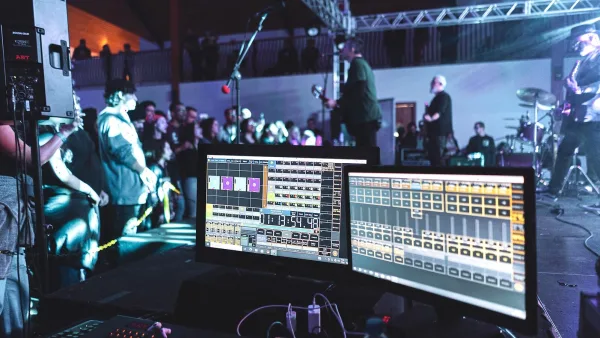
In a quiet room, a handpan carries perfectly well on its own, but ensembles and outdoor performances usually need a microphone. Placement changes the character quite a bit: a mic close to the Gu opening exaggerates the bass, while one aimed at the tone fields captures more of the fingertip articulation. Because handpans vary so much between makers, there's no single correct position — a small-diaphragm condenser for detail, a dynamic mic for louder settings, or a stereo pair for spatial resonance are all worth trying. Go easy on compression too; squash the dynamics too far and you lose exactly the touch-sensitivity that makes the instrument worth recording in the first place.
The Bottom Line
The Hang started as one Swiss company's very specific instrument; the handpan is the whole family it inspired. Both work the same way — tuned steel, played by hand, built around a single scale — and both reward patience over force. If you're thinking of buying one, our complete buyer's guide covers what to check, and our round-up of options by budget is worth reading too. New to playing? See our beginner's guide, and it's worth a look at our list of common mistakes to avoid before you buy or play.



Comments