

Glockenspiel article
Glockenspiel for Beginners: A Complete Guide
The glockenspiel is accessible to beginners from the first session. Here's what to buy, how to start and the order to learn in.
The glockenspiel is one of the more accessible instruments to begin on. The layout mirrors a piano keyboard, so note relationships are immediately visible, and producing a sound requires only striking a bar with a mallet. That said, there's a defined technique to learn and a specific order of study that makes progress faster.
Starting Equipment
You'll need:
- A student glockenspiel with at least two octaves (the Yamaha GL1 is the standard beginner recommendation)
- A pair of hard plastic or brass mallets (often included with the instrument, though aftermarket mallets usually sound better)
- A stand or flat table to place the instrument on
- Basic music notation resources if you want to read sheet music from the start
Holding the Mallets
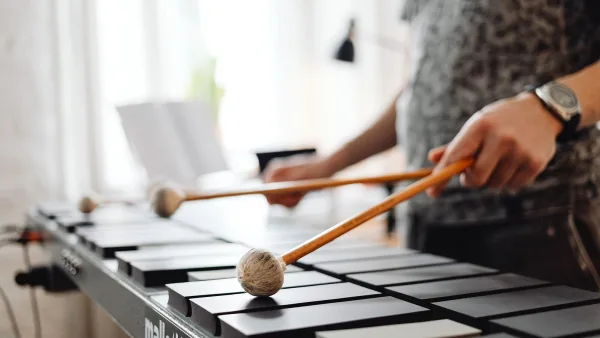
Hold each mallet between the thumb and forefinger, letting the others curl loosely around the handle. The mallet should feel balanced, not gripped tightly. Strike each bar with a slight downward flick of the wrist, allowing the mallet to bounce off immediately after contact — this is what allows the bar to vibrate and ring. Holding the mallet against the bar after striking damps the sound.
Getting Your Bearings
The layout of a glockenspiel is identical to a piano keyboard: the natural notes (C, D, E, F, G, A, B) are on the bottom row; the accidentals (sharps and flats) are on the raised second row. If you can find middle C on a piano, you can find it on the instrument too, just scaled differently. Spend your first session simply playing scales — C major first, then G major and F major — and listening carefully to the tone each bar produces when struck in different positions along its length.
Learning to Read Music
The glockenspiel is a pitched instrument, so learning to read treble clef notation is worthwhile early. Note that written pitch sounds two octaves higher in performance — a convention you'll need to understand if you use orchestral sheet music. Many beginners start with letter-named or numbered bar notation and move to standard notation once the note names are learned.
First Pieces to Learn
Simple pentatonic melodies work well to start: "Happy Birthday", "Mary Had a Little Lamb" and "Twinkle Twinkle Little Star" are accessible and help establish independent hand coordination. Progress to pieces using all seven natural notes before introducing accidentals. Most glockenspiel method books follow this sequence.
For buying guidance on first instruments and accessories, the glockenspiel buyer's guide covers the decision clearly.



Comments