


Frame Drum article
Frame Drum for Beginners: A Complete Guide
The frame drum rewards slow, deliberate practice from the first session — three clean tones and basic pattern work are achievable quickly; the depth that follows takes a lifetime.
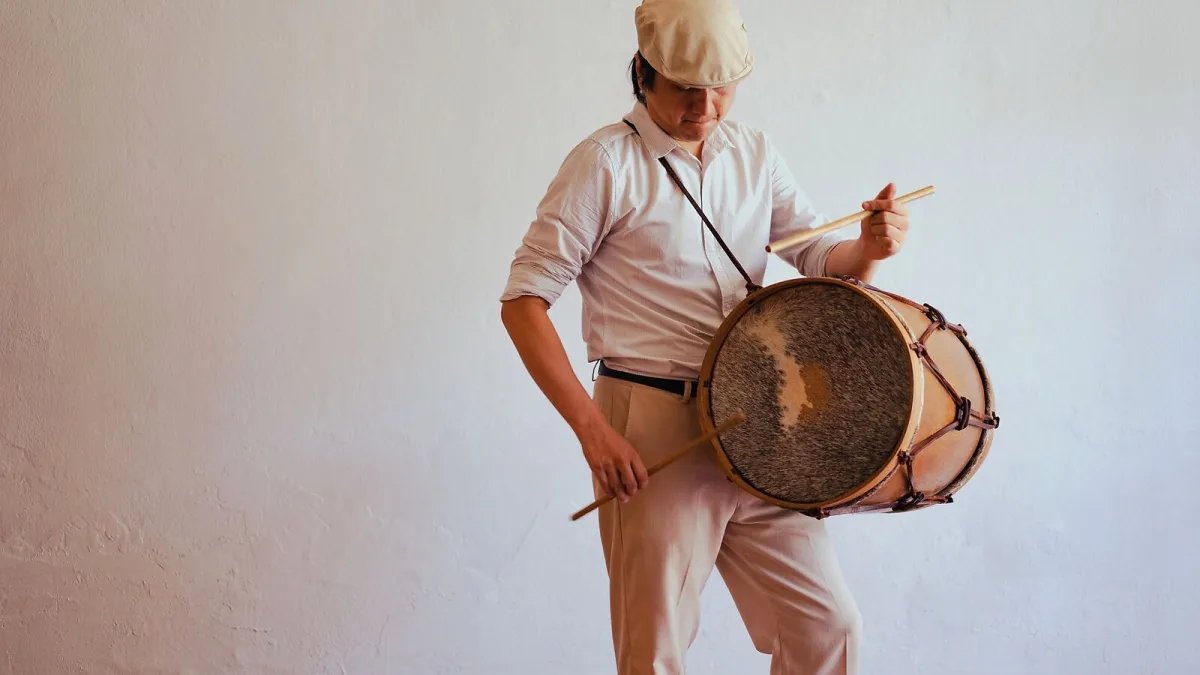
The frame drum is one of those instruments that seems accessible — it has no strings to tune, no keys, no mechanical complexity — and it is accessible, but in a specific way. The physical approach to the instrument is simple; the depth of what you can do with it is not. This guide is for the beginner who wants to understand what they are working with, how to get their first useful sounds, and what direction to take early practice.
What You Are Producing (Physically)
When you strike a frame drum head, you set the membrane vibrating at its natural resonant frequency — a pitch determined by the diameter of the drum and the tension of the head. Tighter head tension raises the pitch; a larger diameter drum has a lower fundamental. Unlike a tom or a snare drum, the frame drum does not have a deep resonating chamber beneath the head — the resonance is almost entirely in the head and the ring of the frame itself. This is why frame drum technique is so focused on hand position and tone production: the instrument responds directly to exactly what your hands do.
Your First Three Tones
Most frame drum traditions organise their rhythmic vocabulary around a small set of fundamental tones. Getting these tones clean and consistent before attempting complex rhythms is the right approach — it mirrors how traditional players learn within their musical communities.
- Open tone — played near the edge of the head with relaxed fingertips. The hand rebounds immediately after contact, allowing the head to ring freely. This is typically the highest and most resonant tone.
- Bass tone — played near the centre of the head with the pad of the fingers or palm. Produces a lower, fuller sound. In Arabic and Persian traditions this is often called the "doum" tone.
- Muted/slap tone — struck and immediately dampened. Produces a short, dry accent. Used to create rhythmic articulation and syncopation. In Arabic notation this is often the "tak" or "ka" sound depending on which hand produces it.
Developing Consistent Technique
The most important early goal is making each tone sound the same every time. Inconsistency — a slightly different angle of the hand, a slightly different point of contact — is audible on a frame drum in a way it might not be on a heavily processed electric instrument. Slow, focused repetition is the most effective tool available: play a single tone continuously at a tempo where you can control every stroke, then gradually increase the tempo as consistency improves.
Avoid the common beginner trap of practising at a speed where the tones are not clean. Fast, messy practice reinforces bad habits faster than slow, clean practice builds good ones.
Your First Rhythmic Pattern
Once you can produce two clean, distinct tones reliably, introduce a simple two-element pattern — open tone / bass tone in alternation. This mirrors the basic rhythmic cells used in many frame drum traditions. Start at a slow tempo and count carefully. The goal at this stage is rhythmic evenness (every beat the same duration) rather than speed.
A useful exercise: record a short loop of yourself playing and listen back. It is much easier to hear timing and tonal inconsistency on a recording than to notice it while you are playing. This kind of feedback loop accelerates progress considerably.
What to Expect Over Time
Within the first month of regular practice (twenty to thirty minutes daily), a beginner can expect to have three clean, distinct tones and a few simple rhythmic patterns under control. Within three to six months, comfortable facility with more complex patterns, better dynamic control and the beginnings of musical phrasing. The deeper you get into a specific tradition — Irish, Arabic, Persian, Brazilian — the more the technique branches and specialises. Each tradition has its own refinements and its own repertoire, and that depth is part of what makes this a lifelong instrument.
The setup guide walks through grip, posture and tone production step by step. For an overview of the broader instrument family and its traditions, the complete guide is a useful companion.





Comments