


Punk Music article
The History of Punk Music
Punk didn't come from nowhere and didn't stop with the Sex Pistols. This history traces the full arc from The Stooges and CBGB through hardcore, post-punk and 90s pop-punk to today.
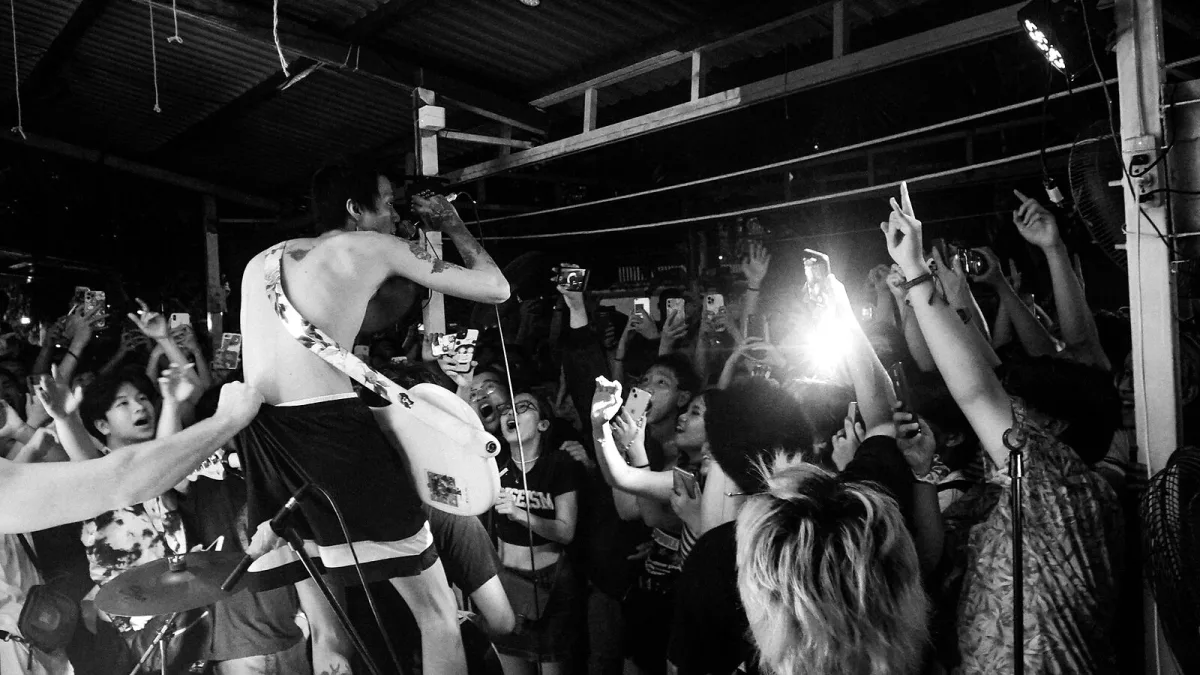
The history of punk music isn’t a neat timeline with one starting point and a clear finish — it’s more like a fire that spread across several cities at once and kept finding new material to burn through. But there’s a shape to it, and knowing that shape makes everything else easier to follow.
Before Punk: The Sound That Made It Possible
In the early 1970s, rock had become enormous and overproduced. Stadium tours, concept albums, virtuoso solos. Some musicians were already pushing against that. In Detroit, The Stooges and MC5 were playing raw, aggressive, high-volume rock that nobody else was making. In New York, the New York Dolls brought glam theatricality to primitive rock ’n’ roll. In the Velvet Underground’s shadow, a downtown New York scene was developing that valued directness and attitude over technical polish. These weren’t a movement at the time — in retrospect, they became “proto-punk.”
New York, 1974–77
The downtown New York scene cohered around CBGB, a small club on the Bowery that opened in December 1973. By 1974–75, the Ramones, Television, Patti Smith, Blondie and Talking Heads were all playing there. They were very different from each other — the Ramones were direct and fast, Television were exploratory and guitar-obsessed, Patti Smith combined rock with poetry, Talking Heads were rhythmically innovative and art-oriented. What connected them was a rejection of mainstream scale and a willingness to perform in small, sweaty venues.
The Ramones’ debut album, released in April 1976, distilled this approach into something essentially new: 14 songs in 29 minutes, power chords, fast eighth-note strumming, repeated hooks. It became one of the templates punk built itself on.
The British Explosion, 1976–77
British punk music had its own social context. High unemployment, industrial decline, class resentment. The Sex Pistols, managed by Malcolm McLaren, became a media story as much as a musical one. Their interview with Bill Grundy on ITV in December 1976 put punk on the front pages. The Clash were more expansive — politically explicit, musically curious, incorporating reggae, rockabilly and soul from the start. The Damned played faster than any of them. The Buzzcocks wrote short, melodic songs about desire and romantic anxiety.
The UK scene also established punk’s visual culture: spiky hair, ripped clothing, safety pins, provocative graphics. And it built an independent infrastructure — Stiff Records, Rough Trade, small pressing plants, fanzines — that influenced independent music for decades.
Hardcore and American Scenes, 1979–85
As the initial British punk wave wound down, American musicians intensified it. Hardcore punk music emerged in scenes across the United States around 1979–81: faster tempos, shorter songs, more aggressive performance, tighter connection between band and local audience. The key scenes were Washington D.C. (Minor Threat, Bad Brains, Fugazi), Los Angeles (Black Flag, Circle Jerks, X, Fear) and New York (Cro-Mags, Agnostic Front). Dischord Records and SST Records developed as independent labels central to each scene respectively.
Bad Brains combined hardcore speed with reggae and demonstrated what was possible technically within punk’s accelerated framework. Minor Threat’s Ian MacKaye developed the straight-edge movement around a commitment to sobriety and non-violence within the hardcore community.
Divergence: Post-Punk and Anarcho-Punk
Some artists took punk’s energy toward experiment and complexity. Joy Division, Wire, Gang of Four, Siouxsie and the Banshees and Public Image Ltd moved into post-punk — using dub, funk, electronics, unusual structures and darker emotional territory. Crass and Conflict developed anarcho-punk, a form of explicitly political hardcore rooted in pacifism and anti-authoritarianism, with self-released, cheaply priced records.
The 1990s Revival and Pop-Punk
Green Day’s Dookie in 1994 introduced a new generation to accessible, melodic punk. The Offspring, Rancid, NOFX, Bad Religion and later Blink-182 built a mainstream American pop-punk tradition. The 1990s also saw ska-punk, with bands like Rancid and No Doubt combining punk with Jamaican ska and reggae rhythms. By the late 1990s and early 2000s, pop-punk had become a genuinely commercial genre.
Punk Since 2000
Punk has continued to evolve without a single dominant story. Post-hardcore, emo, folk punk, queercore and numerous regional underground scenes have developed punk’s methods in different directions. The infrastructure punk built — independent labels, self-booked tours, small-venue culture — remains the foundation of independent music broadly. The genre’s continuing significance is less about any fixed sound than about an accessible way of participating in music on your own terms.
For who to listen to across these periods, see our best punk music artists and essential punk music albums. A broader overview is in our beginner’s guide.




Comments