


Shoegaze article
The History of Shoegaze
A sound built from at least four earlier traditions, named as an insult, and granted barely half a decade in the spotlight before quietly outliving everything that displaced it.
Every genre has an origin story, but few are quite as tangled as shoegaze's: a sound assembled from at least four earlier traditions, given a name its own musicians resented, granted barely half a decade in the spotlight, and then quietly outliving almost everything that displaced it. Tracing the history of shoegaze says as much about how music criticism shapes a scene as it does about the records themselves.
Borrowed materials, before the genre had a name
Nothing in music arrives from nowhere, and this particular sound is a clear case study in accumulation. Phil Spector's "Wall of Sound" productions had already proven, decades earlier, that dozens of layered parts could merge into a single overwhelming sonic image. The Jesus and Mary Chain's 1985 album Psychocandy demonstrated something more specific: that genuinely sweet, hook-laden melodies could survive being wrapped in extreme feedback and distortion, rather than being drowned by it. And the Cocteau Twins, though usually filed separately under dream pop, supplied a third crucial ingredient — Elizabeth Fraser's expressive, often unintelligible vocals and Robin Guthrie's heavily processed, atmospheric guitar work.
Add a post-punk interest in texture over technical display, and a punk-inherited sense of physical loudness, and the raw materials were all sitting in late-1980s Britain, waiting for a scene to assemble them.
A shoegaze scene forms around Creation Records
That assembly happened, largely, around the London label Creation Records, which released landmark work from My Bloody Valentine, Ride and Slowdive. My Bloody Valentine's early records, particularly 1988's Isn't Anything, began pushing guitar distortion toward something closer to an environment than a riff. Ride and Slowdive followed with their own, distinct takes — Ride generally more riff-driven and structurally conventional, Slowdive edging closer to the atmospheric spaciousness of dream pop.
A name nobody particularly wanted
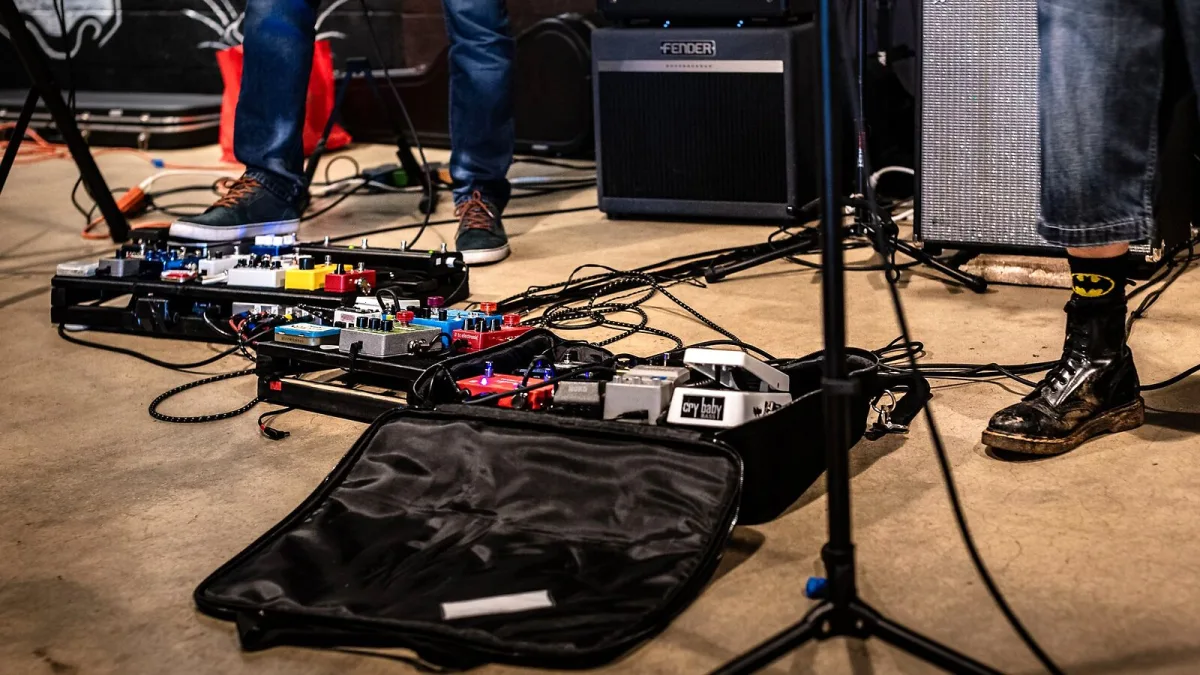
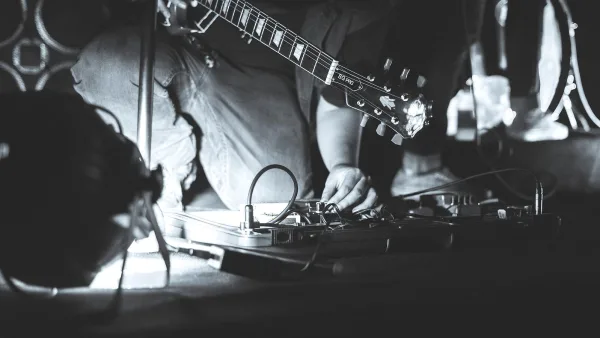
It's worth pausing on how shoegaze actually got its name, because the story reveals a certain amount of critical hostility. British music journalists in the early 1990s used the word dismissively, mocking performers who appeared to stare down at their effects pedals rather than engage a crowd with conventional rock-star showmanship. Accounts differ on exactly which writer coined it first, and the label was, for years, something bands endured rather than embraced. Only with time did the term lose its sting and become simply descriptive.
When shoegaze peaked: 1990 to 1993
The genre's commercial and critical high point arrived in a remarkably tight window. Ride's Nowhere landed in 1990; Chapterhouse's Whirlpool and My Bloody Valentine's landmark Loveless both appeared in 1991; Catherine Wheel's Ferment and Lush's Spooky followed in 1992; Slowdive's Souvlaki closed out the era in 1993. Loveless in particular is widely treated as the moment shoegaze found its defining statement, though that's a critical judgment rather than an uncontested fact — plenty of listeners would make an equally strong case for Souvlaki or Spooky.
| Year | Album | Artist |
|---|---|---|
| 1990 | Nowhere | Ride |
| 1991 | Loveless | My Bloody Valentine |
| 1991 | Whirlpool | Chapterhouse |
| 1992 | Ferment | Catherine Wheel |
| 1992 | Spooky | Lush |
| 1993 | Souvlaki | Slowdive |
A remarkably short reign
What's striking, looking back, is quite how briefly shoegaze held critical favour. By the mid-1990s, Britpop's guitar-pop revivalism and American grunge had both moved into the space British music journalism had carved out for this earlier sound, and much of the original scene found itself unfashionable almost overnight. Some bands split; others simply kept working with far less press attention than they'd had a few years before.
The quiet second life of shoegaze
What didn't happen was disappearance. Through the 2000s and 2010s, a new generation of artists began folding these same textures — the fuzz, the reverb, the buried vocals — into other genres entirely. Alcest and Deafheaven merged it with black metal. Nothing, Whirr, Have a Nice Life and Title Fight carried its guitar-wall approach into noise rock and post-hardcore territory. Loosely grouped under the term "nu-gaze," this newer wave doesn't always sound much like classic shoegaze at all, but the lineage back to it is unmistakable.
Keep exploring the story
If you want the fuller picture of what actually makes the sound work, our beginner's guide breaks down the genre's core techniques, and our profiles of the artists who defined it go deeper into the bands mentioned here. For the records themselves, our guide to essential albums and our look at its many modern subgenres both pick up threads this history only has room to gesture at.
The bottom line
The history of shoegaze is defined as much by timing and critical circumstance as by any fixed musical formula: a handful of influences colliding in one place, a short but extraordinarily fertile creative window, a hostile nickname that outlasted the hostility, and a second life built by musicians who weren't even part of the original story. Few scenes get to be reduced, dismissed and then rediscovered quite so completely.





Comments