


Future House article
A Beginner's Guide to Future House
A step-by-step introduction to future house: the beat, the bass, the origins, and how it differs from the styles sitting right next to it.

Let's build this up properly, one piece at a time, the way you'd learn any new subject. Future house has a reputation for being hard to pin down, but once you know what to listen for, you'll spot the sound within seconds. Here's the complete picture, step by step.
Step One: What It Actually Is
Future house is a 2010s electronic house style built around a four-to-the-floor beat — meaning the kick drum lands on every single beat, four times a bar — combined with a highly processed, melodic bassline that behaves more like a lead instrument than a typical low-end part. It developed in the UK and wider European dance scene during the early 2010s, becoming widely recognised as its own genre by around 2015–2016.
The name itself is a little misleading, so let's clear it up early: it isn't named after any specific futuristic technology or production method. It simply describes an updated, heavily designed form of house music, where familiar dance-floor structures get paired with unusual bass timbres and modern digital processing.
Step Two: Where It Came From
Rather than appearing from nowhere, it formed where several existing styles overlapped:
- Deep house supplied warmer chords and a groove-focused feel.
- UK garage contributed swing, syncopation and its distinctive plucked-bass vocabulary.
- Electro house and big-room EDM added louder, more aggressive drops built for festival stages.
- Fidget house brought rhythmic, heavily modulated bass movement.
Producers Tchami, Oliver Heldens and Don Diablo are the three names most closely tied to the genre's rise, though exactly who "invented" it remains genuinely disputed — genre labels rarely have one clean origin point. Tchami is generally credited with popularising the term itself, initially using it more as an open-ended description than a strict category; Oliver Heldens helped carry a closely related sound to a much wider audience soon after.
Step Three: The Sound That Defines It
If you remember nothing else, remember this: in future house, the bass is usually the main event, not the kick or the melody on top. Producers describe the sound in all sorts of ways — "metallic," "elastic," "rubbery," "plucked," even "talking" — because the bassline is deliberately built to have a clear, singable rhythm and pitch movement, almost like a vocal phrase.
| Element | Typical approach |
|---|---|
| Tempo | Around 124–128 BPM (roughly 120–130 BPM overall) |
| Kick pattern | Four-on-the-floor, straight and steady |
| Bass | Melodic, heavily processed, rhythmically prominent |
| Arrangement | Sparse breakdown contrasted with an energetic, bass-led drop |
Step Four: How It Differs From Its Neighbours
This genre sits close to several other styles, which is exactly why it can be confusing at first. Deep house is generally calmer and less drop-focused. Big-room house leans on scale rather than syncopation. UK garage keeps the same swing but drops the straight four-to-the-floor kick. Bass house tends to be darker and rougher. Tropical house shares an accessible, polished feel but leans on melody over bass-led drops. None of these boundaries are strict — plenty of tracks genuinely sit across two categories at once, and platforms don't always agree on where to file a given release.
| Neighbouring genre | What it shares | Main difference |
|---|---|---|
| Deep house | Warm chords, house groove | Usually calmer, less drop-focused |
| Big-room house | Large drops, festival energy | Less syncopated, less melodic bass writing |
| UK garage | Swing and syncopation | Drops the straight four-to-the-floor kick |
| Bass house | Heavy bass-led drops | Generally darker and rougher |
A Quick Word on How It's Made
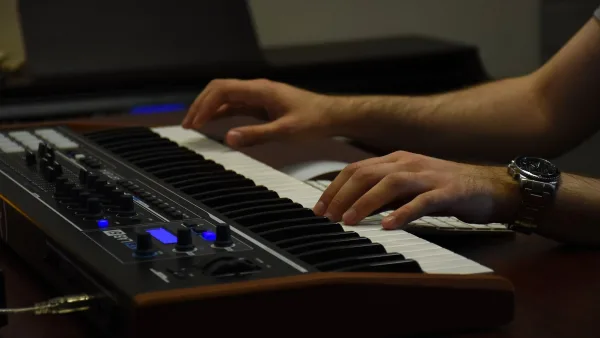
You don't need to be a producer to appreciate this, but it helps to know the basic ingredients: a subtractive or wavetable synthesiser for that distinctive bass, sidechain compression to duck the bass whenever the kick hits, and careful arrangement that alternates a sparse breakdown with a bass-driven drop. None of this needs exotic gear — the techniques can be recreated in any modern DAW, from Ableton Live to FL Studio, which is part of why the style spread so quickly through SoundCloud in its early years.
Step Five: Putting It Into Practice
Now that you understand the theory, the fastest way to make it click is to actually listen with these ideas in mind. Our newcomer's listening guide gives you a practical starting sequence, and our piece on the artists worth knowing puts names to everything you've just learned.
A Quick Recap
Future house: a four-to-the-floor house style with a melodic, heavily processed bass doing most of the work, born from deep house, UK garage and electro house colliding in the early 2010s. Hold onto that one sentence, and every future house track you hear from here on will make a lot more sense.



Comments