


Kids Guitar article
Kids Guitar for Beginners: A Complete Guide
Half of every early struggle on a kids guitar is the instrument's fault, not the player's. Here's a proper first-weeks plan, buzzy chords and all.
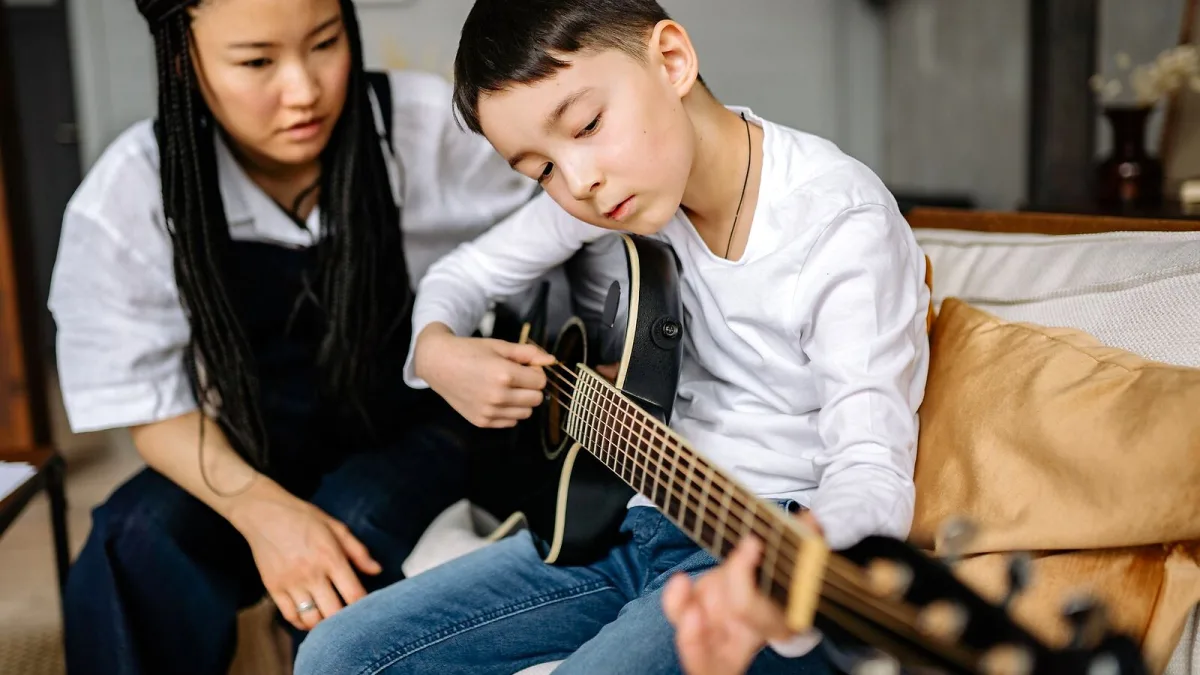
I got my first guitar off my brother's floor, string buzz and all, and it took me years to work out that half my early struggles were the instrument's fault, not mine. A good kids guitar shouldn't fight you like that. Here's a proper first-weeks plan for a first kids guitar — the stuff nobody tells you before you hand a child one and expect magic on day one.
Before a single note: check the kids guitar setup, seriously
This is the bit that gets skipped constantly, and it shouldn't be. If the strings sit too high above the fretboard — something called the action — every single chord becomes a battle of finger strength that has nothing to do with musical talent. Get a tech to check the action and the neck relief before lessons even start. I've seen more kids give up over a badly set-up instrument than over any actual lack of ability, and it's completely avoidable.
Posture and hold: the unglamorous bit that actually matters
Sit with the guitar's waist resting on the leg, both feet flat, shoulders relaxed rather than hunched up around the ears. The fretting arm should hang loose enough to curl the fingers naturally over the strings, not stretch flat against the neck like a plank. It looks boring compared to actually playing something, but bad habits formed here in week one are brutal to unpick three years down the line — trust me, I had to unlearn a few myself.
Week one: sound before technique
Forget chords entirely for the first few sessions. Just strum all the open strings, downward, nice and even. Get a feel for how the kids guitar actually responds — how much force makes it ring versus how much just deadens the strings. This matters more than it sounds: a kid who's spent a week getting comfortable with basic strumming has a genuine head start over one who was thrown straight into chord shapes and immediately felt useless.
Week two: first single notes
Press one string down just behind a fret, using the fingertip rather than the flat of the finger, and pluck it. Notice straight away how little pressure it actually takes — press too hard early on and sore fingertips will put anyone off fast. A few honest pointers:
- One finger, one string, until it's genuinely comfortable — don't rush to add a second.
- Short sessions, ten to fifteen minutes, beat one long grinding hour every single time.
- Tender fingertips for the first couple of weeks are completely normal; calluses are coming.
- Celebrate a clean single note before worrying about anything more complicated.
Weeks three and four: the first proper chord
A simple two-finger chord is usually the first real milestone, and it's genuinely thrilling the first time it rings out clean. Expect buzzing strings and muted notes constantly at this stage — that's not failure, that's exactly what learning a chord looks like for every single guitarist who has ever picked one up, myself very much included. Switch slowly between two chord shapes once one feels solid, without any pressure to be fast.
What to actually expect, so nobody panics
| What happens | Why it's completely normal |
|---|---|
| Strings buzz on chords | Finger placement and pressure take real repetition to get consistent |
| Fingertips ache | Calluses build with regular short practice, not with pushing through pain |
| Progress feels slow some weeks | Motor skills plateau, then jump — it's rarely a straight line |
| They lose interest for a few days | Totally normal; a favourite song or a jam together usually brings it back |
Keep the fire lit
The single biggest thing that keeps a kid coming back to their kids guitar isn't technique at all, it's enjoyment. Let them strum along to a song they actually love, even messily, way before they can play it properly. Play something together if you can, however basic. A kids guitar earns its keep by getting picked up voluntarily, not by being practised out of obligation.
Where to go once the basics click
If you haven't sorted the actual instrument yet, our complete guide to kids guitars and our buyer's guide cover sizing and setup in more depth, and our guide to kids guitars by price tier is handy if you're still deciding what to buy. Once you're a few weeks in, it's worth reading our list of common mistakes to avoid, because a couple of them catch nearly every beginner.
The bottom line
Nobody sounds good in week one, and that's not a warning sign, it's just how learning guitar actually works. Get the setup right, keep sessions short and genuinely enjoyable, and let the excitement of a song they love do the heavy lifting that discipline alone never quite manages with a kid. The rest builds itself, one buzzy chord at a time.




Comments