


Gibson Victory article
Gibson Victory: A Complete Guide
Produced briefly in the early 1980s as Gibson's answer to Fender's Jazz Bass, the Victory is a distinctive instrument with an asymmetric design, active electronics option and a devoted following in the vintage market.
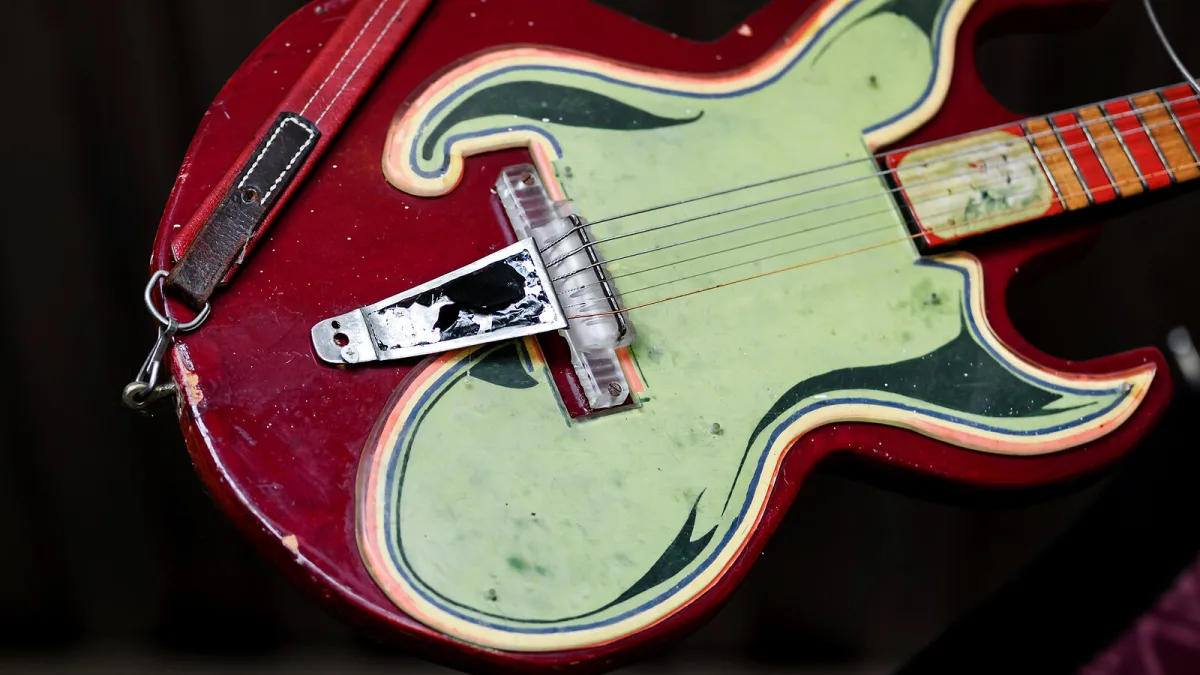
The Gibson Victory is one of the more unusual instruments in the American manufacturer's history — a bass guitar conceived at the start of the 1980s as Gibson's direct response to Fender's Jazz Bass dominance. It came at a time when Gibson was willing to experiment with asymmetric body designs and active electronics, and the result is an instrument that sits apart from most of the company's other output, both in appearance and in the market it was targeting.
Origins and Context
The Gibson Victory arrived around 1981, during a period when Gibson was losing ground in the bass market to Fender and emerging Japanese manufacturers. Rather than develop an instrument that echoed the Precision or Jazz Bass directly, Gibson took a different approach — an asymmetric offset body design that was visually distinctive and ergonomically considered, paired with two single-coil pickups in positions broadly analogous to the Jazz Bass configuration. It was intended to be a working player's instrument rather than a boutique piece, priced competitively and built to standard Gibson production quality at the Kalamazoo plant.
Construction and Specifications
The instrument uses a mahogany body — standard Gibson practice — with a bolt-on maple neck, which was an unusual choice for a company whose Gibson Les Paul had always used set necks. The fingerboard is rosewood on most production examples. The two single-coil pickups are positioned in neck and bridge positions, giving a tonal range from warm and thick to bright and present, blendable through the dual volume controls.
Gibson offered the Victory in two principal configurations: the standard passive version and the MV (Master Volume) variant with active electronics. The active version adds an on-board preamp that boosts the signal and gives a broader, more aggressive tonal range — useful for cutting through in a full band mix. Both versions share the same body and hardware, differing only in the electronics.
Tonal Character
It produces a sound that sits between the warmth associated with Gibson's mahogany construction and the brighter, more articulate character of the double single-coil pickup configuration. In passive mode, it has a clean, mid-forward tone that sits well in rock and funk contexts. The active MV version extends the dynamic range considerably, making it more versatile for players who need to adapt to different sonic environments. The instrument is not known for the thunderous low end of a Precision Bass — it is more nuanced than that, better suited to players who listen carefully to where the bass sits in a mix.
Legacy and Current Market
The Gibson Victory was in production for only a few years before being discontinued in the mid-1980s. It never achieved the mainstream profile of Gibson's Les Paul or SG, and its unusual design meant it fell outside what most buyers expected from the brand. Paradoxically, this has worked in its favour in the vintage market — the Gibson Victory is a collector's piece precisely because it is distinctive and because it represents a specific, short period of experimentation in Gibson's history. Well-preserved examples in original condition are sought after by collectors and by players looking for something beyond the standard vintage bass options.
For more detail on specific variants and what to look for when buying, see our complete buyer's guide. Players new to the model will find our beginner's guide covers the practical aspects of owning and playing one.






Comments