


Gretsch Guitars article
Gretsch Guitars Explained: Features, Types and Tips
That bright, twangy snap in a mix is often a Gretsch. Here's the history, the body styles and the pickups that create the brand's signature sound.
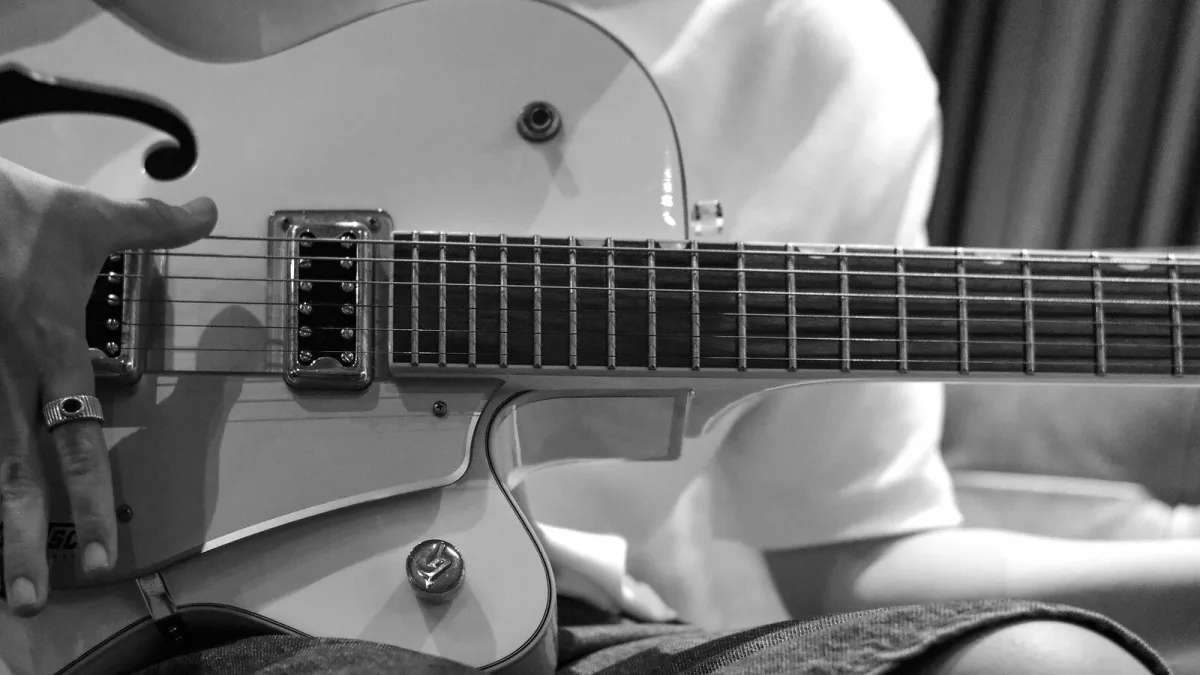
There's a particular sound that makes you turn your head in a record shop — bright, twangy, with a percussive snap that no other brand quite manages. More often than not, that's Gretsch guitars doing what they've done since the 1950s. This is the story of how they got that sound, what actually sits inside the body, and why players from Chet Atkins to Brian Setzer have never quite been able to leave them alone.
Where Gretsch Guitars Come From
The name goes back further than the guitars themselves. Friedrich Gretsch founded the company in Brooklyn, New York, in 1883, originally making banjos, tambourines and drums rather than anything with a neck and six strings. The first instruments to actually carry the Gretsch name arrived in 1933, in the shape of archtop acoustics built for jazz players and flat-top guitars aimed squarely at country and western performers. The Electromatic name, still used across the range today, first appeared in 1939. Solid-body models followed in the early 1950s, largely as an answer to the feedback that came with playing hollow instruments louder than they were ever designed for.
The Sound Chet Atkins and George Harrison Chased
Gretsch didn't become iconic through specifications alone — they became iconic because specific players made them sound like nothing else. Chet Atkins shaped the brand's country and fingerstyle identity so thoroughly that his name still sits on a signature model. Eddie Cochran and Duane Eddy pushed that hollow-body twang into early rock and roll, while George Harrison playing a Country Gentleman and Tennessean during the Beatles years put Gretsch guitars in front of more people than any advert could have managed. Later, Brian Setzer became rockabilly's most visible modern ambassador for the brand, and Malcolm Young's Gretsch Jet gave AC/DC a rhythm tone that was unmistakably his own. None of that happened by accident — the guitars genuinely sound different, and that's worth understanding properly.
Three Body Types, Three Different Personalities
Almost everything about how a Gretsch actually sounds comes down to one decision: how the body is built. There are three broad approaches.
- Hollow body — a fully open acoustic cavity, giving the richest resonance and the most "vintage" character, but also the most prone to feedback at real volume.
- Center-block (semi-hollow) — a solid block running through the middle of an otherwise hollow body, adding sustain and feedback resistance while keeping some of that airy resonance.
- Solid or chambered solid body — the tightest, most controlled response, and the easiest to push into higher-gain territory without the whole guitar howling back at you.
None of these is objectively "better" — a hollow body isn't a lesser solid body, it's a different instrument built for a different job. Gretsch's own material describes the trade-off nicely: hollow bodies deliver a big, resonant sound; center-blocks balance that fullness with focus; solid bodies hand you maximum control.
Filter'Tron Pickups and the Bigsby
Two components do more than anything else to create the Gretsch signature. The first is the Filter'Tron pickup, a humbucking design introduced in 1957 that reads brighter, clearer and more percussive than the darker, thicker humbuckers most other brands favour — it's part of why these guitars cut through a mix without sounding harsh. Broad'Tron pickups, used on some newer and more affordable models, aim for a fuller, higher-output take on the same idea. The second is the Bigsby vibrato, a spring-loaded tailpiece that adds gentle pitch wobble rather than the dramatic dive-bombs of a Fender-style tremolo — think subtle shimmer and rockabilly ornamentation, not divebombs.
Finding Your Way Around the Range
The current line-up is organised into three main tiers, and it's worth knowing them before you go shopping. Streamliner sits at the entry point, built for players who want the look and the basic formula without the higher price. Electromatic occupies the middle ground, delivering the classic designs — hollow, center-block and solid — at a more accessible cost than the flagship range. The Professional Collection sits at the top, with the finer pickup variants, construction details and vintage-oriented finishes that justify the jump in price. There's also a Custom Shop, artist-signature models, and a separate Roots range covering acoustics and resonators.
| Tier | Positioned for |
|---|---|
| Streamliner | Budget-conscious players wanting the core Gretsch look and feel |
| Electromatic | Players wanting established designs without flagship pricing |
| Professional Collection | Players prioritising specific pickups, hardware and finish quality |
The Bottom Line
Gretsch guitars reward a bit of homework before you buy, precisely because the range spans such different instruments under one badge. If you're weighing up an actual purchase, our Gretsch buyer's guide goes through what genuinely matters at each price point, and our roundup of the best Gretsch guitars for the money breaks the range down by what each type of player actually needs. New to the brand entirely? Start with our beginner's guide instead — it's a gentler way in than a full technical breakdown.




Comments