


Gibson Firebird Guitar article
Gibson Firebird Guitar Explained: Features, Types and Tips
The Gibson Firebird looks like nothing else in Gibson's catalogue — here's the design history, the model range and the construction that gives it a sound of its own.
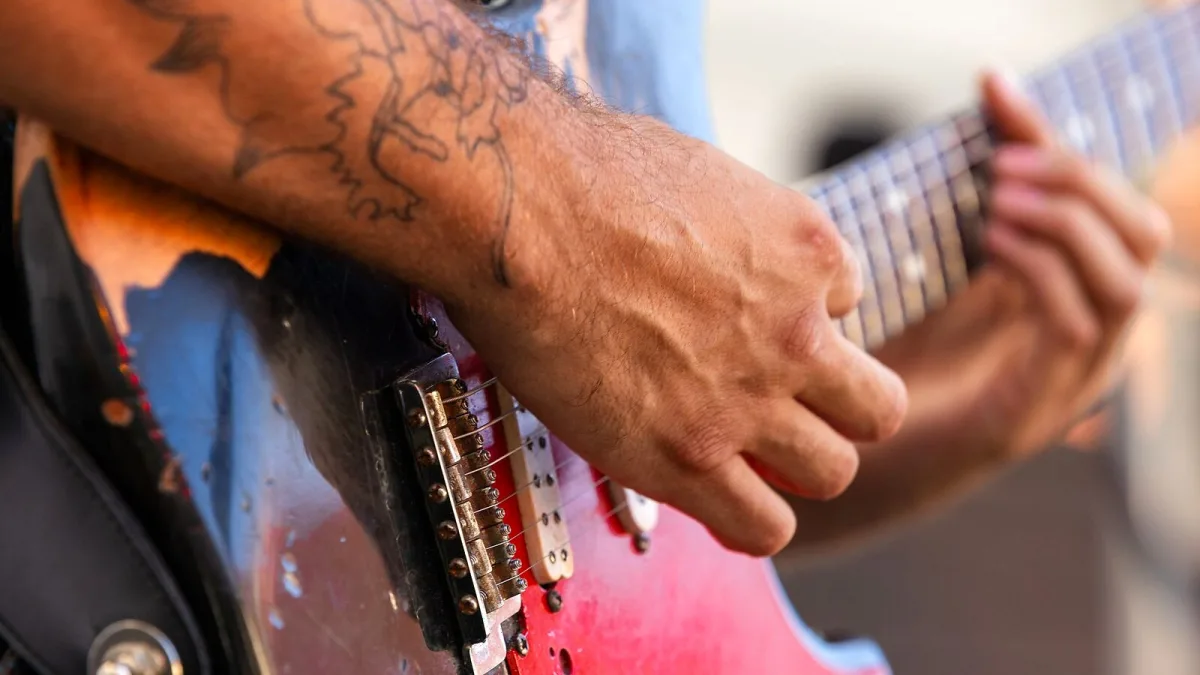
The Gibson Firebird is the guitar that looks like it's leaning into a corner even when it's sat still on a stand. Launched in 1963, it swapped the Les Paul's curves for something sharper and more aeronautical, and it still divides opinion on looks alone. This guide explains where the design came from, how the model range breaks down, why it sounds the way it does, and what you should know before you go looking for one.
Where the Design Came From
By the early 1960s, Gibson's president Ted McCarty was watching Fender eat into the company's share of the electric guitar market with sleeker, more futuristic shapes. His answer was to bring in an outsider: Ray Dietrich, a car designer with form-language from Detroit's golden age rather than a background in lutherie. That's the giveaway in the Firebird's profile — the long, swept horn and the offset waist read more like a tail fin than a traditional guitar body.
The result was unlike anything else in Gibson's catalogue. Where the Les Paul and SG used a mahogany body with a glued-in (set) neck, the original Gibson Firebird was built neck-through — a single central strip of mahogany and walnut ran the full length of the instrument, from the headstock to the strap button, with separate mahogany "wings" glued to each side to form the body shape.
Reverse Versus Non-Reverse: Two Different Guitars, One Name
Ask about one of these guitars and the first thing to clarify is which era you mean. The original 1963 design is now called the "reverse" Firebird, because its long horn sits on the treble side and the headstock angles back the opposite way to a normal Gibson — reversed, not the strings or the playing position, just the visual logic of the shape.
Around 1965–66, cost and manufacturing complexity pushed Gibson to simplify. The "non-reverse" Firebird that followed swapped to a more conventional body orientation, a standard glued-in neck, and different pickups and hardware. It's a genuinely different guitar under the reversed-again silhouette, not just the same instrument flipped around, and the two eras are not interchangeable when you're pricing parts or judging tone.
The Original Line-Up: I, III, V and VII
Gibson launched the reverse Firebird in four specification levels, numbered with Roman numerals that map roughly onto how much you spent:
| Model | Pickups | Typical appointments |
|---|---|---|
| Firebird I | One mini-humbucker | Dot inlays, simple hardware, no vibrato |
| Firebird III | Two mini-humbuckers | Simpler binding, vibrato on some versions |
| Firebird V | Two mini-humbuckers | Bound fingerboard, trapezoid inlays, Tune-o-matic bridge and Deluxe Vibrola |
| Firebird VII | Three mini-humbuckers | Ebony fingerboard, block inlays, gold hardware |
Modern reissues, Custom Shop recreations and Epiphone's more affordable versions all borrow from this original numbering, but always check the actual specification sheet — a current model wearing a Firebird badge doesn't automatically inherit every trait of its 1960s namesake.
Why a Gibson Firebird Sounds Different
Two things do most of the work. The first is the mini-humbucker — Gibson's own design, physically narrower than the full-size PAF-style humbucker fitted to a Les Paul. A mini-humbucker tends to produce a brighter, tighter, more focused voice, with clearer separation between notes and less of the broad, thick low-mid warmth you'd get from a bigger coil.
The second is that neck-through build. A continuous piece of wood running the length of the guitar generally sustains longer and responds slightly differently under distortion than a bolted or glued joint. Put the two together and you get a lead tone that cuts rather than smears — one reason the Firebird found favour with blues and blues-rock players who wanted definition at volume.
It's worth saying plainly: not every guitar sold as a Firebird today is neck-through. Studio models, some reissues and various Epiphone versions use simpler, cheaper construction. If neck-through construction matters to you, confirm it on the spec sheet rather than assuming it from the name.
Hardware Quirks Worth Knowing
- Banjo tuners — mounted behind the headstock rather than in the usual inline row, they're mechanically different from ordinary tuners and can feel unfamiliar the first time you restring one.
- Deluxe Vibrola — the vibrato fitted to higher-spec original models looks striking but needs a clean nut and a stable bridge post to stay in tune.
- Long upper horn — great for the silhouette, less great for balance; more on that in a moment.
Firebirds in the Wild
The shape has attracted more than its fair share of famous hands. Eric Clapton played a reverse Firebird I during his time in Cream, Brian Jones used one in the Rolling Stones' early years, and Johnny Winter became arguably the instrument's best-known ambassador through decades of blues-rock. Allen Collins is closely associated with Firebirds in Lynyrd Skynyrd's classic line-up, and more recent players such as Dave Grohl have kept the reverse shape in rotation. None of that guarantees a particular guitar sounds a particular way — but it does explain why the silhouette still turns heads on stage.
Gibson Firebird Versus Les Paul and SG
If you already know Gibson's mainstream shapes, the practical differences are worth spelling out. A Les Paul is heavier, warmer through full-size humbuckers, and set-neck rather than neck-through. An SG is lighter and more direct-feeling but shares the Les Paul's pickup voicing. It sits apart from both: brighter, more focused, and — because of that long offset horn — noticeably different to hold, with a real tendency toward neck dive unless you use a wide strap and get the balance point right.
The Bottom Line
The Gibson Firebird earns its reputation honestly: a genuinely different construction method, a distinctive pickup voice, and a body shape nobody mistakes for anything else. If you're weighing up whether one suits you, our complete buyer's guide walks through what to check before you commit, our round-up of the best Firebirds for the money covers where value sits across the range, and if this is your first serious guitar purchase, our beginner's guide to the Gibson Firebird is the gentler starting point.






Comments