


Fender Jazzmaster article
Fender Jazzmaster Explained: Features, Types and Tips
It was built for jazz players who never wanted it, then became one of alternative music's most iconic shapes. Here's how a Fender Jazzmaster actually works.
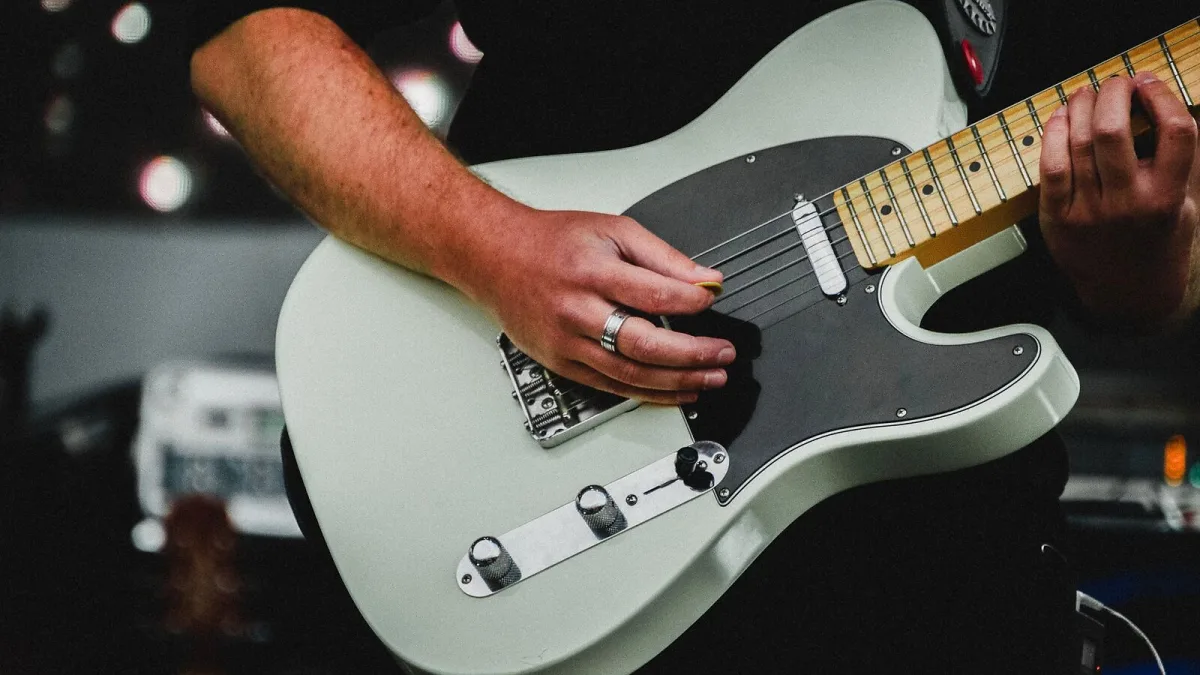
Fender launched the Jazzmaster in 1958 as its most expensive, most sophisticated guitar — and then watched it get almost completely ignored by the players it was built for. Six decades on, that same "failed" design is one of the most recognisable shapes in alternative music. Here's what actually makes a Fender Jazzmaster tick: the body, the electronics, the notoriously fiddly bridge, and the players who turned a jazz guitar nobody wanted into an indie and shoegaze icon.
From Failed Jazz Guitar to Alternative Rock Icon
Fender aimed the Jazzmaster squarely at jazz guitarists who were, at the time, mostly loyal to big hollow-body archtops. It didn't work. Jazz players largely stayed away, and the guitar found its first real home instead in surf music, where its bright Fender amplification, vibrato arm and wide pickups suited twangy instrumental riffs perfectly.
The Jazzmaster's second life came decades later, in noise rock, indie and shoegaze. Bands like Sonic Youth used it as a platform for alternate tunings and prepared-guitar experiments, while My Bloody Valentine's Kevin Shields built an entire signature sound around its tremolo arm — heavy, swooping pitch-bends layered into a wall of guitar. Wilco's Nels Cline and Queens of the Stone Age's Troy Van Leeuwen have kept that lineage going in more recent years, each finding a different use for the same odd shape.
What Makes a Fender Jazzmaster Different
The Offset Body and Wide Pickups
The Jazzmaster introduced Fender's first offset-waist body — the top half is shifted back relative to the bottom, which makes it sit more naturally when you're playing seated. Its single-coil pickups are also physically wider and flatter than a Stratocaster's, sensing a broader area of each string. The result is a fuller, warmer, less sharply focused tone than a Strat, with a distinctive low-mid character that responds well to fuzz and distortion.
Two Circuits: Lead and Rhythm
Where the design gets genuinely unusual is the electronics. A traditional Fender Jazzmaster has two separate, independent circuits rather than one:
- Lead circuit — the everyday setting, with a three-way pickup selector, master volume and master tone, working much like any other Fender.
- Rhythm circuit — switched in via a slider on the upper bout, this routes only the neck pickup through its own dedicated volume and tone wheels, rolling off treble for a darker, mellower voice.
It's not a gimmick preset; it's a genuinely separate passive circuit with its own tonal identity, which is exactly the kind of detail that keeps this guitar interesting decades later.
The Floating Bridge and Vibrato, Explained
Behind the bridge sits a floating vibrato unit, connected to a bridge designed to rock slightly as you use the arm. That movement reduces friction and gives the vibrato its distinctively loose, elastic feel — but the trade-off is a reputation for strings occasionally slipping off the original threaded saddles under heavy playing. Fender built in a vibrato lock specifically to help the guitar hold roughly the same pitch if a string breaks, though it's a safety net rather than a cure for tuning problems caused by a poor setup.
Many players and several current Fender models address this with Mustang-style saddles, which use a continuous groove that holds strings more securely than the original threaded design.
Fender Jazzmaster vs Jaguar vs Stratocaster
Fender's offset family can be confusing from the outside, so here's the short version:
| Model | Character | Best known for |
|---|---|---|
| Jazzmaster | Wide pickups, dual circuits, floating vibrato | Broad, warm tone; surf, indie, shoegaze |
| Jaguar | Shorter 24-inch scale, smaller pickups, more switching | Tighter, brighter, more percussive attack |
| Stratocaster | Three narrower single-coils, synchronised tremolo | Familiar layout, simpler and more stable bridge |
If you'd like the Jaguar side of that comparison in more depth, it's worth reading up separately — the two share DNA but feel quite different under the hands.
Modern Jazzmasters Are a Family, Not One Guitar
A current Fender Jazzmaster can mean several quite different instruments. Vintage-style versions keep the original rhythm circuit and traditional bridge. The Player II, reviewed by Guitar World in 2025, simplifies things by dropping the rhythm circuit entirely and using Mustang-style saddles. The American Professional line goes further still, with a modernised control layout built for players who want the shape and tone without the vintage quirks. Then there are artist and Custom Shop models built around players like Kevin Shields and Troy Van Leeuwen, each tailored to a specific approach.
That range matters if you're actually shopping for one: our complete buyer's guide walks through what to check on each type, and our round-up by price tier breaks down which version suits which budget. If this is going to be your first electric guitar full stop, our beginner's guide is the friendlier starting point.
The Bottom Line
The Fender Jazzmaster is a guitar that never really became what it was designed to be — and that's precisely why it's still around. Its wide pickups, dual circuits and loose, springy vibrato give it a genuinely different feel and voice from anything else in Fender's line-up, and that difference is exactly what surf players, noise-rock experimentalists and shoegazers have all found a use for in their own way. Whichever type you end up with, it rewards a bit of patience with its quirks.





Comments