


Marshall Amp roundup
Marshall Amp: A Complete Buyer's Guide
A wall of amps and a poster on your wall aren't a purchasing strategy. Here's how to choose one that actually suits how you play.
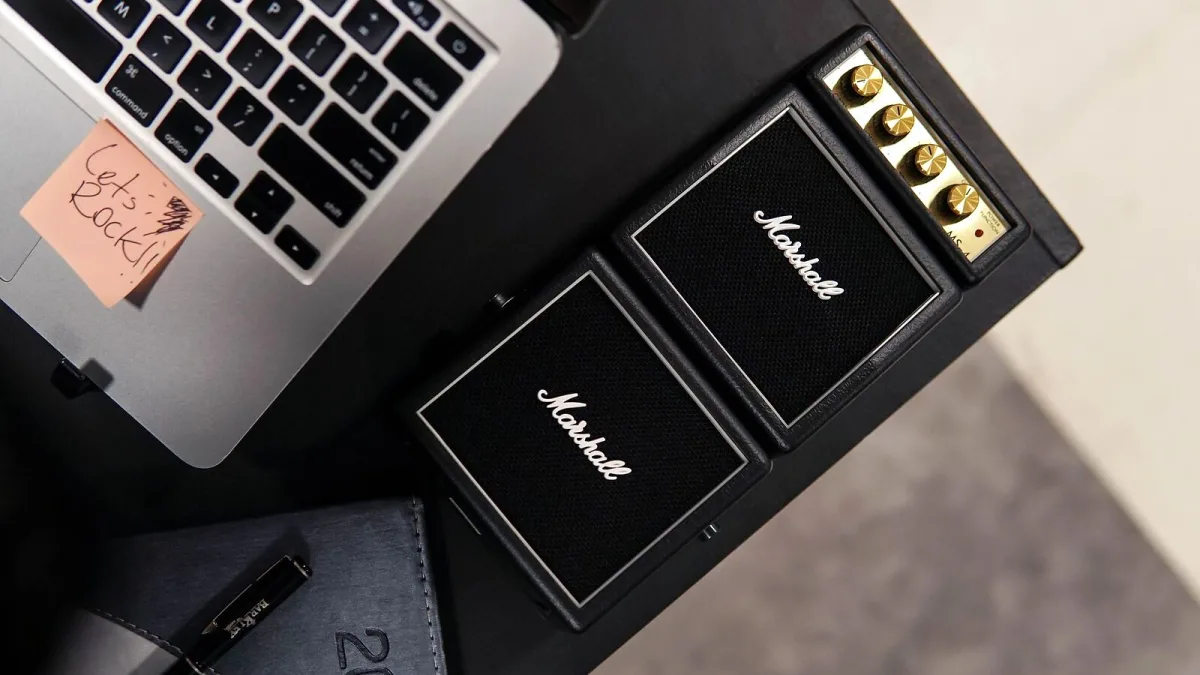
I still remember standing in a guitar shop at seventeen, completely overwhelmed by a wall of amps, convinced I needed the biggest stack in the room because that's what my heroes played on stage. Nobody told me that stack would've been useless in my bedroom. So let's do this properly — buying a Marshall amp should start with how you'll actually use it, not with the poster on your wall.
Start with where you'll actually play it
This is the question that decides everything else, and it's the one most people skip. Be honest with yourself here.
| Where you play | What actually suits you |
|---|---|
| Bedroom or flat | A small combo, solid-state or modeling — low volume, headphone-friendly |
| Home studio | A low-wattage tube combo or a modeling amp with USB recording |
| Band rehearsal | A mid-power combo or small head-and-cabinet pairing |
| Regular gigging | A proper head and cabinet, sized to your venues |
Notice nobody in that list needs a full 100-watt stack unless they're actually gigging. That poster-wall image is lovely, but it's not a purchasing strategy.
Tube, solid-state or modeling: the honest trade-off
This is the decision that shapes everything about how it feels and what it costs. A tube amp gives you that warm, dynamic, slightly unpredictable response players fall in love with — but it needs occasional maintenance, it's heavier, and it costs more. Solid-state trades a little of that magic for reliability, lighter weight and a friendlier price. Modeling amps, particularly the CODE range, throw in multiple amp voices, effects and Bluetooth for the price of one box, which is genuinely brilliant value if you're still working out what sound you love.
My honest take: if you're not sure yet, don't spend tube-amp money before you know what you're chasing. A modeling amp will teach you more about your own taste for less money.
Head and cabinet, or combo?
A combo houses the amp and speaker together — simpler, lighter, one thing to carry. A separate head and cabinet gives you room to grow (swap the cabinet, change the sound) but it's heavier and more expensive to start with. Unless you already know you're gigging regularly, starting with a combo is almost always the sensible move.
Don't ignore the cabinet and speakers
It's easy to focus entirely on the amp and forget the speaker does a huge amount of the tonal work. A closed-back 4x12 gives you scale and low-end punch that looks the part on stage, but a single 1x12 or 2x12 combo is far easier to actually transport and just as capable of sounding brilliant in a smaller room. Celestion speakers like the Greenback or Vintage 30 will sound noticeably different from each other, so if you ever get the chance to compare cabinets in person, take it.
Questions worth asking before you pay
- Will I ever play loud enough at home to hear this amp's power-stage character, or would a lower-wattage model make more sense?
- Do I need an effects loop, USB recording or Bluetooth, or am I paying for features I'll never touch?
- Is there a return policy, and can I actually try it through headphones or at bedroom volume in the shop?
- Am I buying for who I am now, or who I hope to be in three years' time?
That last one caught me out badly at seventeen, and I'd genuinely rather you didn't make the same mistake.
Bringing it together
Buying a Marshall amp doesn't have to be intimidating once you separate the decision into honest, answerable questions: where will you play it, how much maintenance are you willing to do, and do you actually need the extra flexibility of a head and cabinet. If you'd like the fuller technical picture first, our Marshall amp explainer covers the ranges and terminology in more depth, and once you've narrowed things down, our roundup of the best Marshall amps for the money gives you actual models to compare at each budget.
The bottom line
Buy for the room you actually play in, not the one you're dreaming about. Everything else — tube or solid-state, combo or stack — falls into place once that first answer is honest.






Comments